Newspapers often go all out on Christmas Eve, often with stunning illustrations or photos on their front pages. This year is no different, except that it’s very different. With Omicron raging, lockdowns, limits on gatherings. It’s been a hard year or two for most, regardless of the season. No commentary on religion here. Just design and the feeling of hopefulness the season often brings. And the incredible front pages don’t hurt! After about two years with COVID-19, it’s nice to have hope so I appreciate these covers even more this year.
For whatever reason, Canadian newspapers seem to blow out their covers disproportionately compared to other places in the world. I looked through about 20 Canadian covers and at least half had very Christmas-y covers. The proportion of America papers was much, much lower, which was surprising. Many didn’t publish today.
Canadian Christmas Eve
Alas, the covers. First I will start with Christmas Eve in Canada. Each of Canada‘s big three has a very different feel, in line with its target audience. First up, the National Post. The stained glass look and the black really pop. It’s such a striking visual. The National Post has been doing this since its first year, 1998, and every year I love it. It’s become a Christmas tradition. It definitely has a stronger religious feel than many others, but that is by design. Of course their vertical flag, as it often does, helps creating a more powerful visual.
Next up, the Toronto Star. The Star has recently hired a handful of staff to focus on print visuals, including an art director, formerly from the National Post. It shows. This illustration is lovey. Happy-making.
Then the Globe and Mail. Like the National Post, the Globe has been doing a similar cover for years. A beautiful oil painting, from the Art Gallery of Ontario, with a little text. In fact I have learned they have been doing it since before 1998 at least, featuring art from its parent company’s art collection. Most years it’s more of a winter theme rather than Christmas.
Then there is the Guardian from Charlottetown, P.E.I. Just a pretty, hopeful and happy painting, submitted by the very non-winter-named Summer Kelly, 11. Amazing work from a young artist.
Around the world
And now for covers from around the world! This Het Parool cover is one of my faves. I just find the illustration to be so magical and eye-catching/pleasing.
Reporte Indigo is known for their illustrations. And they don’t disappoint here. So classy. Stunning.
Kleine Zeitung has a beautiful illustration but they don’t gloss over COVID. It’s part of our lives.
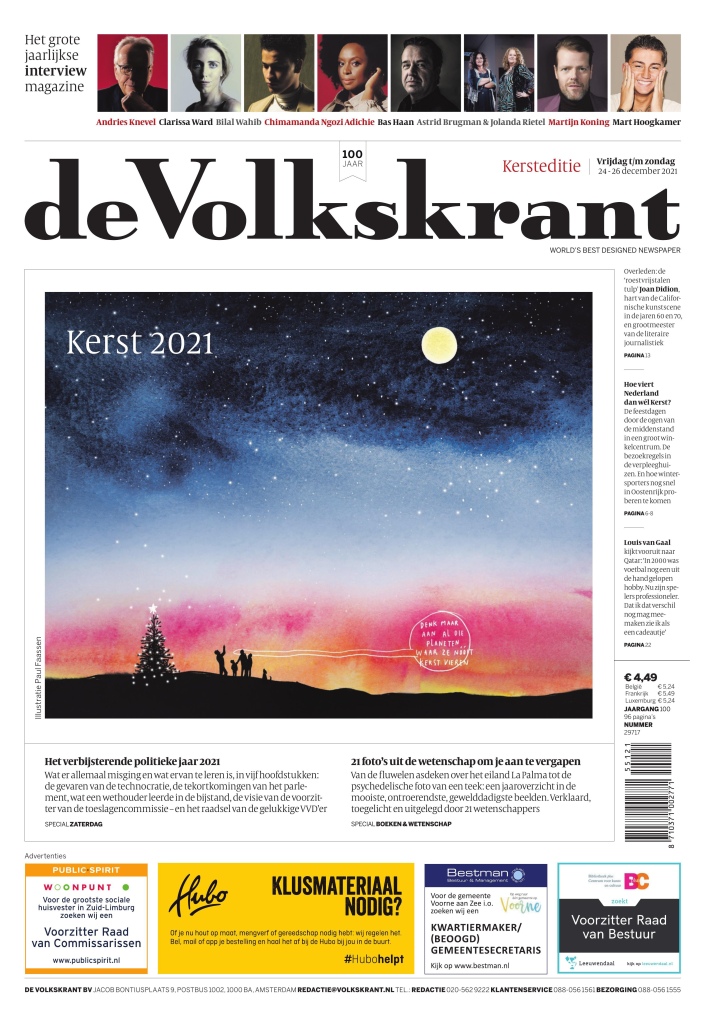
This cover from de Volkstrant is just simple and elegant. Really pretty art.
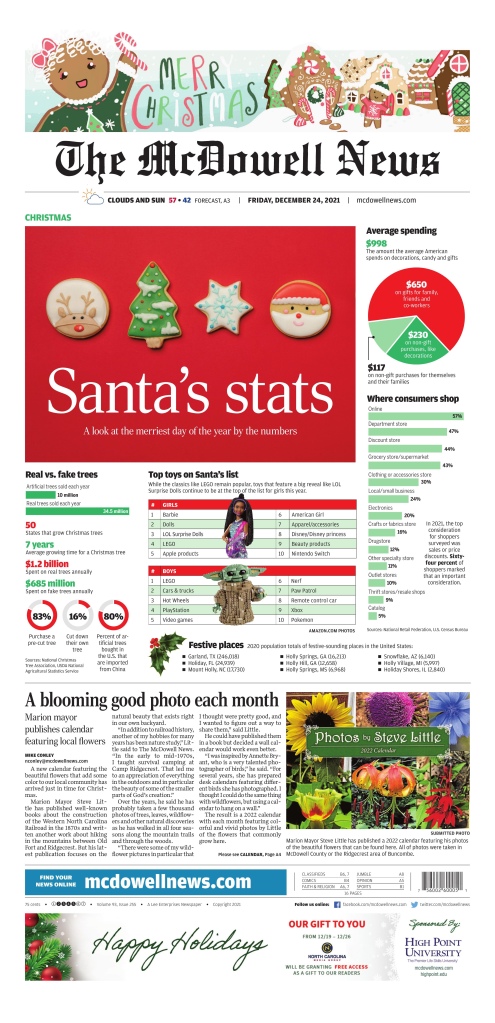
And this McDowell News front page. It’s different! Christmas stats. Very American. Nice contrast. It’s fun and informative.
There were more, but these were the tops that I saw. Thanks to all the newspaper designers out there, still doing their thing. I appreciate how much effort still goes into these pages. Happy holidays, everyone.
The Villages Daily Sun goes above and beyond in visual journalism, print specifically. Colin Smith and Adam Rogers tell us more.
By Brad Needham
Print might be on the way to becoming an afterthought for some newspapers, but not the Villages Daily Sun in Florida. It is proudly and heavily visually designed for print. They don’t even have an Instagram account. I know because I posted a front page on my Instagram account once and couldn’t, for the life of me, find their Instagram handle. Yet shortly after I posted it, they found me! An editor sent me a note saying they don’t have Instagram and they are a print-first publication (but they do have a Tumblr account!). As a longtime mostly print journalist and print designer, I love that. So naturally I asked them if I could talk to a designer. Not only did they oblige, they sent me two! And they each sent pages. And a visual philosophy.
I am so thankful to have heard back from both Colin Smith, the senior project designer, and Adam Rogers, managing editor of innovation. I had a lot of fun reading through their thoughtful answers, looking at their stunning pages, and feeling like I’m not alone as a print lover in a digital world.
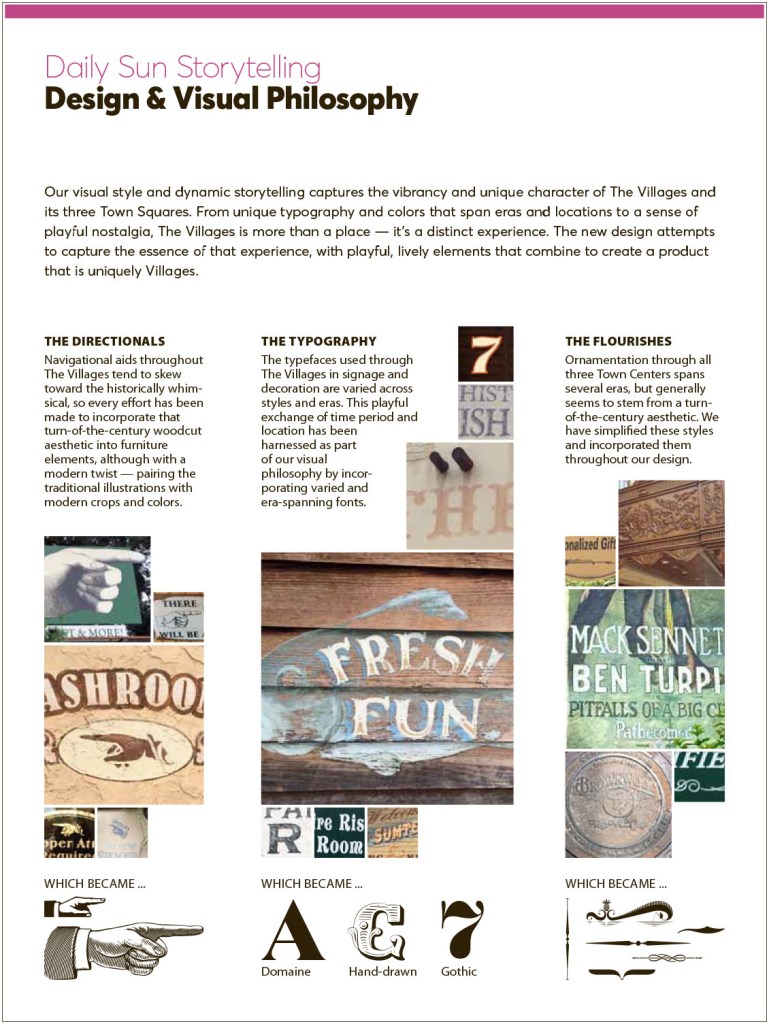
The first thing they sent me was their design and visual philosophy document. It is fun to read. Here is how it begins.
I knew right away these were my kind of people. They have designed a newspaper to reflect their community. Not just in content, but design. Amazing. How can you not love a philosophy like this?
We’re not just filling pages, we’re a daily friend offering news, information, community moments, support and, most importantly, surprises on every page.
The answer? You can’t. You must love this, or you’re on the wrong blog. This blog is for all the print that’s fit to print.
I will turn it over to Adam and Colin. Eds. note: these responses are from early September.
How did you get into newspaper design? Adam: It was something I sort of stumbled into as a student at Youngstown State in Ohio. My degree is in TV and video production, but I was minoring in multimedia design. That led me to a page design opportunity at the student newspaper The Jambar where I ended up working for four years and decided to focus my career efforts on print design.
Colin: My academic background is urban planning and architecture. I started news design at my college paper, then it became my first job out of college. I’ve been in the industry ever since.
What do you like about newspaper design? And what makes it different from other design? Adam: I really like that you have the opportunity to start with a fresh canvas every single day. With 365 editions each year, you can experiment. See what works, what doesn’t and learn from it. And I feel like whether its design or general knowledge of the world, I learn something new every single day.
Colin: Philosophically, I like being able to tell stories to wide audiences on a daily basis. I especially love working on redesigns — the chance to weave visual worlds for our readers to explore. On a personal level, I like the frequent, immovable deadlines of daily news production — it’s perfect for a procrastinator like me.
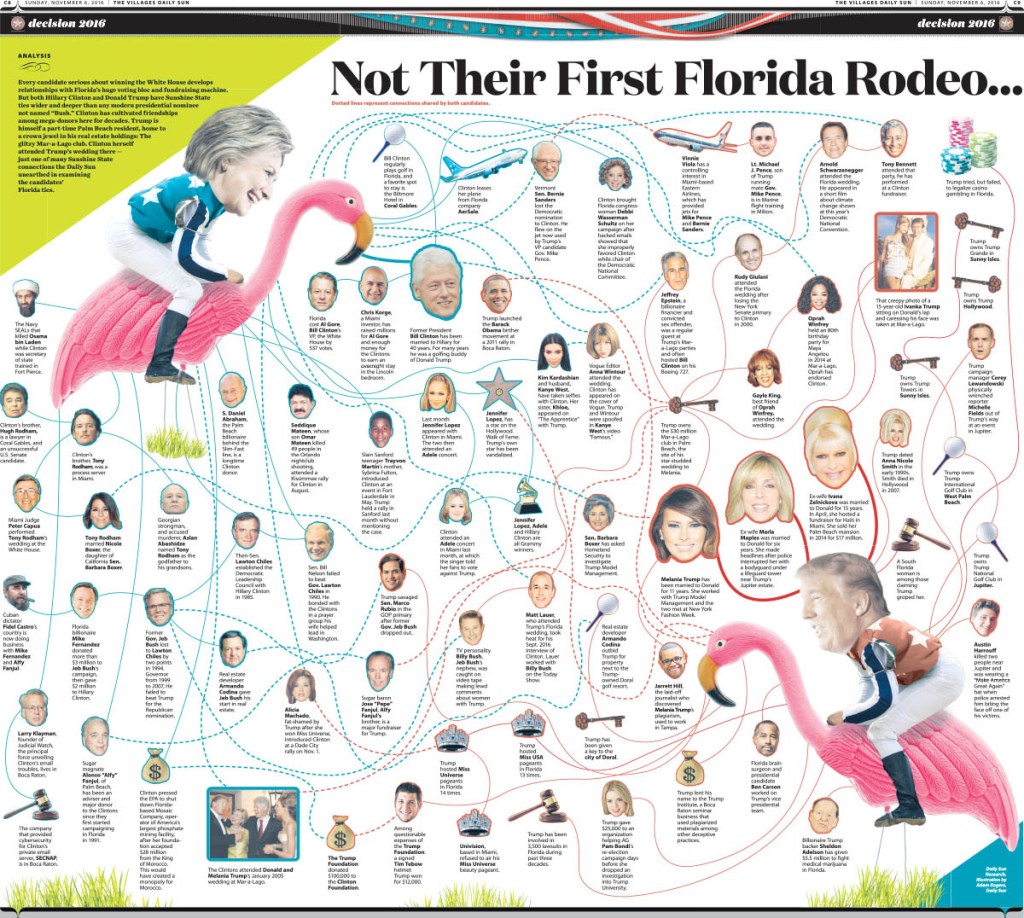
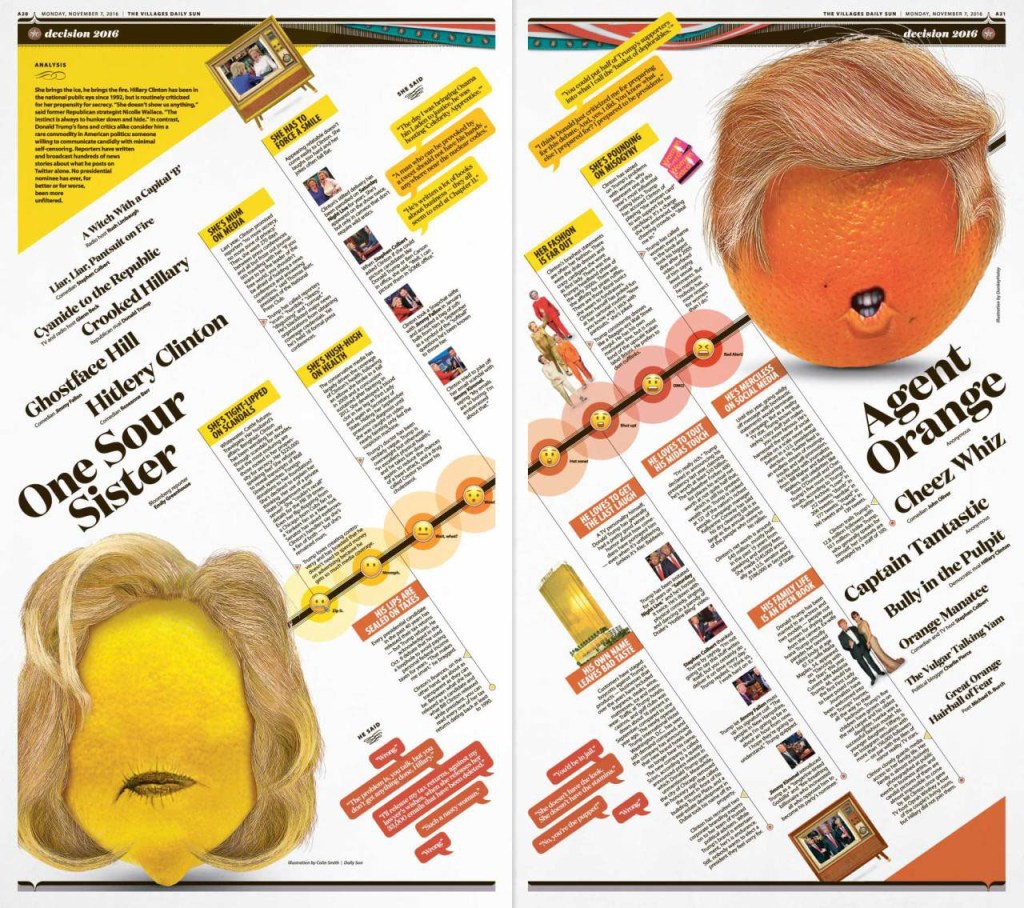
What was the most fun you have had with a design? Adam: I would have to go back to a doubletruck presentation I worked on during the 2016 election showing all of Donald Trump and Hillary Clinton’s connections to each other and to the state of Florida. It involved some colourful photo illustrations of the candidates riding flamingos. Honestly, Colin Smith and I had a lot of fun throughout that entire election cycle creating illustrations for a variety of topics along the way.
Colin: The Daily Sun has definitely been the most fun at I’ve had at a paper. I love redesigns, as I’ve mentioned, and this was at the first paper where (aside from the nameplate) nothing was off limits. It’s a paper that wants to have fun in a community built for having fun. That’s opened up so many paths visually. The editor has been a huge part of that evolution. She really has helped push me in directions I would have never thought exploring at other publications, and I think it’s really made a unique product in the process.
Do you rely on one design principle more than others (white space, text as design, colour, cutouts, etc.)? Adam: At the Daily Sun we focus a lot on just being consistent. We have built a beautiful core structure for our newspaper that highlights our colour palette and carefully selected typography. From there we make strategic decisions on when to break from the templates. And when we do, we usually go pretty big.
Colin: Great question. When in doubt, I go to the grid. Barring that, then I tend to focus on clean typography and common alignments. I don’t like to modify my type too much, so generally it’s one colour and one alignment. And you can’t go wrong with a beautiful dominant image. I tend to shy away from cutouts mostly because, after 20 years, I’m just tired of doing them (although I will if I must, but it’s not my go-to move). And I’m always a sucker for a symmetrical layout.
Tell me about a design idea you loved that was rejected or just wasn’t working so you had to abandon it. Adam: I joke a lot about having a pile of abandoned pages that I burn for warmth during that one week of winter we get in Florida. And that’s true to some extent. After a decade it’s tough to narrow it down to one that stands out. Our projects and pages grow and evolve so much during our design process that I’ve learned to not to get emotionally attached to an idea. We try to put the our readers and the storytelling above our own egos.
Wherein most newspapers follow an assembly line model, our process is more circular, with reporters, editors and designers working in concert to iterate and elevate our content in ways that surprise our readers and surpass expectations.
Colin: Too many to count, honestly. I used to revise and revise and revise before showing a page/project/redesign, but that philosophy doesn’t work at a paper where we have a very deliberate style we’re going for. So now I do a quick mock-up, get input from the editor to see if I’m going in the right direction or not, then I either refine what I’ve done or archive it and try something else. Honestly, I’ve never flat-out thrown a design away. If something doesn’t make the cut, I’ll usually file it away possibly for use later. Generally if I’m really excited about a design, I’ll find a way to get it used. Although I’ve had print/web designs implemented then discarded after I’ve left a paper, so I guess that’s stung a little more. But such is life.
I like the idea of your design direction matching your community, i.e. a heavily designed community begets a heavily designed newspaper. Tell me more! Adam: If you were to visit The Villages (which everyone really should some day) you would see that the developers put a lot of time and thought into the small details. We like to say that the community is designed to take you back in time, but you can’t always hit on exactly when. We’ve taken their fun but meticulous sense of design for the community and have made the newspaper reflect that. From the colour palette down to our use of woodcut and victorian flourishes, we have pulled inspiration from all corners of the community.
Colin: I believe the true power of newspaper design is the ability to create a visual microcosm of the community that is filled with all the surprises, delights, familiar places and new experiences that one expects from a journey in their city or town. I believe the areas of the paper should capture the personalities of a place (quiet cafés and loud clubs, bustling streets and quiet leafy suburbs). Visually, The Villages is a master planned community with several strong visual identities. On top of that, residents here have very active lives and fascinating stories to tell. There is always so much going on, and so much life to capture, that it really puts the onus on the Daily Sun to be as energetic and vibrant as our readers.
Visually the editor challenged me to come up with an overall design that was both nostalgic and thoroughly modern. That’s why you’ll see Victorian text flourishes paired with vibrant citrus colors to create something that blends a fondness for the past with an optimistic vision of the present. The goal was to create a kinetic vibration throughout the entire publication that is both familiar and yet also completely unique to our community.
I’ve been told the idea your covers are based on (lots of small bits of information) carries on on the inside. This concept and a few others seems to make this paper stand apart from others. Can you show some examples and tell me why you decided to do that? Adam: That is very true. While The Villages may be a mecca for retirees, they break every stereotype for seniors imaginable. We are blessed to have a very active and engaging community to cover. Our readers are very busy and we want to respect their time. So we implement of a lot quick hit information and alternative story formats that make the news quickly and easily digestible. We use this approach in every section in concert with traditional longform presentations.
Colin: Adam probably already went into this, but just in case he didn’t, here you go. Even though the vast majority of our readers are retired, they are still quite busy. Between social gatherings, planned events and daily excursions we owe it to our readers to get as much information into every page as possible. Since Villagers come from around the U.S. and the world, we try to get as much into each edition as possible. Our high ad stacks make it difficult to get a lot of traditional articles on a page, so instead we run a collection of briefs, photos and alternative story formats along the tops of inside pages (we call them attics) with a longer read below it.
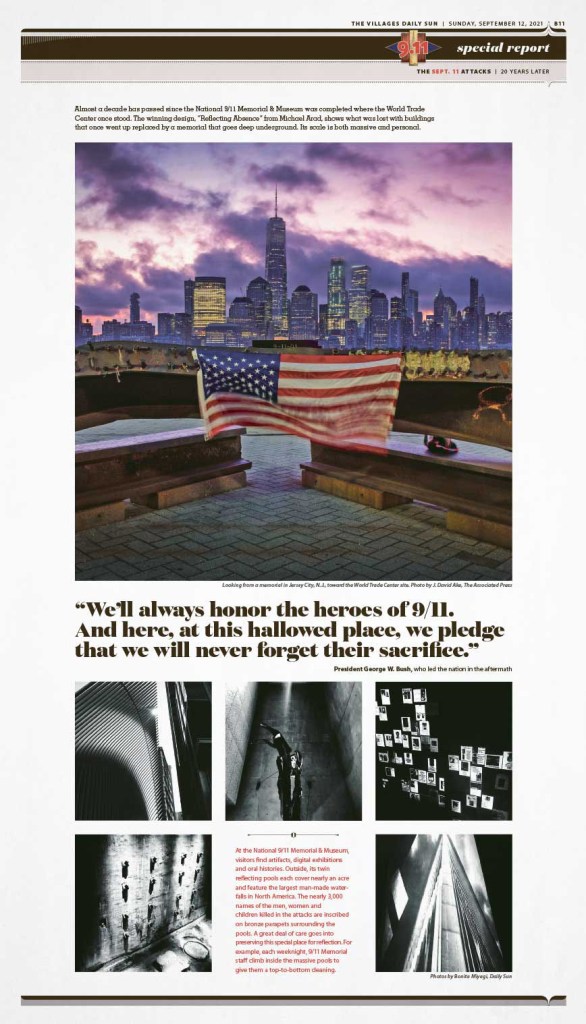
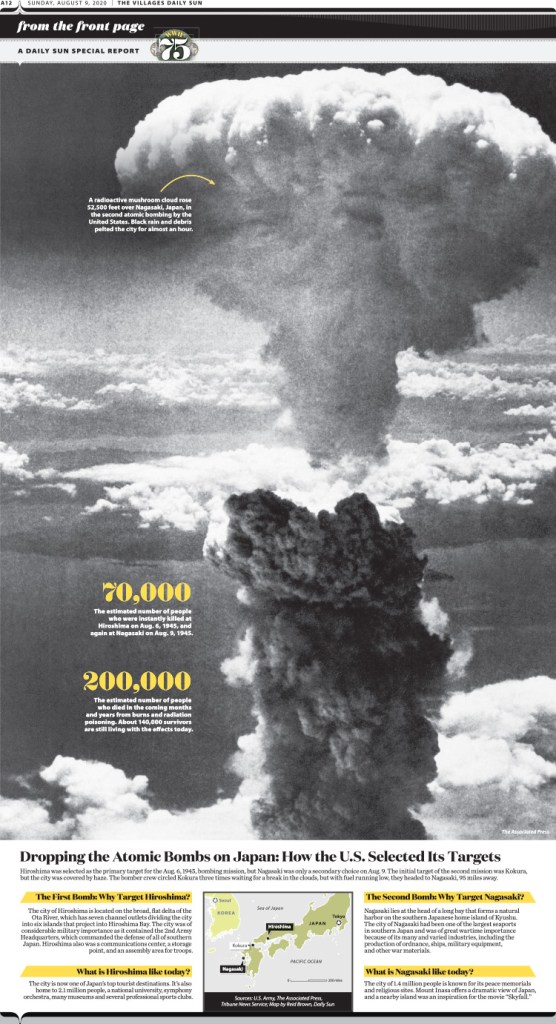
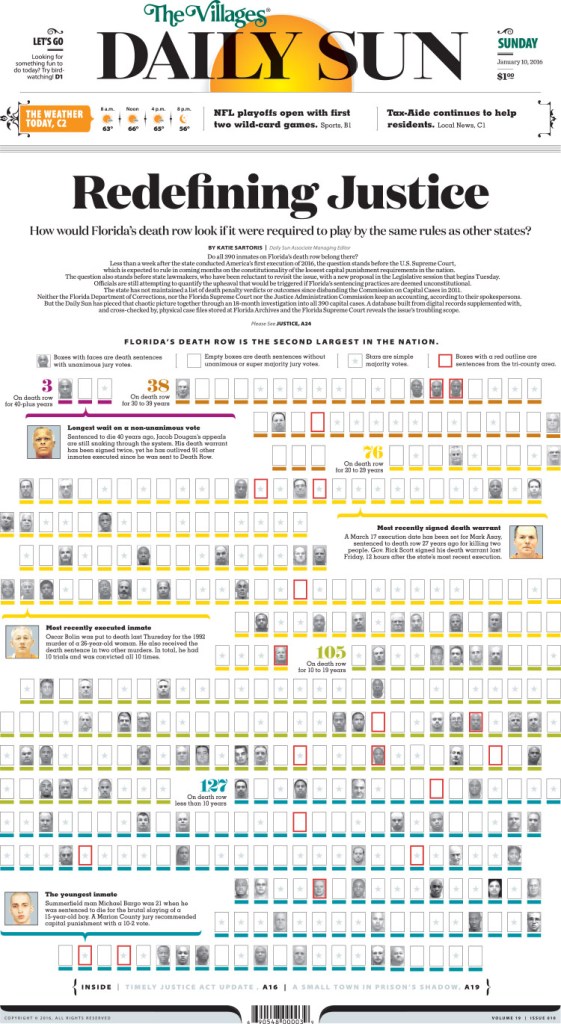
It might be like picking favourite family members, but if you had to pick a few favourite pages, what would they be and why? Adam: First I would go back to a 2013 page on the 50th anniversary of the March on Washington. I worked on this page with the help of executive editor Bonita Burton and it evolved from a traditional centrepiece that we just kept pushing bigger and bigger. Our design and typography has changed a lot since then, but this did land me my first SND Award of Excellence and I was truly humbled. Then I would say a 2016 front page information graphic that was part of our multi-year “Redefining Justice” investigation into Florida’s death row. It really pushed my organizational skills and I spent a lot of time making sure the information we were presenting on a complex topic was digestible. And then more recently an inside page on the atomic bomb that was part of a yearlong series we did on the 75th anniversary of the Second World War. I really like working with historic photography and finding ways to present it in striking ways.
Colin: Ooh, that’s a good question. I mean, I’ve been redesigning our paper for so many years it’s hard to pick just a few. But if I had to: + Redesign/Template-wise, I love our A2-A3 world map — I really had a fun time drawing the map, and the page has so much personality. We used to have a sea monster on the page, and I do miss it.
+ We have some templated local front pages that really have a lot of visual oomph that I’ve enjoyed putting together, too.
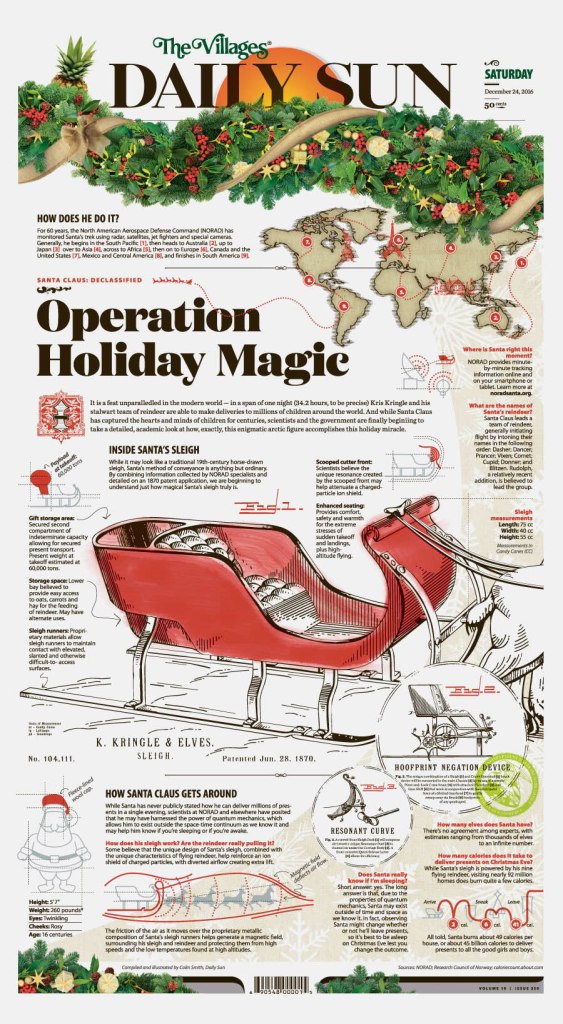
+ When I’m not redesigning the paper, some pages I’ve worked on that I really like have been a Christmas cover with a Santa sleigh based on an 1800s patent application (we’ve gotten a lot of mileage out of that one, re-running it pretty much every year).
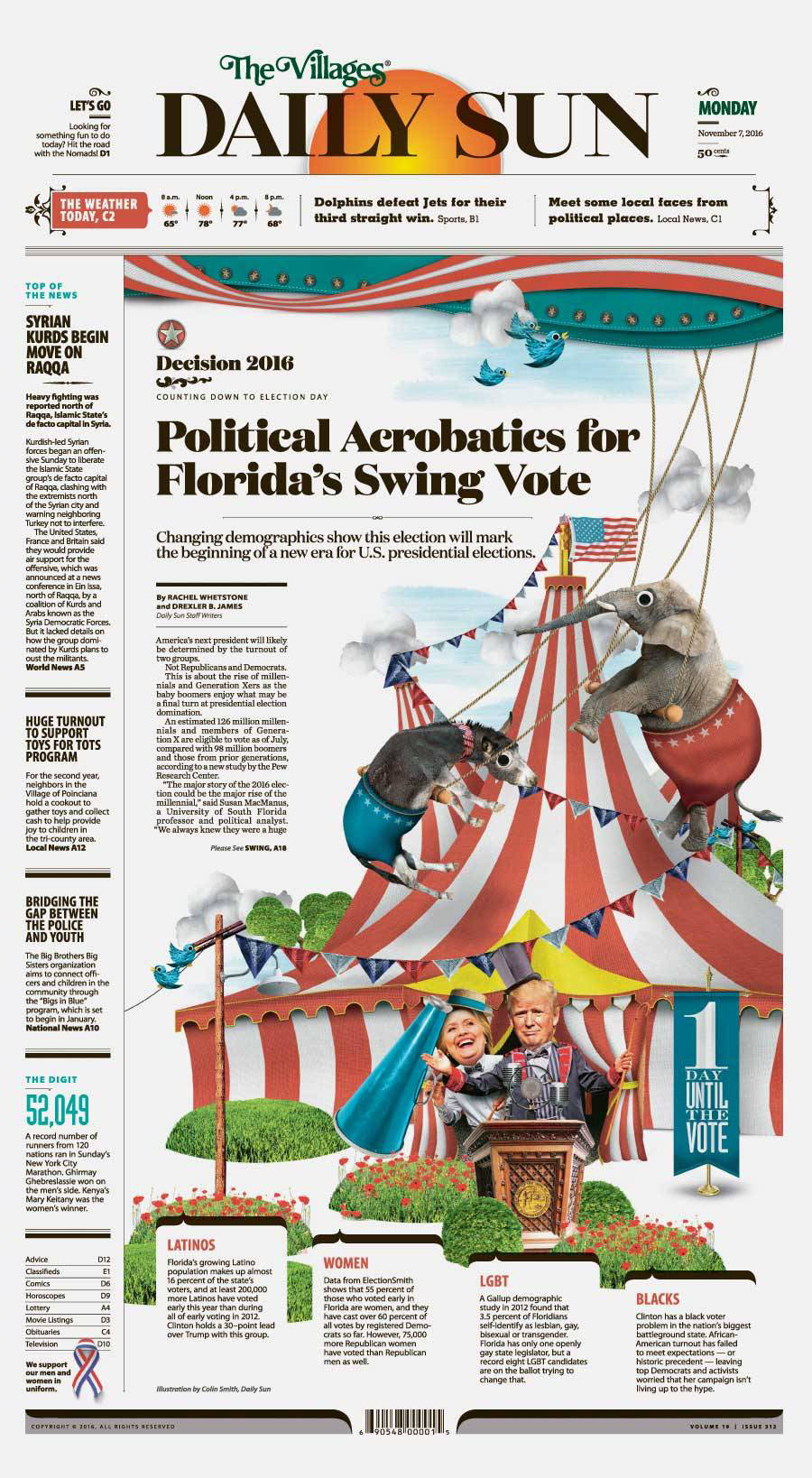
+ An oldie but a goodie, but I also really had a ton of fun designing our 2016 election coverage and doing those illustrations.
Tell me a little about your process. How do you come up with ideas? Adam: For our bigger projects, we huddle up a lot to brainstorm. Sometimes it’s really simple to just run with your first idea, but we talk a lot here about not stopping too short. One thing Bonita says to us a lot when approaching a page is “what can we do that we’ve never done before.” And then the brainstorming kicks off. Even if it’s not a huge project, just turning to one or two other people in your pod or in the newsroom can help elevate an idea or a page. We’re sort of all in this together.
Colin: Ideas for stories is pretty simple. Generally main stories are planned weeks in advance and special projects are planned months in the future. The bigger the project, the more the lead-time for visual discussions — from data visualization to the need for photo reporting and illustration. Actual designing for special projects doesn’t begin until about two weeks in advance, with final design beginning in earnest a few days before publication.
As far as the ideas, it’s a back-and-forth process where the narrative is weighed with how we’ll tell the story visually and one, the other or both are adjusted until we’re happy with the final result.
And that’s a wrap from Colin and Adam. But what fun. It seems like the Villages Daily Sun would be any print designer’s dream job. Thanks to both for all their insight.
From really northwest to regular northwest America, this newspaper designer is making the most of her opportunity at newspaper that loves its design
By Brad Needham
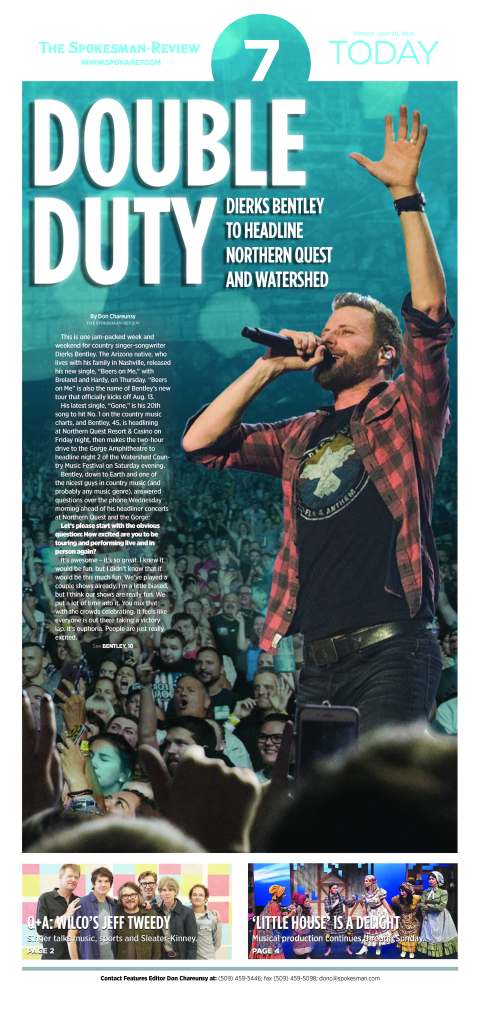
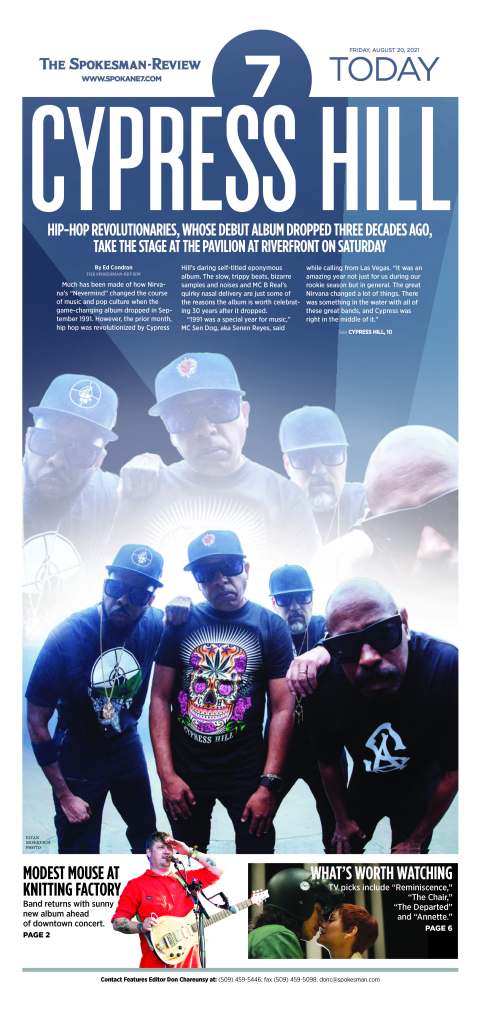
One of the things that frustrates me about trying to promote newspaper design is that it is often so hard to find out who is responsible for all the amazing designs I see. I would love to shoutout all the amazing talent behind the stellar newspaper front pages from around the world. But I can’t just turn to the masthead or page 2 and see, Cover Design by … as one might in a magazine. That’s why I was tickled when I posted a Spokesman-Review arts cover on my Instagram account and I got a response from the paper. They told me they would pass my message onto their designer (including the comment about wondering if the reverse text was readable in print). And then Caitlin Miller, the designer in question, contacted me on Twitter to tell me, yes, indeed, the text was perfectly legible!
The page just popped for me. The contrast. The big display. Smokey Robinson‘s eyes and the joy in his face, which is especially notable in a never-ending pandemic.
I have long been a fan of the Spokesman-Review’s design, particularly their front page. I think it’s one of the consistently best designed newspapers around. They give it their all and achieve solid, and sometimes outstanding, results. I hope I have the good fortune of talking to an A1 (1A?) designer one day (nudge, nudge!). Side note: I love that the Spokesman-Review posts, every day, its front page, other section fronts and historical pages on its website (link to Sept. 23 front page). The more we can celebrate print the better, and they have a lot to celebrate.
Being such a fan, naturally I asked Caitlin if she’d be willing to talk to me. And she said yes! While she’s not been in the industry long, she’s making a splash. And unlike most U.S. designers, her career started further north than this high-kilometre Canadian has ever lived or worked (and I lived/worked in Fort McMurray and Fairview, both Alberta, as well as Prince George and Fort St. James, B.C., which are pretty far north).
Caitlin talks about her growth as a designer. And she talks about working within the framework of your newspaper. Some papers, like the Spokesman-Review, really pride themselves on design. Other papers, particularly in the present print media climate or smaller papers, don’t go big on design every day. Caitlin now gets to work with a team that loves design, one that submits a pile of pages to the Society for News Design‘s design competition every year. And I bet that passion for design is contagious!
Here is our chat. I have sprinkled a few more of her eye-catching Spokesman-Review designs throughout the questions, and end with some pages from her pre-Spokane days in Alaska.
It’s a never-ending learning experience, and I love that.
Caitlin Miller on working in journalism
How did you get into newspaper design? I fell into it. What got me into print news was a semester working at The Sun Star as the managing editor at the University of Alaska Fairbanks. Certainly, no design experience! My job in that position was strictly editing and guiding writers (albeit at writers’ own discretion of accepting my edits, but that’s working at a college paper for you).
I kept my eye on the local paper as a possible job prospect in Fairbanks for a while. After I graduated, I was working at a hotel and would read the paper daily, including checking classifieds. Finally, a copyeditor position opened. I knew the former editor-in-chief of The Sun Star was working as an editorial assistant at The Daily News-Miner and hit her up. Funnily enough she had deleted my number from her contacts, but when she figured out it was me, she was supportive of my interest and put a good word in. I applied the next day, and a month later I was hired. I learned newspaper design on the job and taught myself a lot of what I now know, but I knew I couldn’t grow staying in Alaska, which is how I found myself at The Spokesman-Review. It’s a never-ending learning experience, and I love that.
However, I knew that I always wanted to work in newsprint. It’s a bit of a family legacy, with my grandfather and his father working in it, respectively in different aspects.
What do you like about newspaper design? And what makes it different? First, I like that I’m using both sides of my B.A. I hold a degree in English and art and being able to interact with both design and words is satisfying to say the least.
(A writing mentor) opened my eyes to the beauty of page layout; she gave me a reader’s perspective.
I was meeting with a writing mentor at a coffee shop one day, and as we were catching up, she had asked me where I was working, and I answered that I was at the paper and explained my job. We found ourselves in conversation about the benefits of a physical copy (versus web) reading of a newspaper. She opened my eyes to the beauty of page layout; she gave me a reader’s perspective, a perspective I’ve never interacted with before as a designer despite my own reading of papers. But things always look differently from another’s eyes, don’t they? Through her gaze, we discussed the way readers interact with stories, how a jump from the front page to an inside page, or a refer/tease, could bring a reader to stories they wouldn’t have likely known about otherwise. Not everyone thumbs through all the pages of the paper. How many of us non-sports people don’t give sports a single glance? Or maybe a parent only bought the paper to keep record of a story on the front page related to their child. Suddenly, that parent finds himself or herself on Page A5 reading about a column on a local event involving a nonprofit that seeks to benefit cancer awareness.
What was the most fun you have had with a design? My favourite pages are those with the most agency. In a way, this applies here, also. Those pages that I’m given a feature story or column with lots of art, I like being able to take the lead and do what I see fit with it. I like that editors who give me the content trust my judgment. They also know I’m not afraid to ask questions, so communication between us is so very important, including sending page proofs for them to see and affirm or correct where needed. Pages where I am given lots to work with, and pages with breaking news also are fun to work with. I’m really thankful for templates however, because sometime a page just needs that basic layout and nothing more, and that’s cool.
I hope I can, with the pages I provided, express the “most fun” I’ve had with design. It’s hard to explain otherwise, and these include my favourite pages as well.
Do you rely on one design principle more than others (white space, text as design, colour, cutouts, etc.)? I do a lot of cutouts. Always have. But, gosh, do they take time. It can really depend on the page I’m working on. Feature-y pages will likely have cutouts whereas hard news pages will likely not, at least from me thus far. Colour does play a role, oddly. Sometimes I look at a page after I’ve completed it and go, “Wow! How did this work out!”—and it turns out that all the photos visually correlate by complete happenstance. I tend to avoid lots of white space, however. But at The S-R, I’m learning the benefits of it. We use it far more than I’m used to, whereas before, I was very adamant on squaring everything off and making sure everything fits tightly on a page.
Tell me about a design you loved that was rejected. I don’t think I can answer this exactly how you want it answered, simply because it isn’t about something being rejected. I don’t think I’ve had an entire page design rejected before; however, I have had aspects of designs criticized and rejected. It isn’t a good feeling. But talking through it and learning from it is important. Maybe it’s something the design editors were avoiding you didn’t know about. Great. Now you know not to do that ever again. Or maybe it’s a learning experience between you and the more experienced designer who suggests the text be more horizontal in nature and less vertical. Awesome. Now you can take that experience and apply it to future designs that might have similar elements that could benefit from it.
It still feels crummy sometimes having your work criticized. But it’s worth it.
It still feels crummy sometimes having your work criticized. But it’s worth it. The team effort is important, and you can learn a lot from working with others and seeing design through your critics’ eyes.
Are there any designers or publications other than those you have worked at that you are sure to look at? If I’m in a new city or town, or visiting family, I’m sure to pick up the local paper. It’s hard not to look at design now wherever I go. This includes magazine covers — it’s interesting the crossover between the two, like siblings of sorts. But I look at both general design, and what stories they put where, such as what the designer of that paper chose (or perhaps editors — this really depends on the size of the paper!) for the lead, down the rail, centrepiece, down page, etc. It can say a lot for what the town sees as important, and a lot of time localization is prioritized over national wire stories.
It might be like picking favourite family members, but if you had to pick a few favourite pages, what would they be and why? I’ll address my career thus far. I’ve noticed with The Daily News-Miner my favourite covers are the ones where I have the most agency. And perhaps the same can be said with The Spokesman-Review. While at the News-Miner, I have a handful of pages I love.
The News-Miner doesn’t like much for creativity, per se, but the Our Town page, a localized feature page that ran weekly, allowed me to kind of do what I want within means. And I loved it. I had a good knack of what was allowed on A1, but Our Town meant I could explore making cutouts, changing fonts, applying gradients. Many of these pages had strong interaction with local audiences who were regular followers of the editor of that page. And, I have to say, there is such satisfaction in knowing how well I did when that editor comes to and tells me the impact I made. I’ve also seen cutouts of various stories from various pages I’ve constructed framed, and that’s a whole other feeling on its own. At the DNM there are other front pages I love for other reasons, ones I’d include in a portfolio, but they certainly don’t hold an impact like the one’s that have made a personal connection with me emotionally. Maybe the emotionality of it sounds biased, but it really can help a person grow as a designer to know what they’re doing is good in some way or another.
As far as my work at The Spokesman goes, I haven’t quite hit that emotional satisfaction yet, but being at a much larger paper might have much to do with that. However, working with the Seven cover at the Spokesman (weekly entertainment feature section) really allows me to explore my skills as a designer, and there is much satisfaction in that. I really can’t wait to see where this takes me.
Tell me a little about your process. How do you come up with ideas? There isn’t much to say about this. Either I have a good idea of where I’m going with something or I don’t. A lot of times I can look at the content and know exactly what is going where, but I think experience has a role in this. And other times I might spend three hours just trying to figure out and experiment with where I’m going to take a page. I may even sometimes have multiple ideas in my head. It’s interesting, working at The Spokesman is such a different experience coming from a small paper. Before, a lot of decision making was solely up to me, regarding what stories go where and what art should appear where. At The Spokesman there’s an editor for everything, including photo placement.
The Spokesman Review has some exceptional designs. How much pressure is there to continually produce great work? Do you swing for the fences every day? The Spokesman staff is so supportive. However, while I’m fairly confident in my abilities, I certainly feel a lot of pressure! I took over the design of the Seven cover after a couple of months being with the company. Prior to that our A1 designer was doing the cover and he certainly has far more experience than I have. Chris Soprych is helpful in many ways. There are days where I just don’t have a clue what do with the art I get. Frankly, sometimes it just isn’t good enough to work with to produce an eye-catching cover. But then he shows me how he’d approach it and from that I’m able to learn different approaches. I’m thankful, and this experience is a huge part of why I wanted to join The Spokesman-Review.
Certainly, communication is important and helps relieve some stress. I’m not the only one who looks at the page or cover. And others’ suggestions can certainly make or break a page in its success. Constructive criticism is always important. And I really enjoy that so many people are involved with the process and looking at the final proof. I’m also coming from a paper prior to The S-R where I was the only set of eyes on pretty much everything, so it’s all been both a learning experience and a huge relief.
For the young and aspiring designers, remember we do this because we love this.
Do you have words for wisdom for young, aspiring designers? For the young and aspiring designers, remember we do this because we love this. Remember that behind the scenes we still make a difference and affect a reader’s interaction with the paper as whole. We’re not in this for the pay. We’re in it because we love what we do, and we love journalism. But also, for those who may feel stuck at a job that you feel no mobility in, don’t be afraid to extend yourself beyond what’s familiar and apply all over. Call. Talk to editors and tell them you want the job. It may seem old school, but working in newsprint is, believe it or not, still old school. Basically, don’t be afraid to chase your dreams, bug people and be adventurous!
Fave designs
Below is a selection of Caitlin’s favourite designs. She explains what made each of them special. We’ve seen the Spokesman-Review pages. That’s where she is now. This is where she began. “I really feel like the Seven covers for The Spokesman-Review show my potential as a designer in contrast to what I was more so limited to designing at my former job.”
My one issue with this page is the text wrap around the columnist’s mug has a weird break that I didn’t catch until months after when I was going through my portfolio and applying to other papers. Jorgy Jorgensen played a huge part in the Alaska community and touched a lot of people’s hearts. This page brought many people joy and the columnist received many thanks from the community for making it happen. It’s really special to be a part of the community in this way, even being behind the scenes.
This cover page was the moment I realized the power journalism has in a community and how a page designer can contribute to making an impact.
This cover page was the moment I realized the power journalism has in a community and how a page designer can contribute to making an impact. It was also the moment when I knew I found the right career for me. There was a lot of excitement that led up to this page: it was the weekend and unplanned; our 12-page paper needed to be expanded into a 16-page paper, ads had to be moved, everything that was supposed to go on the front page got moved inside. At the time the governor of Alaska had vetoed the state budget, an action that would in turn affect all parts of the state and everyone of all ages. Many were upset by this — Alaska had been facing years of budget cuts already. I knew when I sent that cover I did something. And sure enough, I woke up the next day and discovered that at a protest, Fairbanks residents who didn’t have posters or signs to hold, used our Override editorial front page.
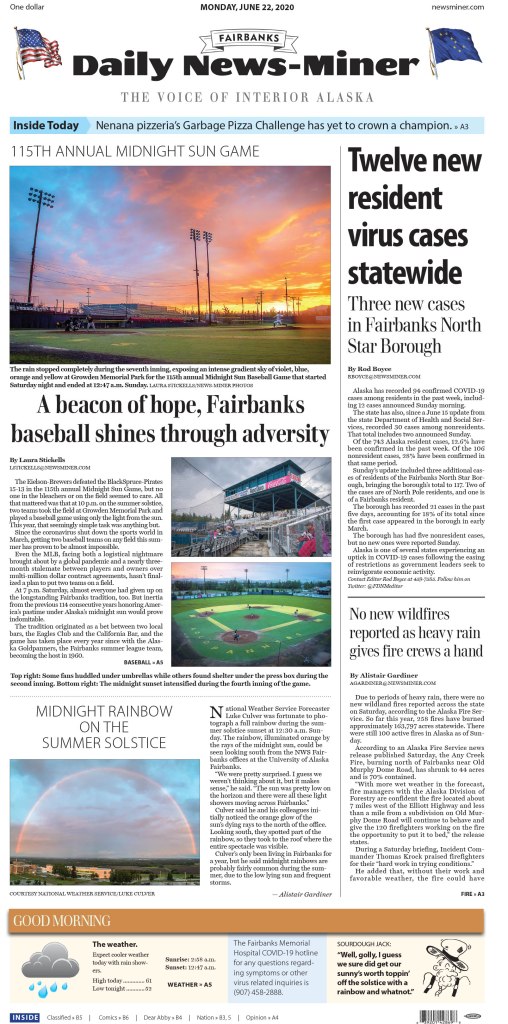
I feel like these pages really captured how the COVID-19 pandemic affected people (pages above and below). We weren’t expecting there to be a Midnight Sun Game that summer. The team that usually hosts the annual tradition cancelled the game due to the pandemic, but a couple of teams from the area came together to make sure it still happened. It was really a “beacon of hope” for a lot of people in a time when so many traditions were cancelled. I think Laura Stickell’s story shows the importance of community and how coming together plays a large part in human morale. It was our sports writer’s last day with the News-Miner and she sure went out with a bang. Great story, great photos.
Want to be featured?
I am always looking for newspaper designers to talk to, whether you’re at a college paper or the Washington Post. Reach out to me through the comments or at bradneedham@gmail.com.
By Brad Needham (but mostly by newspaper designers around Canada)
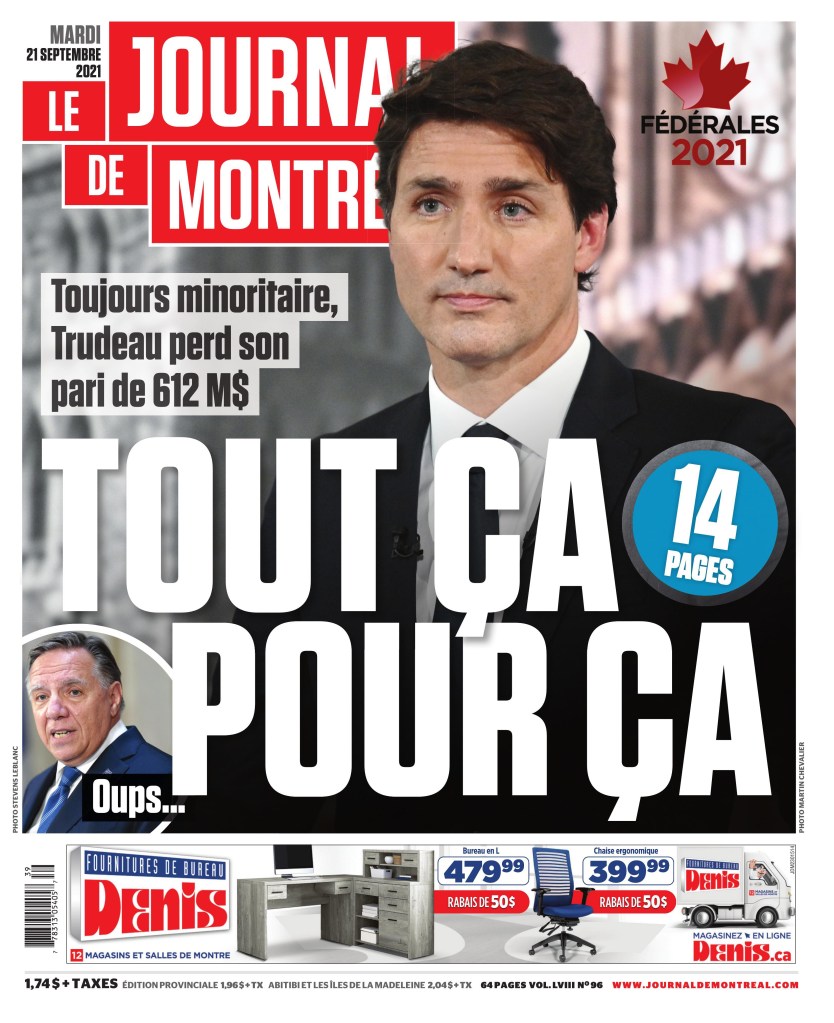
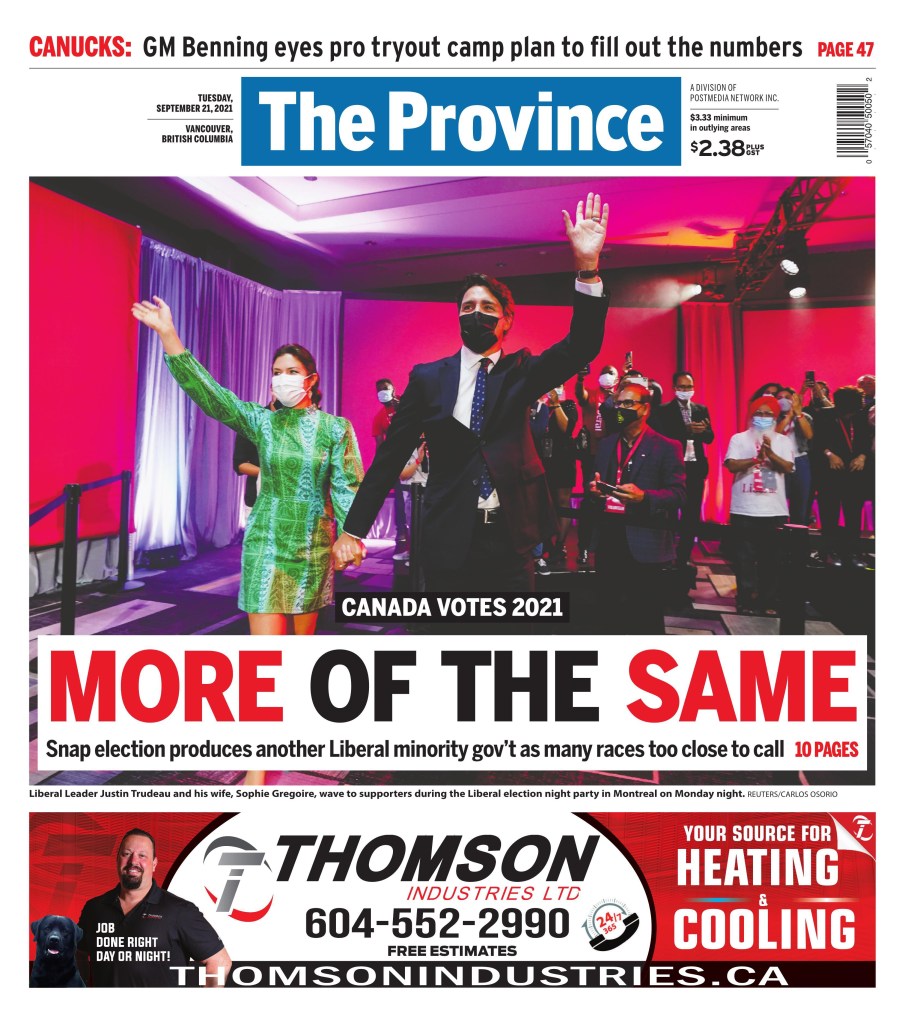
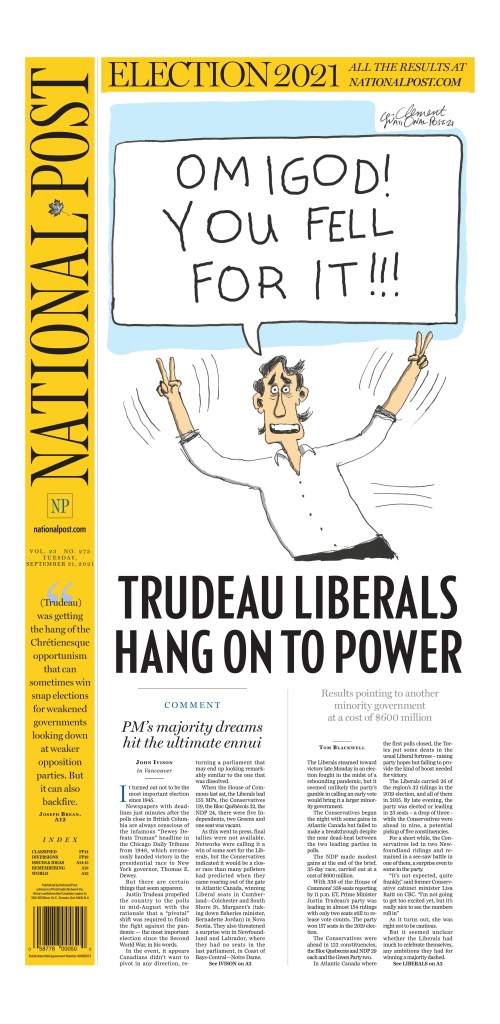
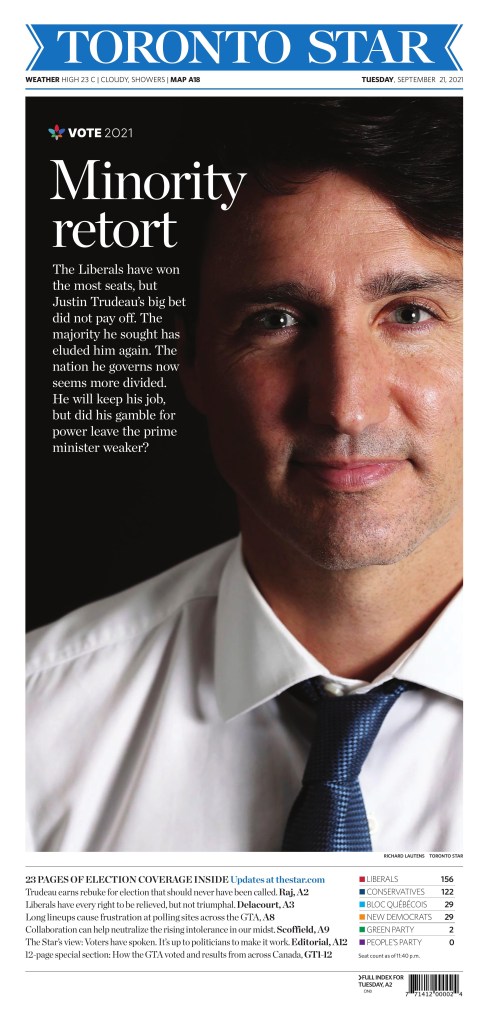
It looks as though making an election newspaper during a pandemic is just as hard as voting in a busy Toronto riding during a pandemic. That is to say not easy. Very little art, no gatherings, no big hugs or ecstatic faces. Despite the results coming in early (as I — and any experienced journalist — would have guessed!), there wasn’t a ton of fresh art used today. I admit I had delusions of grandeur, of waking up to front pages that blew my mind. I love elections, and I love election newspapers. What does blow my mind about these is that most of this work was likely done in people’s homes. That’s an incredible feat, so congrats to all the editors who made this happen. There are some nice looking pages, for sure. I hope for more tomorrow.
Without too much political commentary, and for those not following Canadian politics — which probably includes most of the world and a good chunk of Canadians — this was an interesting election to cover. A minority government that brought itself down and came back as a nearly identical — almost to the seat — minority government, with a Quebec nationalist party seeing the biggest increase (which was still tiny). Naturally, with $612 million spent, it has caused some opinions to be formed in Canada, including in the media. Some in support, some clearly against. That is captured in some of these pages.
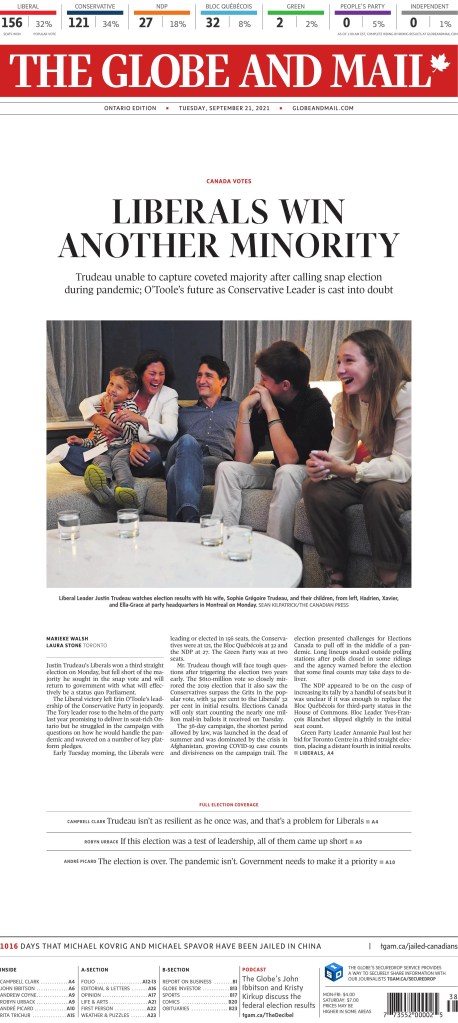
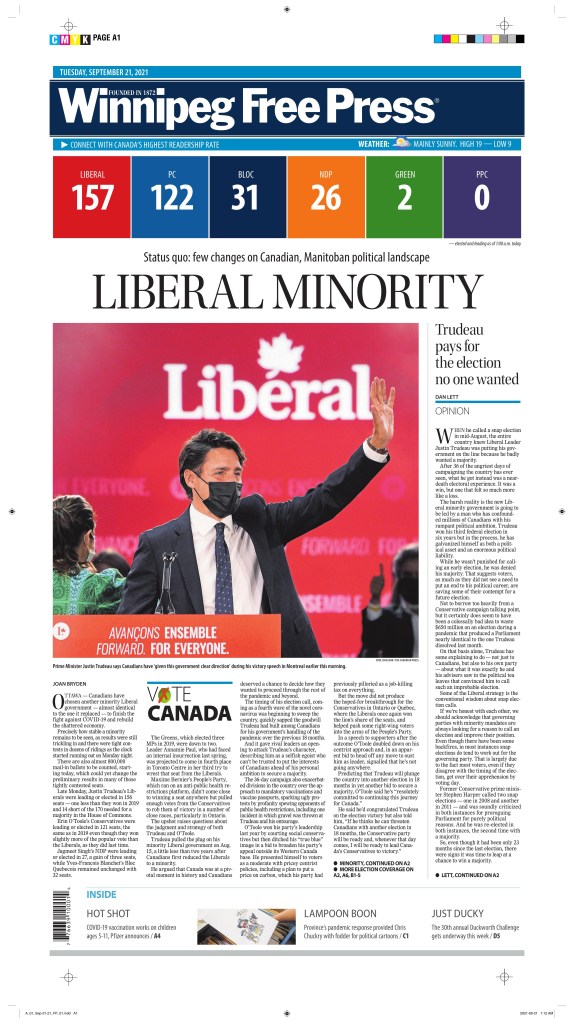
The papers that used fresh art and took a more neutral approach win my election newspaper edition of the this blog! The Globe and Mail wins a majority, with the Winnipeg Free Press filling the role of official opposition. Here is a selection of pages from this election, with little to no commentary on the content or design. Just the pages for your viewing pleasure.
Globe and Mail, Tuesday, Sept. 21
Winnipeg Free Press, Tuesday, Sept. 21
Montreal Gazette, Tuesday, Sept. 21
And now for some more political leaning covers
Most newspapers have a slant of some sort. These papers chose to display theirs, subtly or obviously, on their election covers today.
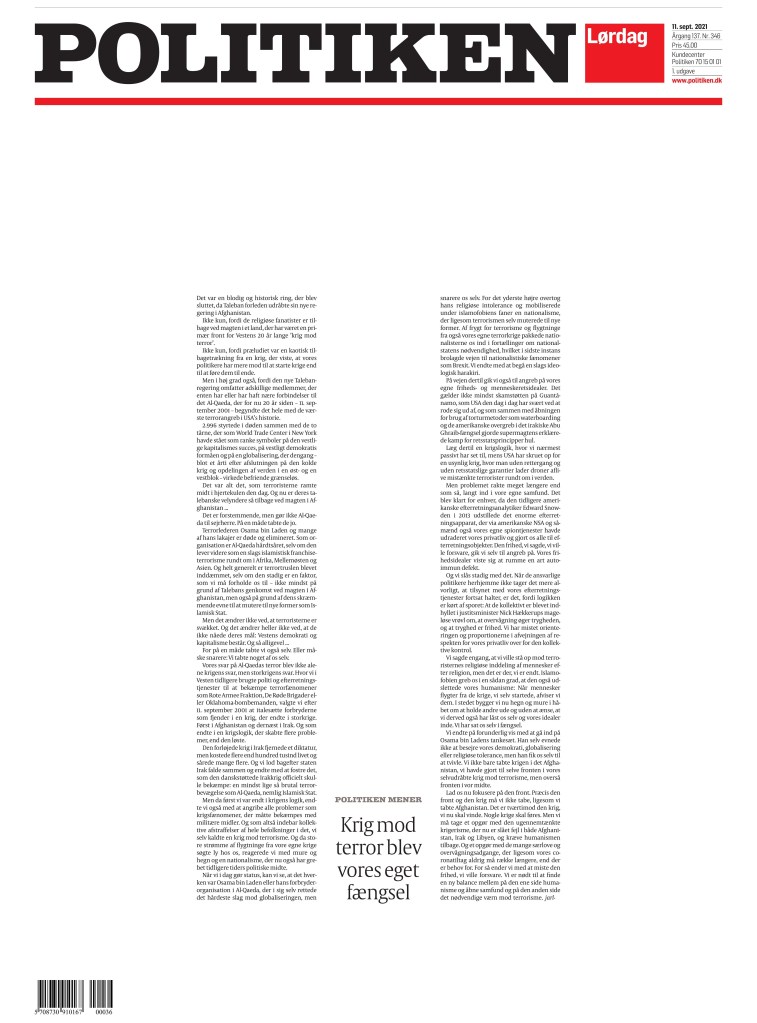
September 11, 2001. 9/11. It was a day that changed the world. The attacks in New York, heard and seen around the world. Today marks 20 years since that infamous day. I remember my first indication something was up was waking up to an email from a friend who worked at the United Nations saying, don’t worry, I am safe. Shortly thereafter the world watched as a second plane flew into the World Trade Center buildings. I was in my final year of journalism school so wasn’t in a newsroom, but I have heard the stories. The chaos. Tearing papers apart. Trying to get special editions out. The Guelph Mercury apparently put out an edition with the attacks on the cover, removing all the stories that were there, but left the turns from the original stories inside.
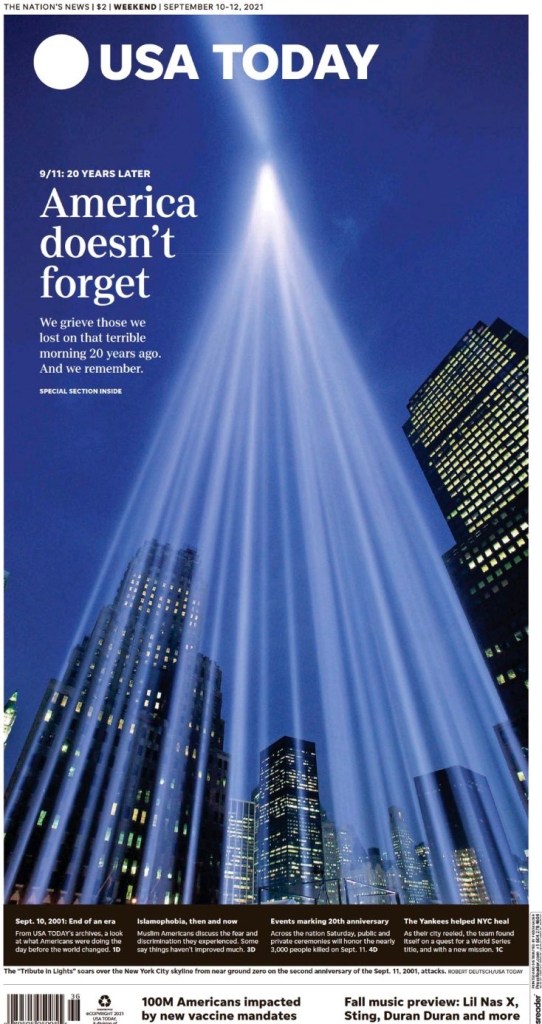
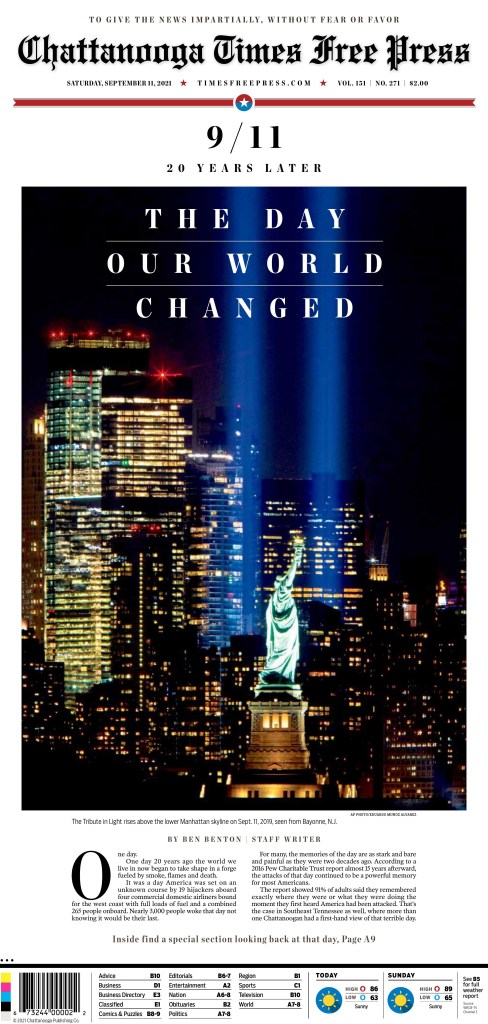
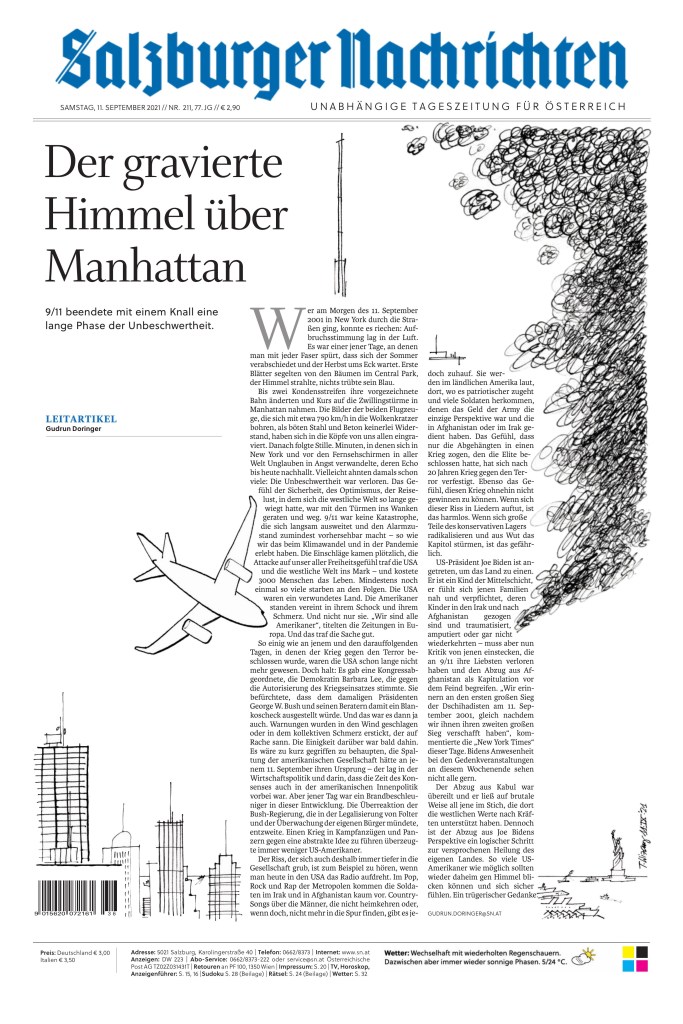
September 11, 2021. Twenty years later, I look at some amazing newspaper covers as the world remembers and reflects on that day. Some are what you would expect. Some are not. It was a tragedy on an unimaginable scale. But this is about the creativity in newsrooms around the world. How do they tell the story visually? I will let the covers mostly speak for themselves. There were dozens (the vast majority of papers in the U.S. had a big 9/11 splash) so I have chosen a few that cover the themes I saw. Some just wildly creative and powerful, simple and elegant. Some showing current photos, some showing destruction. Some taking an artistic approach. Here they are.
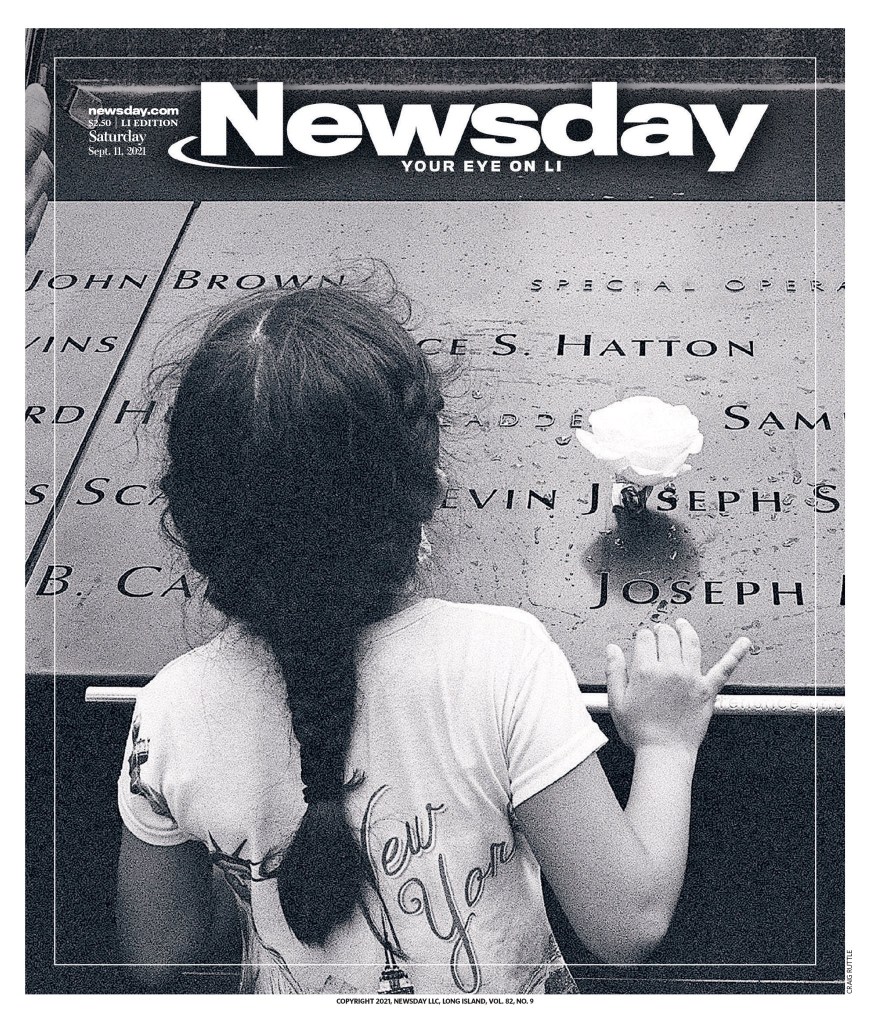
This Newsday cover does so much. It’s different than many others. No towers, no planes, no destruction. Just a little girl. A New York T-shirt. A monument remembering those who died. A single flower.
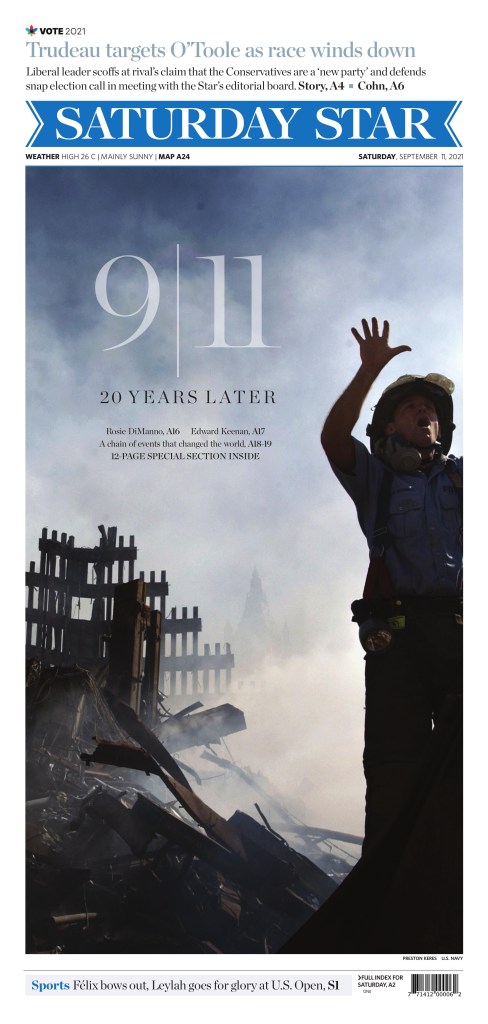
Definitely the strongest 9/11 front page in Canada. The Toronto Star uses a big, powerful image. So well processed. An image similar to this was used in many newspapers. It was just used better here. Minimal text. Stunning.
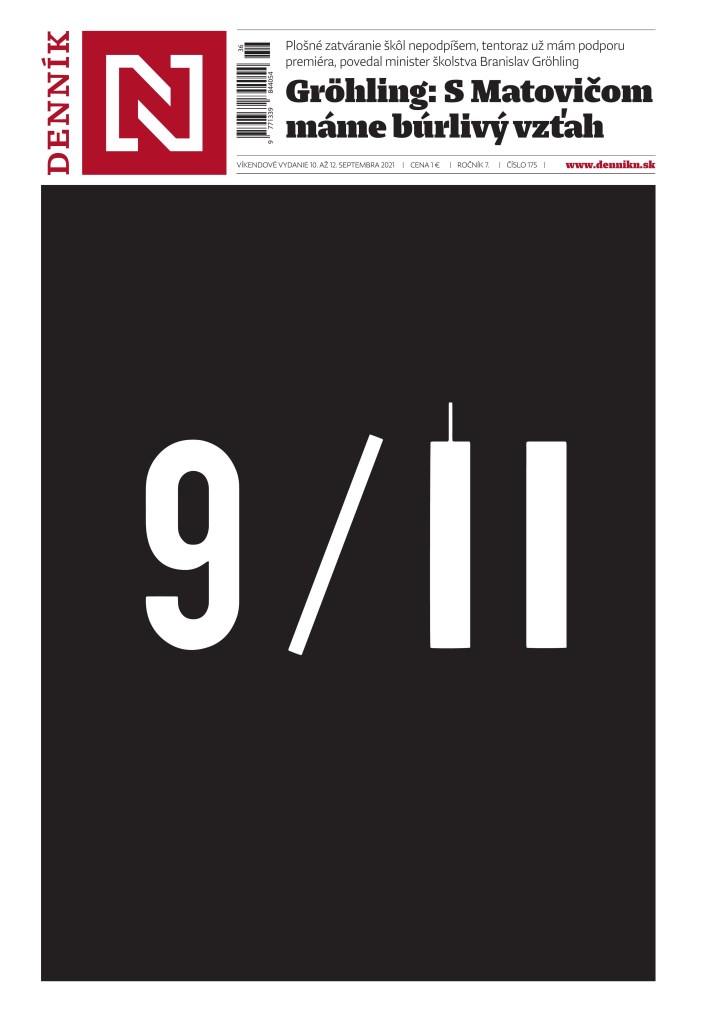
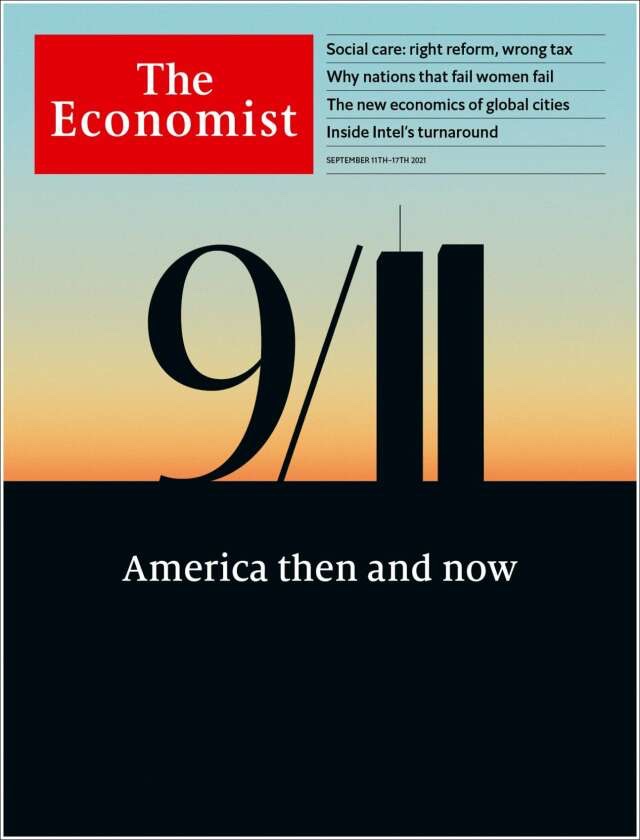
The Dennik N page from Sept. 10 and The Economist from Sept. 11 do something similar with the numbers, similar conceptually, but they look so different. These are two of my favourites. Simple. Beautiful. I love so much that one line, on the first 1, makes all the difference. It takes it from numbers to buildings. So smart.
This is a creative page by Politiken. It is so simple.
These two — above, USA Today, and below, Chattanooga Times Free Press — went with the big photo of the Tribute Lights. Many papers took this approach.
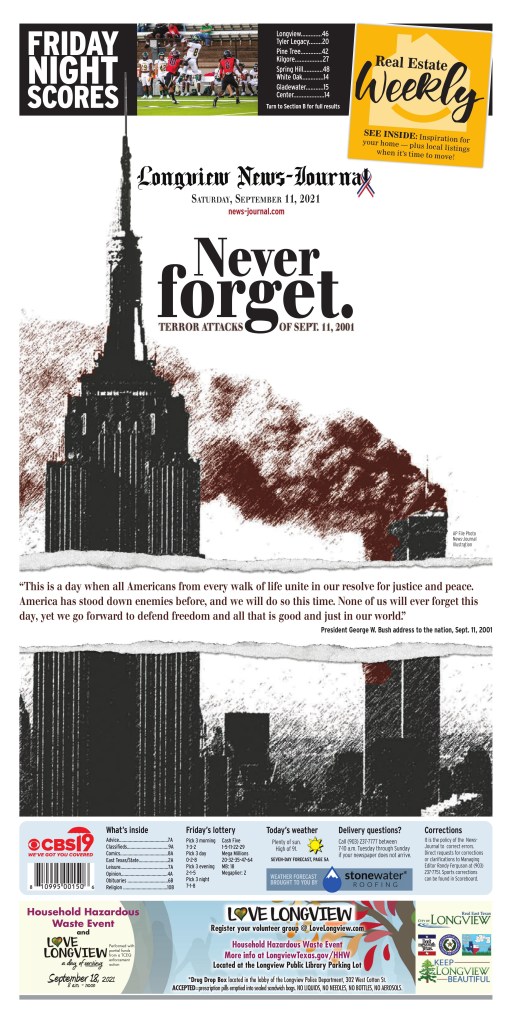
Both these pages used an art-based approach. Above, Salzburger Nachrichten is quite bold. Below is the Longview News-Journal.
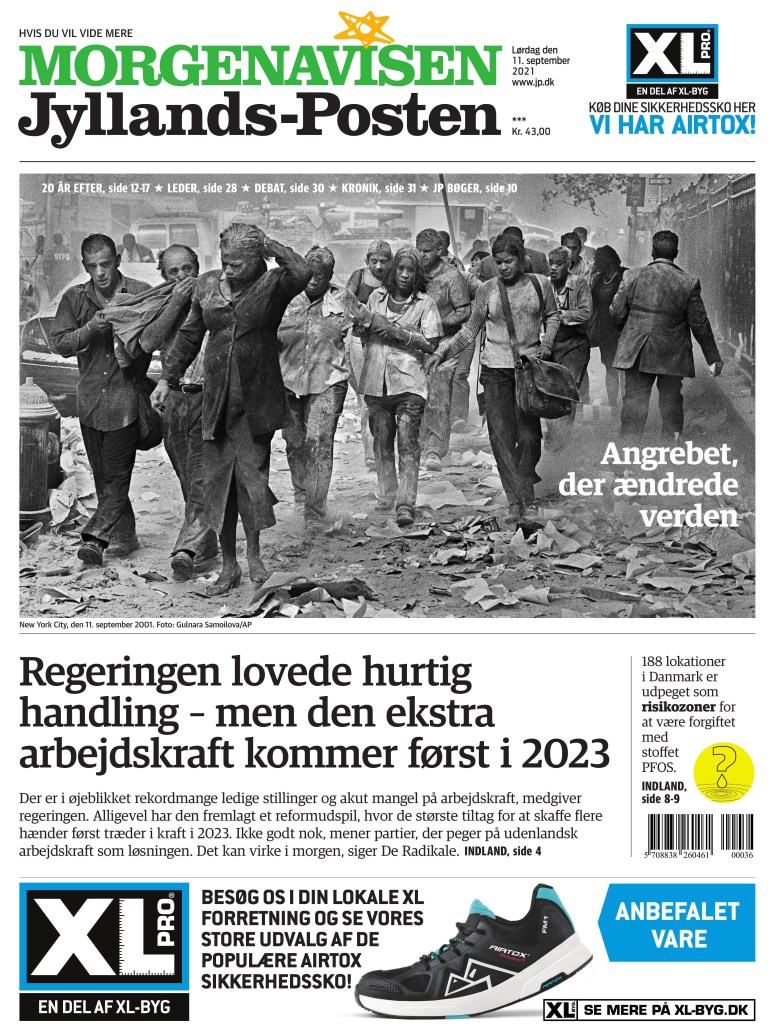
The Jyllands-Posten uses a different photo than most. No destruction visible. But the people. What a photo.
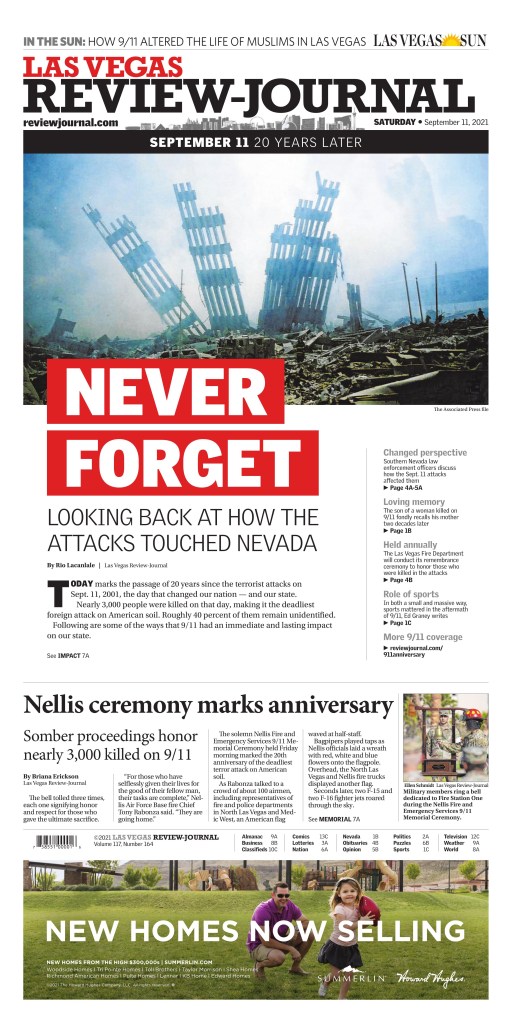
And the Las Vegas Review-Journal. It uses a similar photo to the Star, without the person. This photo was used widely today.
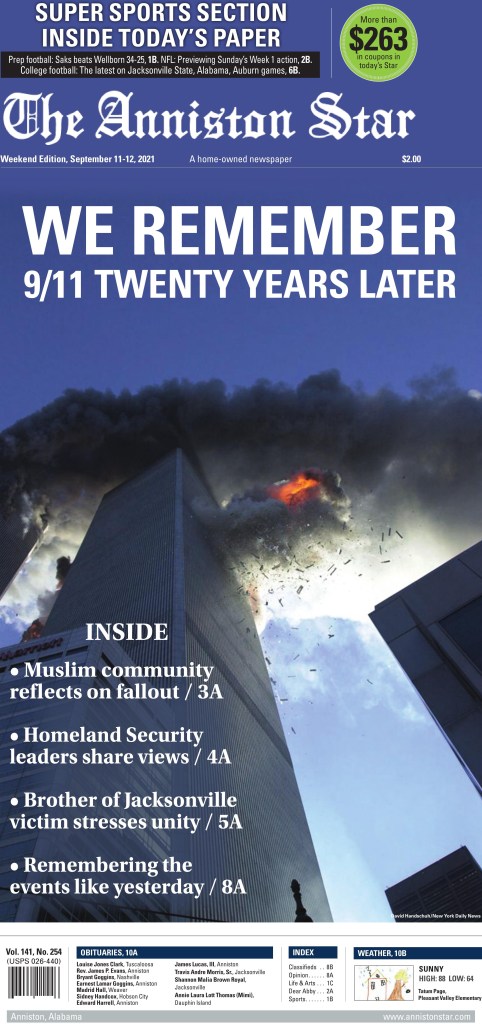
The Anniston Star went with one of the most terrifying photos from 2001. These photos will never not send me right back.
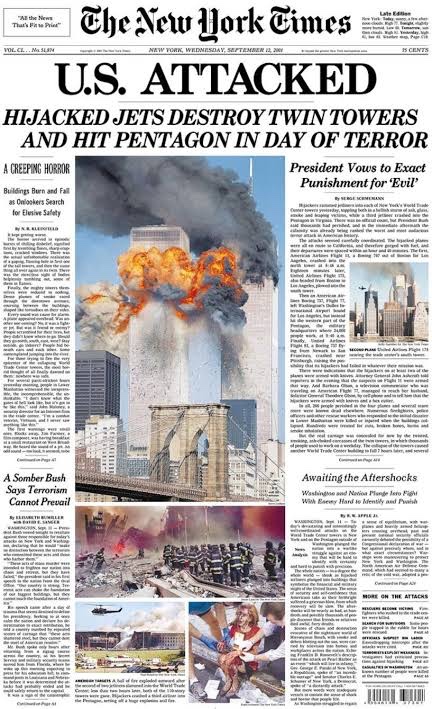
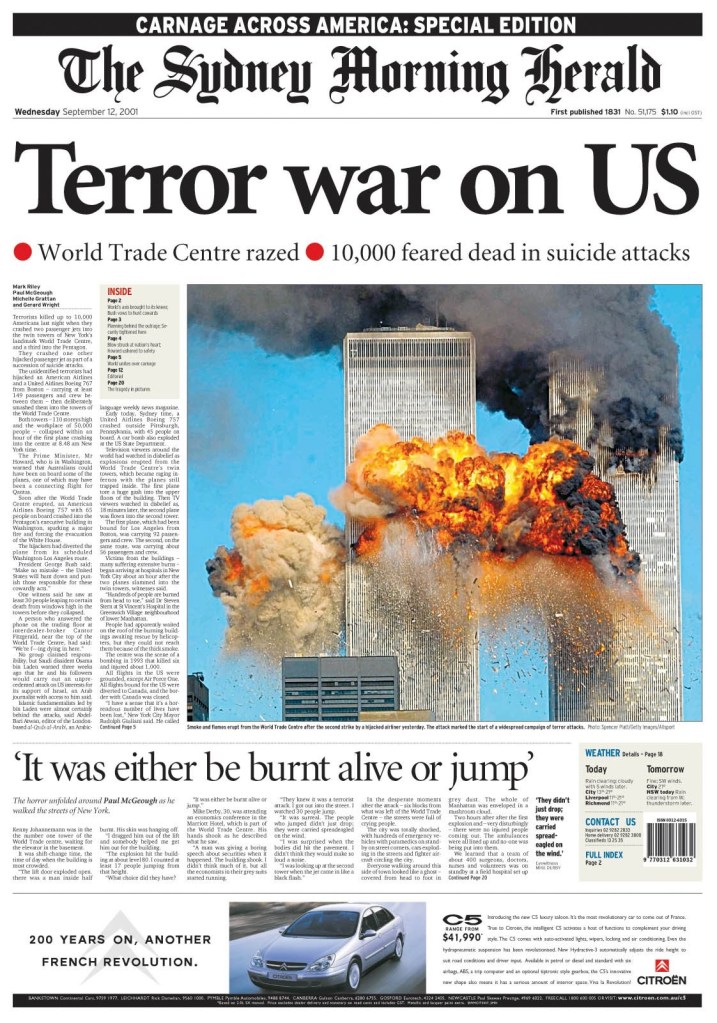
And below are two pages from 2001. I have looked at pages from this time in a previous post, so I won’t go too far into it. The New York Times and The Sydney Morning Herald, Sept. 12, 2001.
On the heels of a major and deadly earthquake in Haiti, Kabul, the capital of Afghanistan, fell to the Taliban two decades after it lost control after a U.S.-led invasion. That is a lot of big news over a couple of days. While there was very little in terms of big pages for Haiti, the same was not true for Kabul. There were several striking pages. It’s a significant story, and one that will be playing out for a long time to come. There will be dire consequences for many in the country, particularly girls and women. Newspapers were right to give it the main play today.
I find it fascinating to see the design choices, both in terms of layout and photo choices. So often there is one photo that stands out. In this case most of the pages used one of two photos. And in some cases the designs and headlines were almost identical. That is not a knock. That’s newspapering. This isn’t the time to for wild design choices or plays on words. These are serious news pages. And these newspapers, all of whom have a strong focus on the world, presented the dire situation to their readers in a way will have an impact. Hopefully the world acts.
Here is a selection of some of the amazing pages from around the world, with the pages mostly speaking for themselves.
The Guardian, Monday, Aug. 16
Globe and Mail, Monday, Aug. 16
The Globe, above, and Hartford Courant, below, are so very similar, but also so well done. They are both powerful pages, achieved with a good, big and clear headline, strong art, and nice but simple treatment of other elements.
Hartford Courant, Monday, Aug. 16
And again this photo. Wow. Used in many papers today. Both the above and deVolksrant below were just three of many who went with this powerful image.
deVolkstrant, Monday, Aug. 16
Jyllands-Posten, Monday, Aug. 16
And a helicopter photo, also used by a handful of papers, including the next three (different pictures or crops, but same idea). The comparison of Vietnam and Kabul is an interesting play in Arab news. A beautiful and powerful headline. It says so much in so few words.
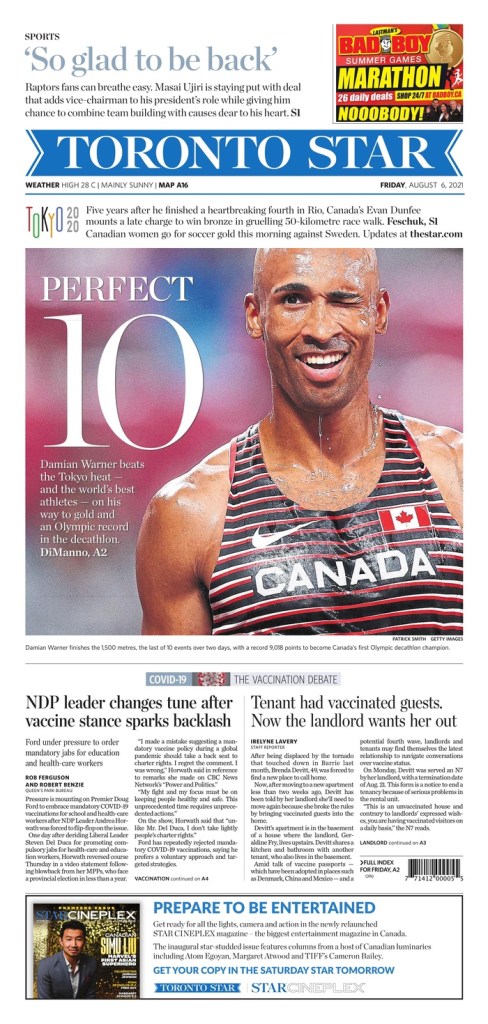
Big sporting events always lead to big coverage from newspapers. And often big and beautiful design. That’s one reason I love the Olympics. Two weeks of big sporting events. Anything is possible. And being in a country like Canada, where we don’t dominate as much as our neighbours to the south, our newspapers make a big deal out of big victories. Tokyo 2020 (21?) was no exception. Using the Freedom Forum’s amazing website, which showcases hundreds of newspaper front pages from around the world every day, I looked through each day and picked out my favourites. There were more. So many. But these were my faves. Editor’s note: as this is a judged event with only one judge, a Canadian, there is a distinct Canadian advantage. That said, Canadian papers swung for the fences every day. And also, I give props to newspapers on this side of the world, who decided to make a big deal out of what could be considered old news. Often 18 or 20 hours after an event, it still dominated the front page. It gave these athletes a chance to live on forever. A moment in time captured.
Gold: National Post (by a hair)
Had the National Post and the Toronto Star approached me like the men’s high jumpers asking for two golds after they tied and decided against a jump off, I might have done that. Alas, I didn’t give them the chance. But I would welcome a design-off if they’re interested. I will facilitate. But I digress. In the absence of that, by a hair …
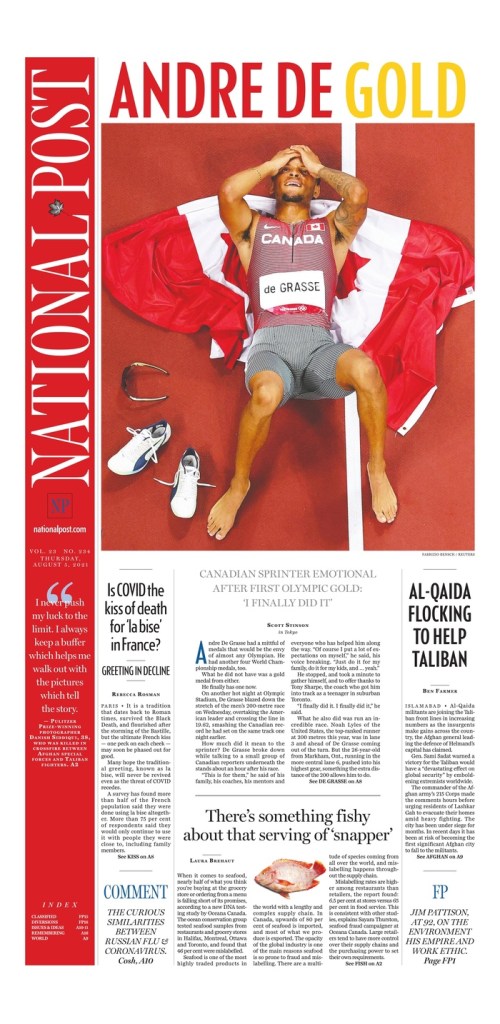
The National Post had some stunning covers, my fave being the one celebrating Andre De Grasse’s gold medal victory in the 200-metre sprint. It was just so well put together. The balance, the colours. The flag complementing the red in his name. While not novel, the gold of the word gold. But it worked, as it looks so nice with the red. The strong photo. And, while not Olympics, the little fish cutout in the middle of the bottom of the page. There is such nice symmetry and balance on this page. The headline is big and bold and colourful. Loved it. It is what helped push it up.
National Post, Thursday, Aug. 5, 2021
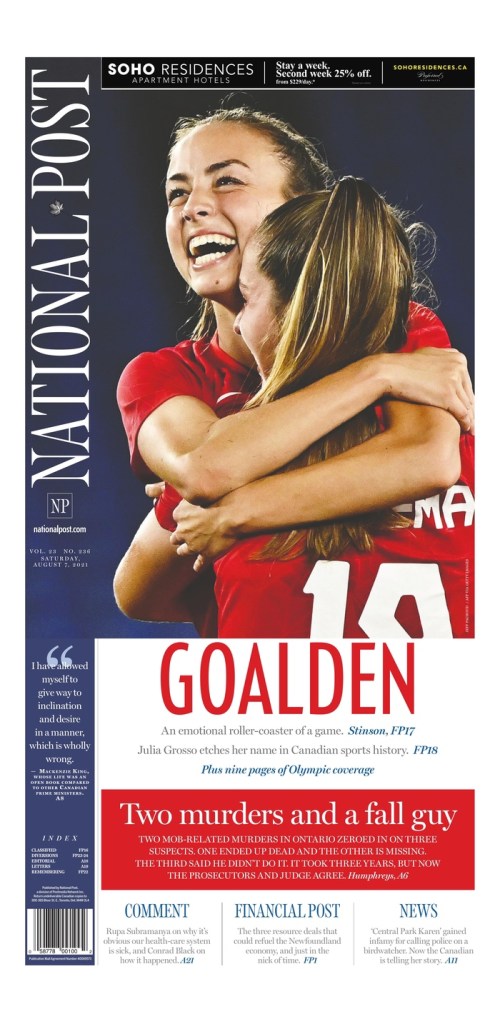
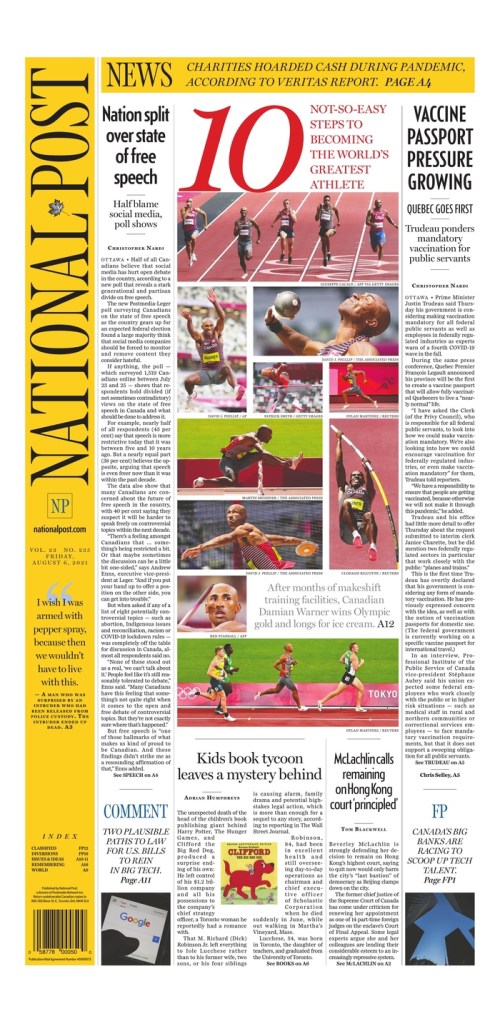
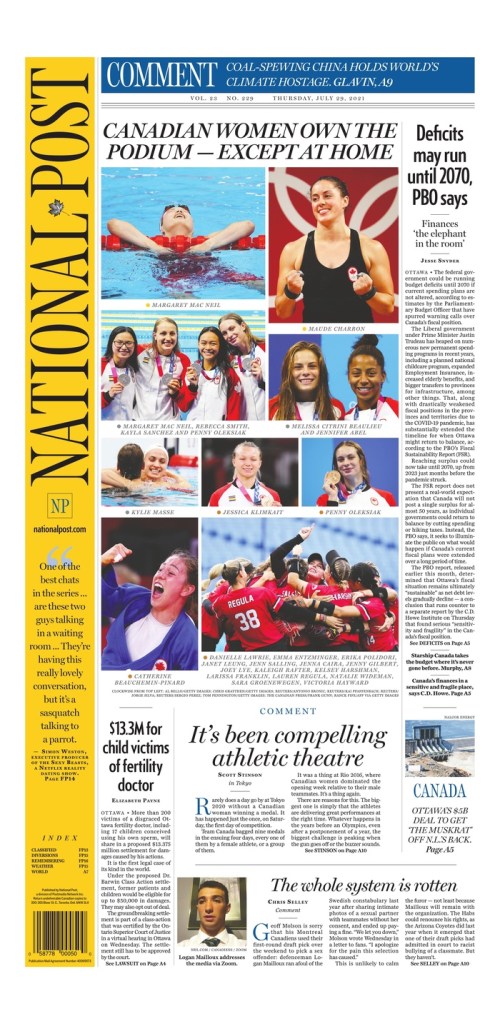
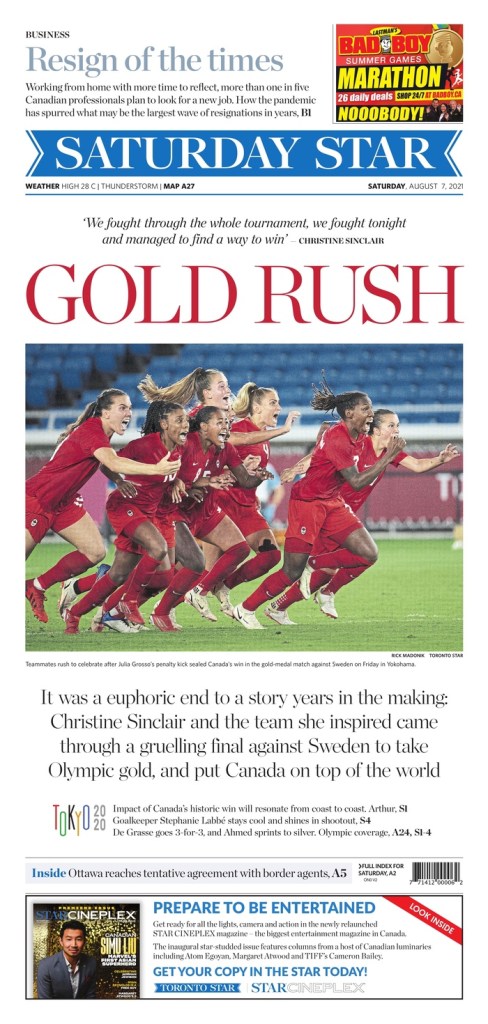
But you can’t top the podium with one strong page. There were three more from the Post that I posted on my Instagram account. The one directly below celebrating the Canadian women’s gold medal in soccer, which again has such a nice colour balance and a beautiful photo. It’s also clean. And the page capturing Damian Warner’s decathlon gold medal. A big 10 (to be expected, and was also used by the Star), a nice collage capturing his events. Just a nice tribute. And one more documenting the success of Canadian women. It was a nice collage. Well put together.
National Post, Thursday, Aug. 7, 2021
National Post, Friday, Aug. 6, 2021
National Post, July 29, 2021
Silver+: Toronto Star
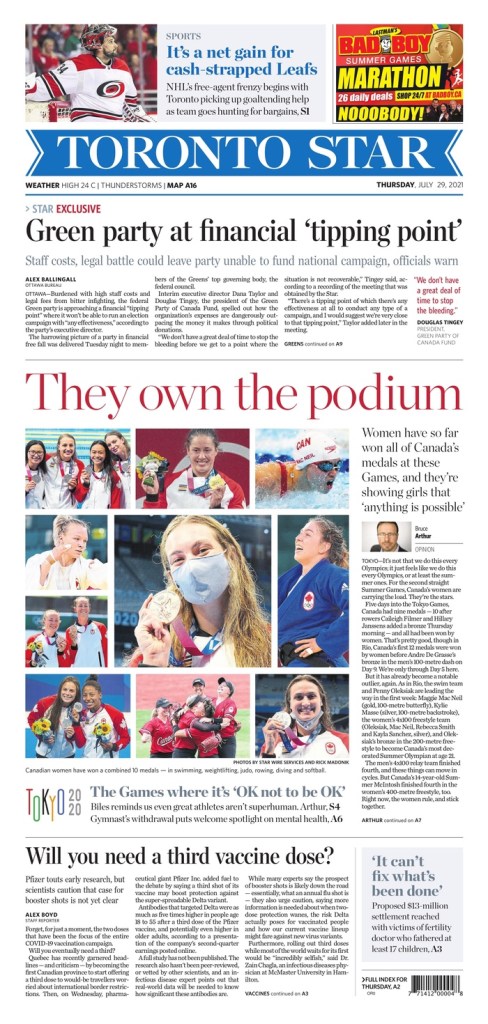
The Star had some beautiful pages. In some cases while the overall design wasn’t quite as strong as the Post, the headlines were stronger. The Star doesn’t have the benefit of working with a vertical flag, which I think so often adds to the Post’s design appeal. But the Star knows how to use the space below (and often above) the flag well. I thought the cover on the women’s soccer gold was the strongest, only because the headline and photo work so well together. Often that’s not considered. Word people come up with good words, design people come up with good designs. But “Gold rush,” with the women all charging off the page and into the paper. Rushing to celebrate the historic win together. And the front blown out for this. Lovely.
Toronto Star, Aug. 7, 2021
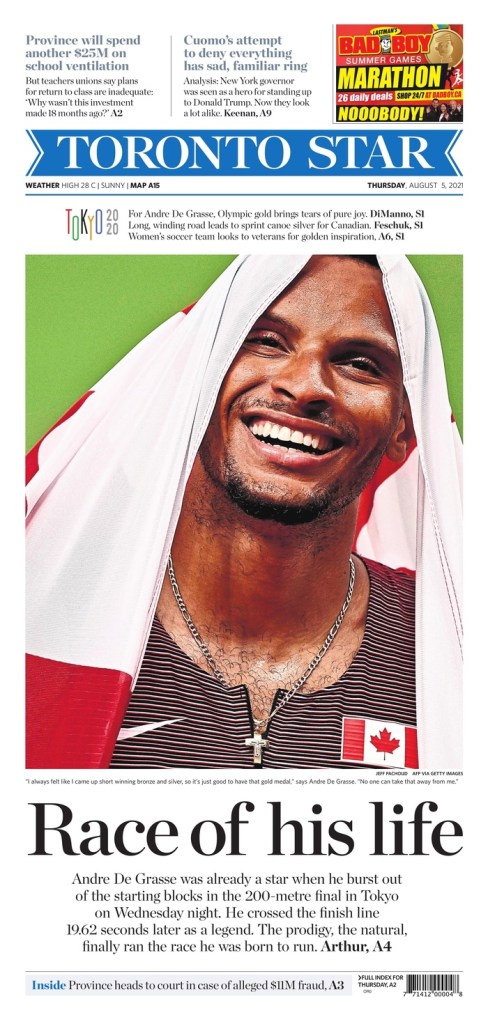
The top pages for the Star and Post came on the same days about the same things. Even about Canadian women dominance. Same day even though either could have gone earlier. The Andre De Grasse page from the Star is fantastic as well. A great emotive photo. Big headline. Nice use of white space. And again a blown out cover for one thing. And just below it was the Damian Warner decathlon page, only faulted for the headline Perfect 10 — I would grant that even if Warner won every event or finished with the best score ever. The Globe and Mail chose the same head. But no shade. A big 10 again and a truly fantastic photo. That wink. Amazing. And I love the play of the display copy on the photo. It’s done well. And the women’s collage. Very similar to the Post.
Toronto Star, Aug. 5, 2021
Toronto Star, Aug. 6, 2021
Toronto Star, July 29, 2021
Bronze: Dagens Nyheter (Sweden)
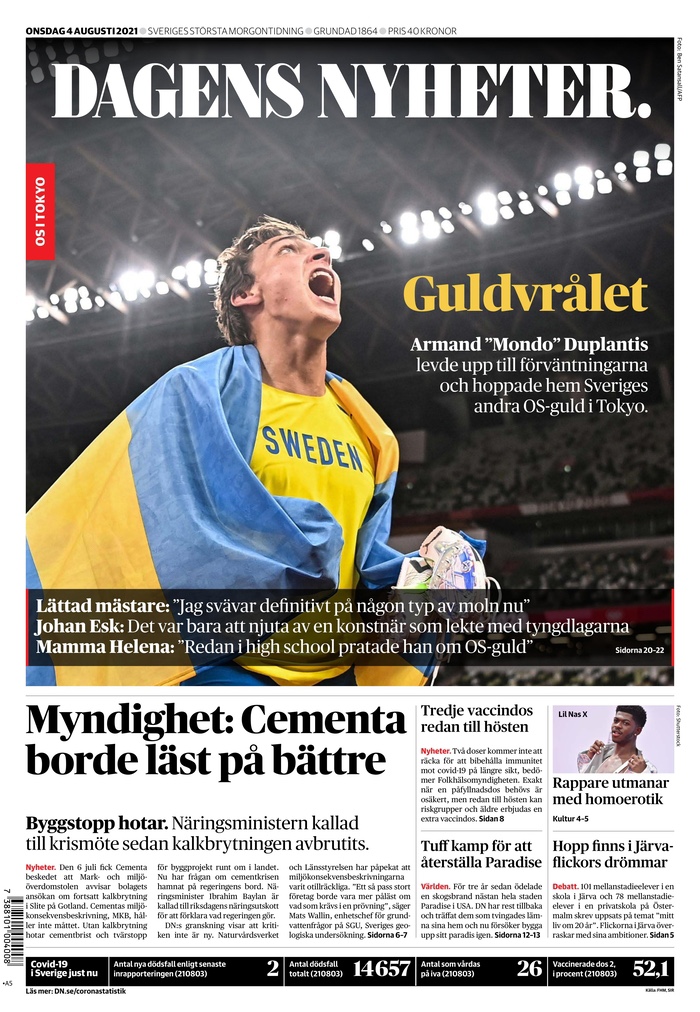
The covers in Dagens Nyheter were just so crisp and clean. An emphasis on strong photography. I have included two, at opposite ends of the spectrum. Heartbreak for the women’s soccer team after losing to Canada in the gold medal match and elation from Armand “Mondo” Duplantis after a gold medal win in pole vault. The display on the photos is done so well. Differently in both but both so good. I love the pull quote on the soccer page and the small yellow head on the pole vault. Such a small head for a big victory but it works so well.
Dagens Nyheter, Aug. 7, 2021
Dagens Nyheter, Aug. 4, 2021
Runner up for being funny: The West Australian
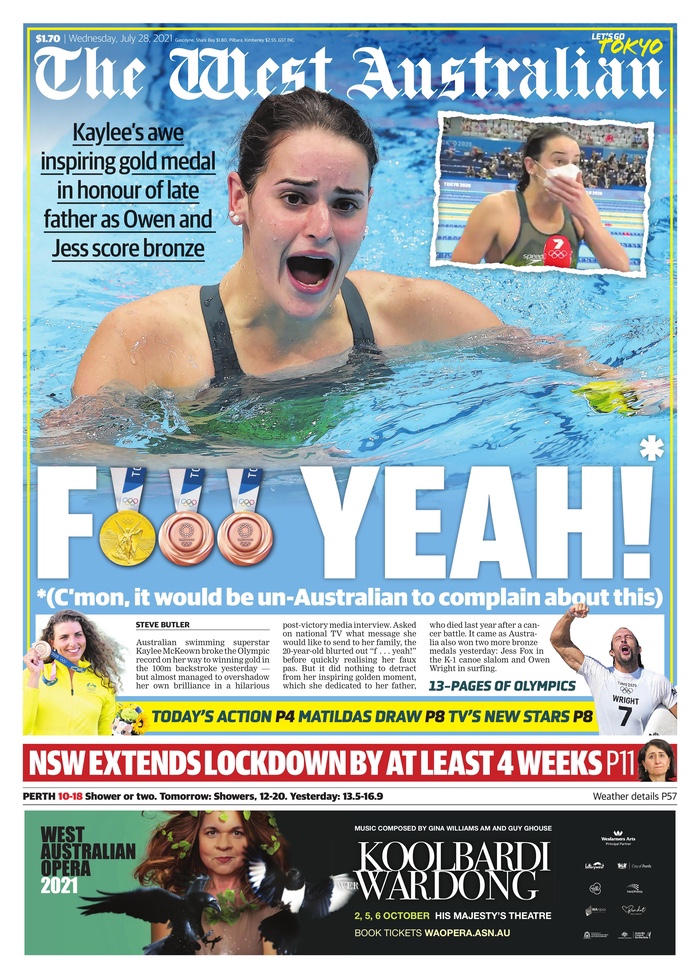
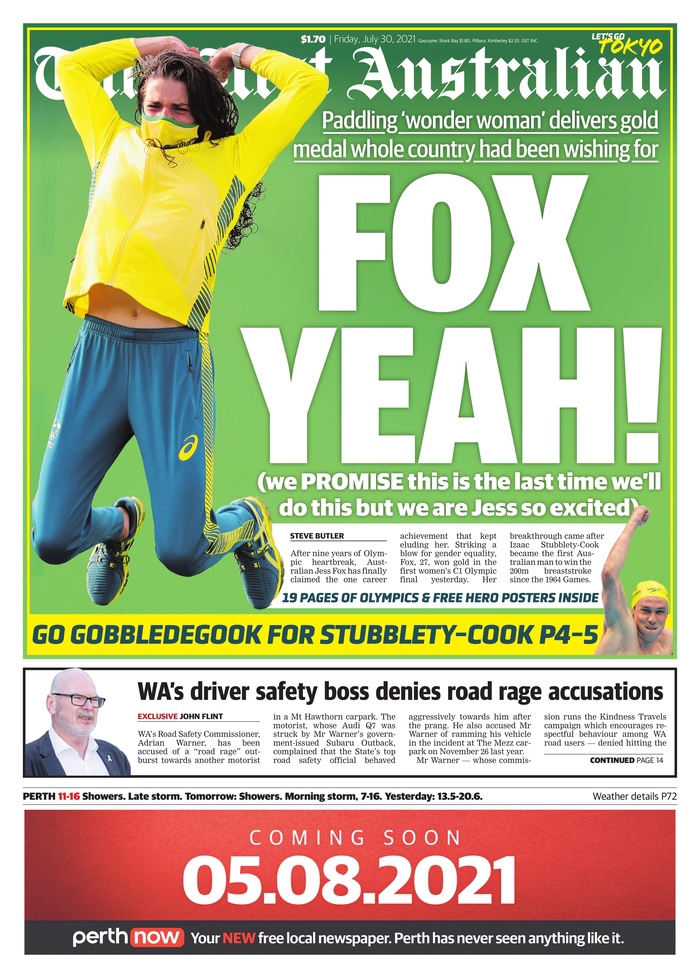
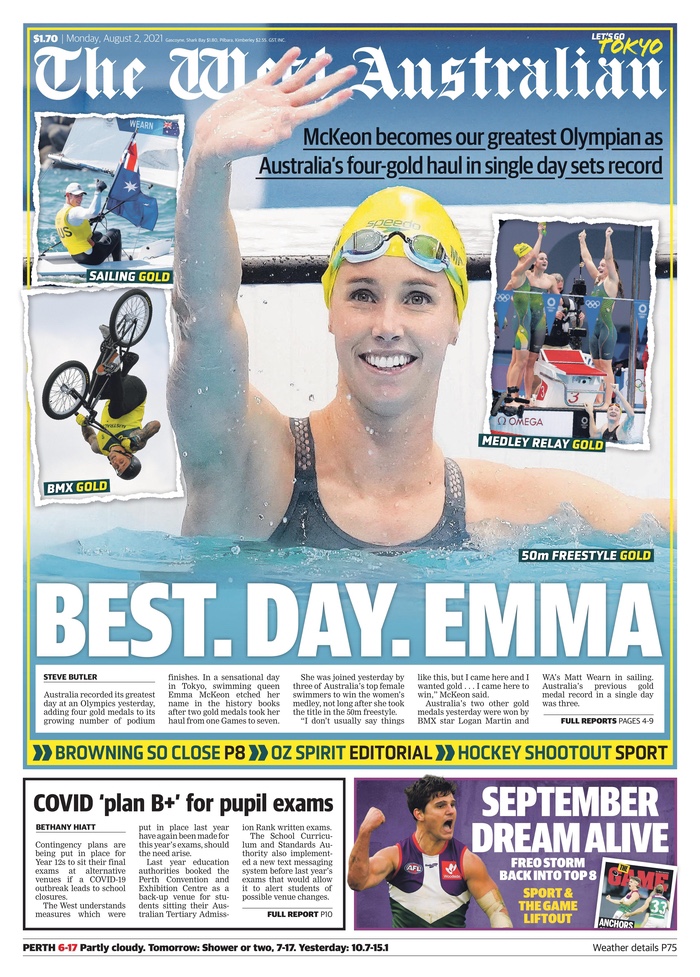
Cheeky? Yes. Did they use the same profane joke twice? Yes. Was it still funny? Fox yeah. But only because they used their decks (or subheads, if you prefer) masterfully. It was a master class in tabloid display. And of course they wouldn’t be here if they didn’t have lovely designs as well. All very similar but still great. No near profanity on the Emma page but also wonderfully done in true tabloid style. Must read in an Australian accent. And a slight pause between each word. Best. Day. Emma.
The West Australian, July 28, 2021
The West Australian, July 30, 2021
The West Australian, Aug. 2, 2021
Olympic efforts
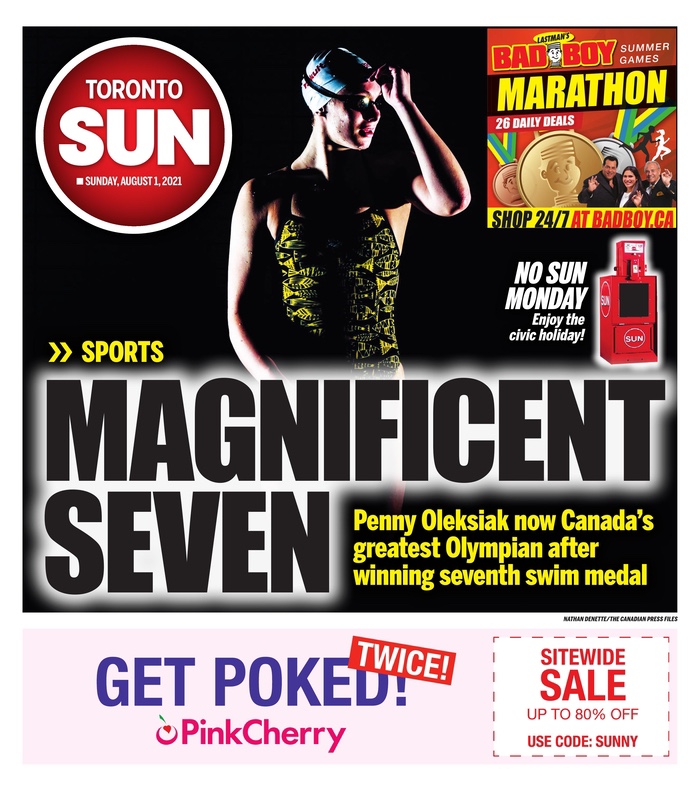
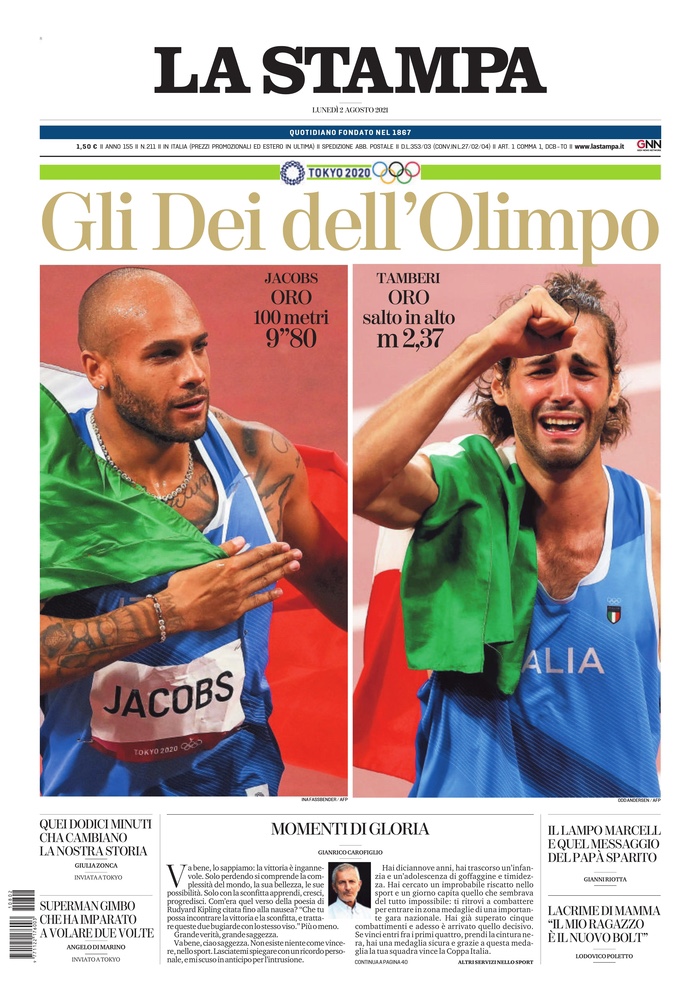
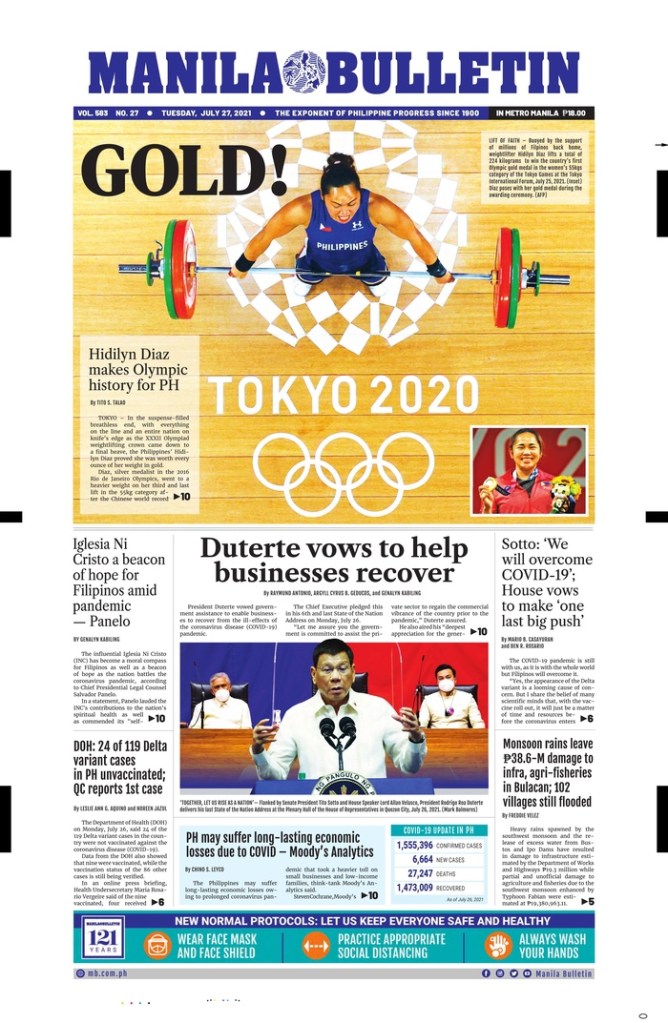
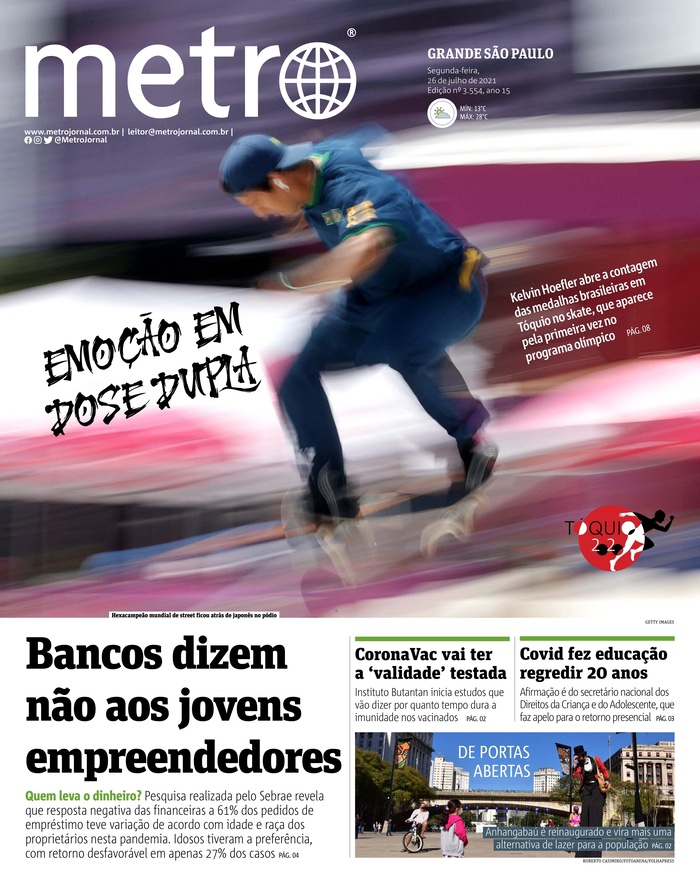
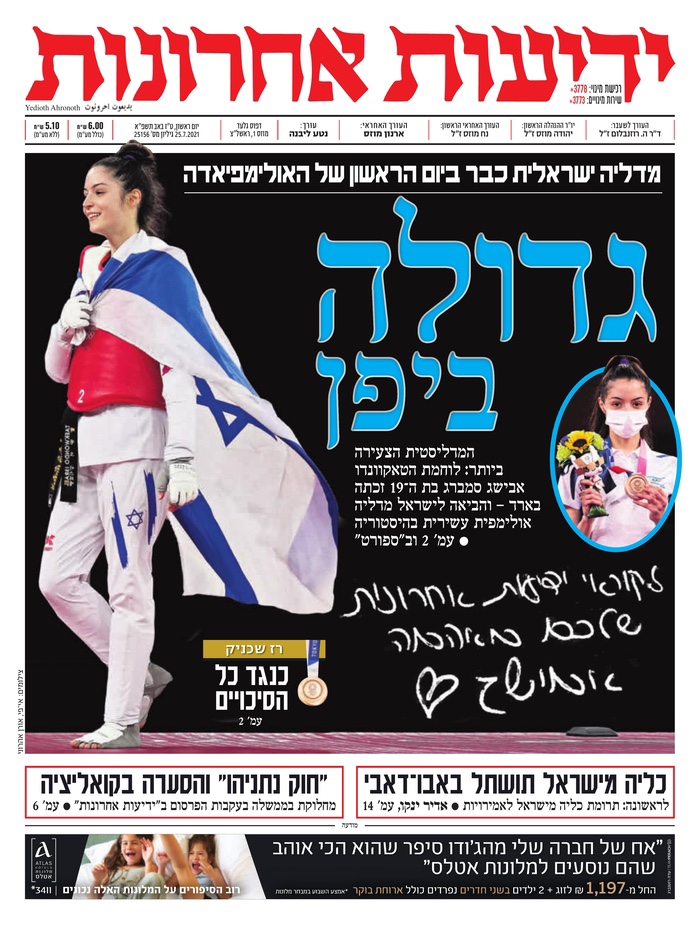
And here are a handful of other great pages I saw. One more from Canada (the Toronto Sun) and then four others from around the world. La Stampa (Italy) shows two big victories, really captures the emotion. The Manila Bulletin (Philippines) has such beautiful colours and a nice bird’s eye view photo. Metro (Brazil) is totally photo driven. A gorgeous photo. And Yedioth Ahronoth (Israel). Nice art and great contrast. And while she is walking off the page, it works. Rules are meant to be guidelines. So follow them when it works. Walk off the page when it doesn’t.
Toronto Sun, Aug. 1, 2021
La Stampa, Aug. 2, 2021
Manila Bulletin, Aug. 2, 2021
Metro, July 26, 2021
Yedioth Ahronoth, July 25, 2021
There were so many nice pages over the course of these Olympics. The Games that probably never should have happened. But tell that to the athletes. While maybe it was reckless, I am thankful for these beautiful covers. This is a dangerous time indeed. For newspapers, for the athletes, for Tokyo, for the world. The athletes gave us something to celebrate. These newspapers put it out there for their readers to see, and left it all on the newsroom floor (probably their basement or kitchen floors in a lot of cases). The power of print is alive and well. 🏅
George Floyd’s death was more than a tragedy. It was a murder. It was a catalyst for an uprising, in the U.S. and around the world. It was a wakeup call, one of many, but one that seemed to resonate with people outside of the Black community. George Floyd, who was killed after allegedly buying cigarettes with a counterfeit $20. Killed by police. For nine minutes and 29 seconds, police had him on the ground, knee on his neck. Somewhere around the eight-minute mark he lost consciousness. But the knee remained. This was May 25, 2020.
His death came to be a symbol of what’s wrong, not only in America, but around the world. The systematic racism that exists and thrives.
Newspapers covered his death in the immediate aftermath and long after. There were many necessary stories, many appearring on front pages around the world. And while newspapers won’t run out of key angles to write about (assuming the editors and decision makers are keeping this story in the collective consciousness), how do designers keep the story fresh, to help keep it dynamic? Sure, a newspaper can put a story over the fold on its front page. It will get attention. But the design can play a key role in elevating the story. You can’t have readers get complacent and gloss over the story. A designer needs to pull them in, and sometimes there aren’t a lot of choices visually.
More than a year has passed since his death. In a world of 24-hour news and social media, most stories don’t get the spotlight for long. This story, the issue it thrust in front of the comfortable and privileged, needs to be there.
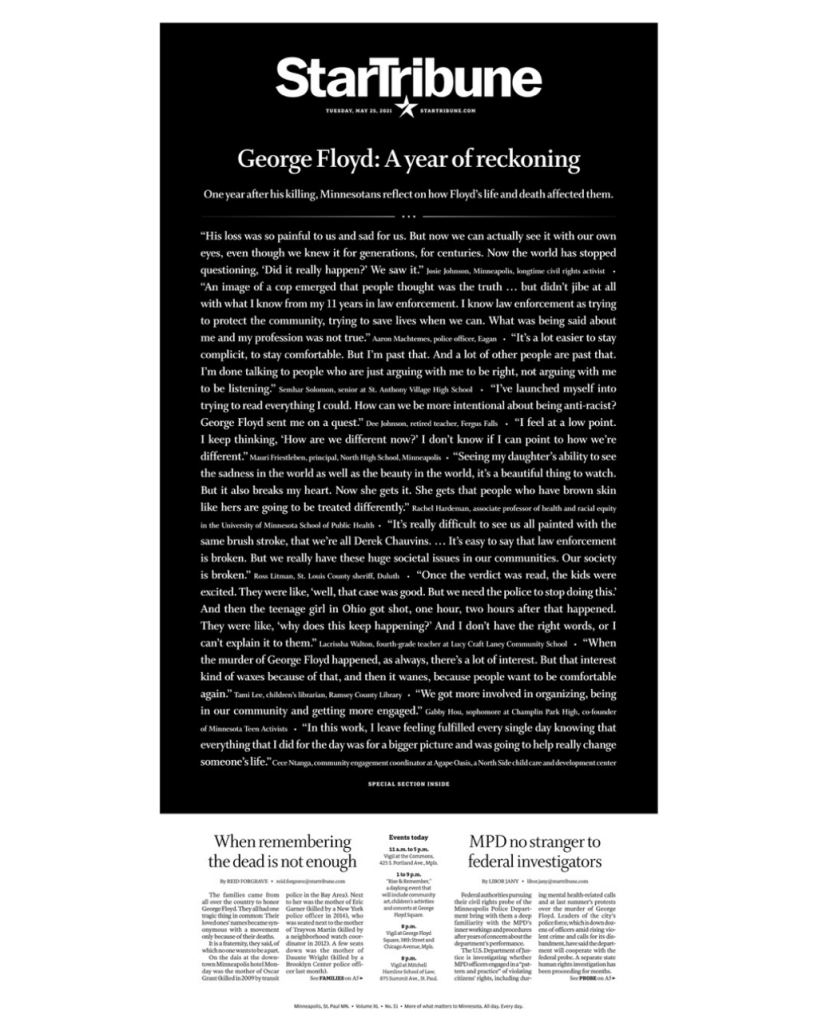
One year after Floyd’s murder, there were two pages that stood out for me, each taking very different approaches to their designs. But both highlight the power newspapers have, and the responsibility they have. And the power of newspaper design. It’s not just the words.
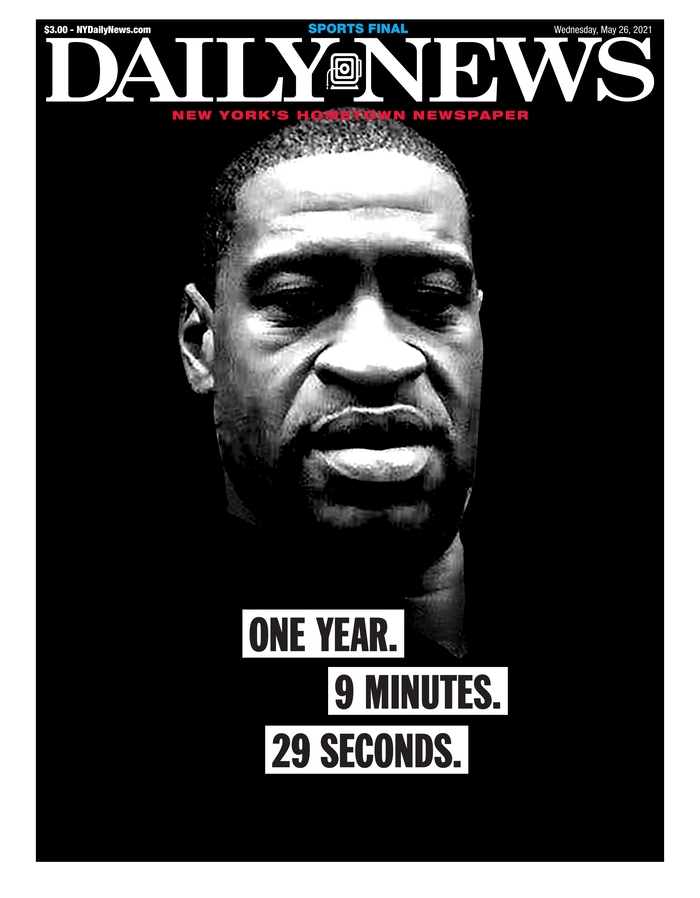
The first page that caught my eye was the New York Daily News. It was striking. A big photo of Floyd. His face instantly recognizable, brightly lit in parts and not in others. Starkly placed on a black background. The white newspaper flag adding contrast. And a great newspaper page almost always has strong words. Or strong words elevate a great page to unforgettable. This one simply says: One year. 9 minutes. 29 seconds. Black text on white on black. Those words are so significant. Anyone familiar with the story will know what it means. Anyone not will be appalled. How the words are played is significant. It was a masterful page. It captured the feeling one year later, and helped keep this story in front of readers.
New York Daily News cover, May 26, 2021
The next page took a very different approach. The similarity was that it was also on a black background. Reverse white text on a black background. But it isn’t a picture of Floyd that makes this page. It’s words. All words. It was a powerful message. When a newspaper makes a decision to run a page without art, the words have to do it all, so they have to be done well. When an issue is so consequential, sometimes words are all there is. The Star Tribune is an exceptional paper. It’s in Minneapolis, where Floyd was killed. While this became a worldwide story, this paper owes it to its community to keep this story front and centre. This page was breathtaking, yet simple. So many words, but that’s why it works. In this instance. In others, it wouldn’t. But it was the right time and the right play and the right words.
Newspapers owe it to readers and to society to run stories like this, to keep these issues, issues like this, like the unmarked graves of Indigenous children in Canada, in the collective conscience. It was in the news again when Derek Chauvin, the police officer who kept his knee on Floyd’s neck, was found guilty of murder. And again when he was sentenced to 22.5 years in prison.
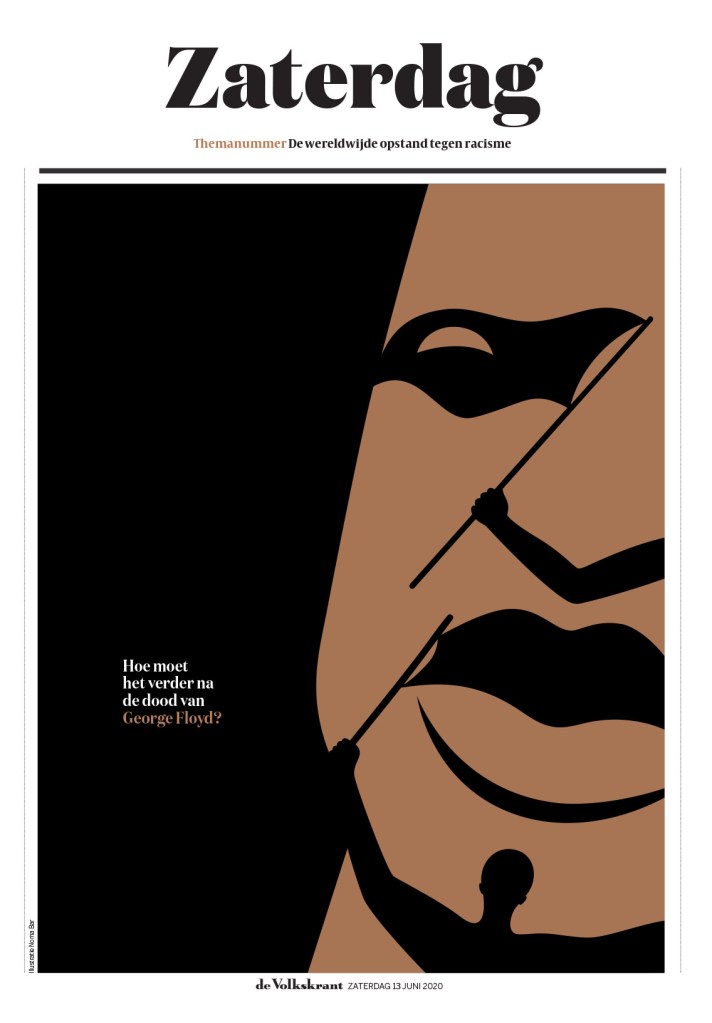
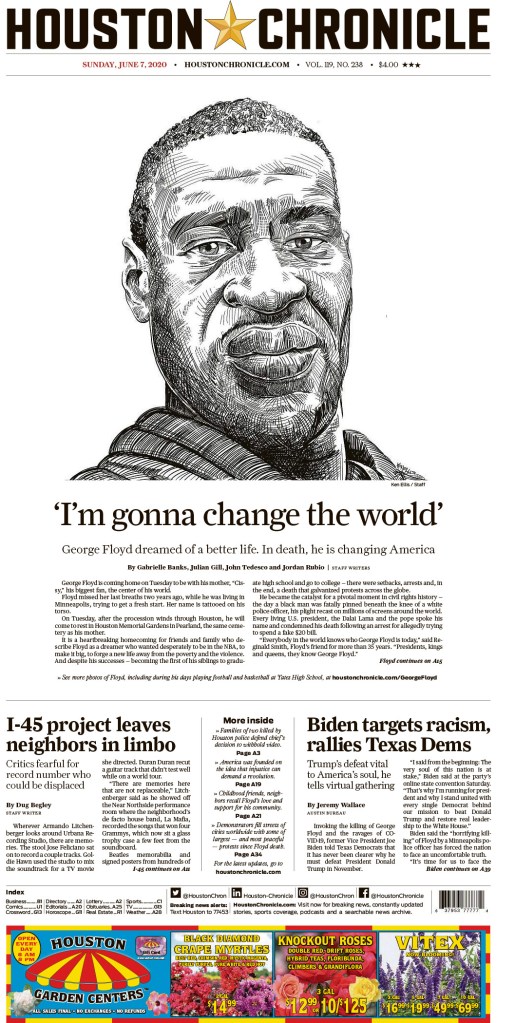
But these pages above, and the ones below (which I’ve shown in previous posts) highlight the power of print design. Three of them show, or somewhat show Floyd’s face, which has become a symbol of the movement and a way to illustrate the story. And newspapers try to present his face in novel ways. As long as newspapers are trying to raise awareness of serious issues through design, I will keep showing them.
Above: de Volkstrant’s stunning and masterful illustration of Floyd’s face, and of the movement it catapulted into the world’s consciousness, and the Houston Chronicle, with a powerful sketch of Floyd.
A newspaper front page can do and say so much. It can capture a key moment in history (man on the moon, the Sept. 11 terror attacks, tragic death tolls). It can celebrate big moments (sporting victories, like Italy’s big Euro 2021 win, or Argentina’s historic Copa America title — a victory for the country and short people everywhere — Google: Lionel Messi height, as it’s the thing most googlers care about after age and money). And it can hold people to account. One of the primary functions of newspapers is to hold people to account. Comfort the afflicted, and afflict the comfortable. These are terms heard in the journalism sphere all the time. And sometimes power doesn’t mean the 1 per cent. Sometimes a city, a country, the world, needs to be reminded. They need to be held to account. Sometimes I need to be held to account. Not just the powerful, but the privileged.
I want to look at two issues from the past few months over two posts. I am looking back because part of the problem can be after a cover comes out, calling out the privileged to act, or at least think, the issue gets a ton of attention and then fades away. Other issues arise. News is happening everywhere, all day, every day. But I want to key in on the design, and how it helped raise awareness.
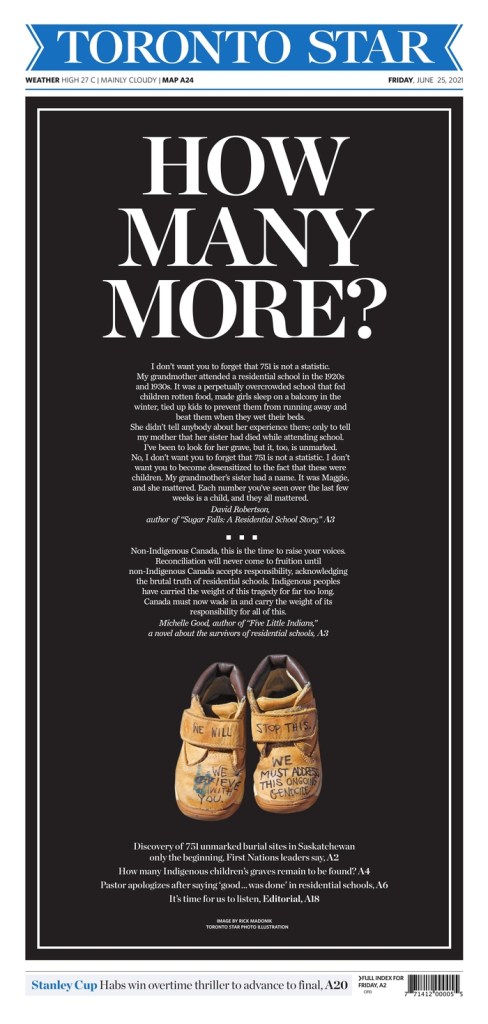
I am looking at the coverage around unmarked graves of Indigenous children being found at residential schools. Another discovery was made in Saskatchewan (after a previous discovery in B.C.) on June 23. On June 24, most Canadian newspapers dropped the ball (I will celebrate, and not critique design here, but I will critique editorial decisions). Postmedia, which has a local paper in Regina, had the story first. An example of why local news matters. Postmedia’s coverage on the first day was strong. The rest were lacking. But the next day, the Star attempted to make amends. The previous day highlights the challenges to newspapers. The story was somewhat late breaking. There wasn’t a ton of information. But, and it’s a big but, the story required more attention than it got. It was the tear-the-front-page-apart kind of story: 751 UNMARKED graves of Indigenous children were found at a former residential school in Saskatchewan. I won’t say hundreds, as every one is important. I highlight unmarked to emphasize the contempt, the lack of humanity, toward the children, the families. Here is what the Star produced the following day, Friday, June 25.
Toronto Star, front page, Friday, June 25. How many more?
This page is powerful for a lot of reasons. First and foremost, the picture of the small shoes. Clearly for a child’s feet. The wording written on them is powerful as well. WE WILL STOP THIS. WE GRIEVE WITH YOU. WE MUST ADDRESS THIS ONGOING GENOCIDE. And the reverse white text on black. The big, all caps headline, with a powerful question: HOW MANY MORE? The start of a story by David Robertson, an Indigenous graphic novelist and writer, and Michelle Good, the author of “Five Little Indians.”
We know there are more. Many, many more. Unmarked graves of Indigenous children who were taken off to residential schools. As a parent I can’t imagine. When my daughter goes to school, she’s safe. That’s just a basic requirement. Safety. I assume she’s learning important lessons. (In Grade 1 and 2 she did learn about residential schools, and I’m grateful for that, as I never did as a child. We’ve been able to talk about it.) But she’s safe. I can’t imagine the trauma, the fear, Indigenous parents must have felt. But I should. I should know. This isn’t ancient history, and even if it was, I need to know. The privileged, who have never worried about these things, need to know. I know this front page is only a piece of paper. But it helped. It brought it to the forefront. And it needs to stay there. Which is why I was glad the Star followed up a little later with this cover, questioning whether Canada’s history is something to celebrate.
Toronto Star, front page, July 1, 2021.
This page was 100 per cent driven by the beautiful and powerful illustration by Chloe Cushman. An amazing, talented illustrator with a knack for evoking emotion with her work.
And credit where credit is due. This was one of the Postmedia pages (the Calgary Sun) the day after the graves were discovered. They had more time, as they knew earlier. But it doesn’t matter. Newspapers need to react. Most didn’t. The ad aside, which unfortunately didn’t reflect the seriousness of the issue, but pays the bills to allow front pages to keep happening, this page was one of the best in Canada the day after. It has a strong image, a big and powerful headline (one-word headlines aren’t uncommon but the right word has an impact).
There are going to be more. Probably a lot more. And despite knowing this, each discovery should feel just as shocking and unsettling as the last. One unmarked grave should elicit intense anger, and spark a call to action. I ask all the white and/or privileged parents in Toronto or Calgary or New York or London: when your kid goes to school, do you expect to see them again? Just think about it. Imagine. #everychildmatters
An observation perhaps not worth noting is that every one of these front pages has a tiny throw to a sports story that might have otherwise been given much bigger play.
This @TorontoStar front page is so powerful. This should have been the lead story in every Canadian paper (and beyond) yesterday. But here is the power of #printmedia at work. Keep it up. This story needs sustained attention. #everychildmatterspic.twitter.com/Fqwd14Er9M
In 1999, I started journalism school at Mount Royal University in Calgary, Alberta. I had big plans. National Geographic photographer. Maybe foreign correspondent in war-torn countries. By the time I graduated in 2001, everything was on track. Except the job. In 2002, I set up a meeting on the other side of the country with a well-known Canadian photographer. Maclean’s, here I come, I thought. My best friend, C.J., and I set off on a road trip. Thousands of kilometres, one week, and a 1991 Chevy Sprint Turbo. Bubbles. And now I ask you to come along. Jump in the way-back machine, imagine yourself in a sky blue Sprint Turbo (the Turbo is worth mentioning every time. Every. Time. Just ask C.J.’s brother), and join me on my cross-country, 20-year journalism lookback journey. I don’t like to celebrate myself often, but I also don’t leave my profession often. After this, I will return to regularly scheduled broadcasting in this blog by focusing on designers still in the biz, and those who are lightyears more talented than I am. I peaked in 2010 (there might have been a higher peak, but the journalism world was having none of it, as it started to contract around this time).
Anyway. Bubbles. The journey began in Calgary. A couple of provinces in between, mostly fine, and then Ontario. Many routine police stops later (driving late at night with Alberta plates in Ontario) and almost no time to sleep, 36 hours later in total, we made it. I had my meeting. I brought my best stuff. I was proud. The verdict? Some potential. He loved the photos later in my portfolio, and said about the one for which I nearly had my head run over by race horses: “you were just there.” Yes, I was. And it was a damn fine photo (if I ever find my pre-digital portfolio, I will add the pic here). Alas, maybe photography wasn’t my path.
Enter Fort McMurray. The daily newspaper, the Today, offered me a job as an editor/designer. I moved up there (on a map, as the Friendly Giant would say, look up, look waaaaay up). It was there, as I have mentioned a few times in this blog, that I discovered the Society for News Design’s Best of Newspaper Design books. And I found my new love. Newspaper design (in case the book title didn’t get you there).
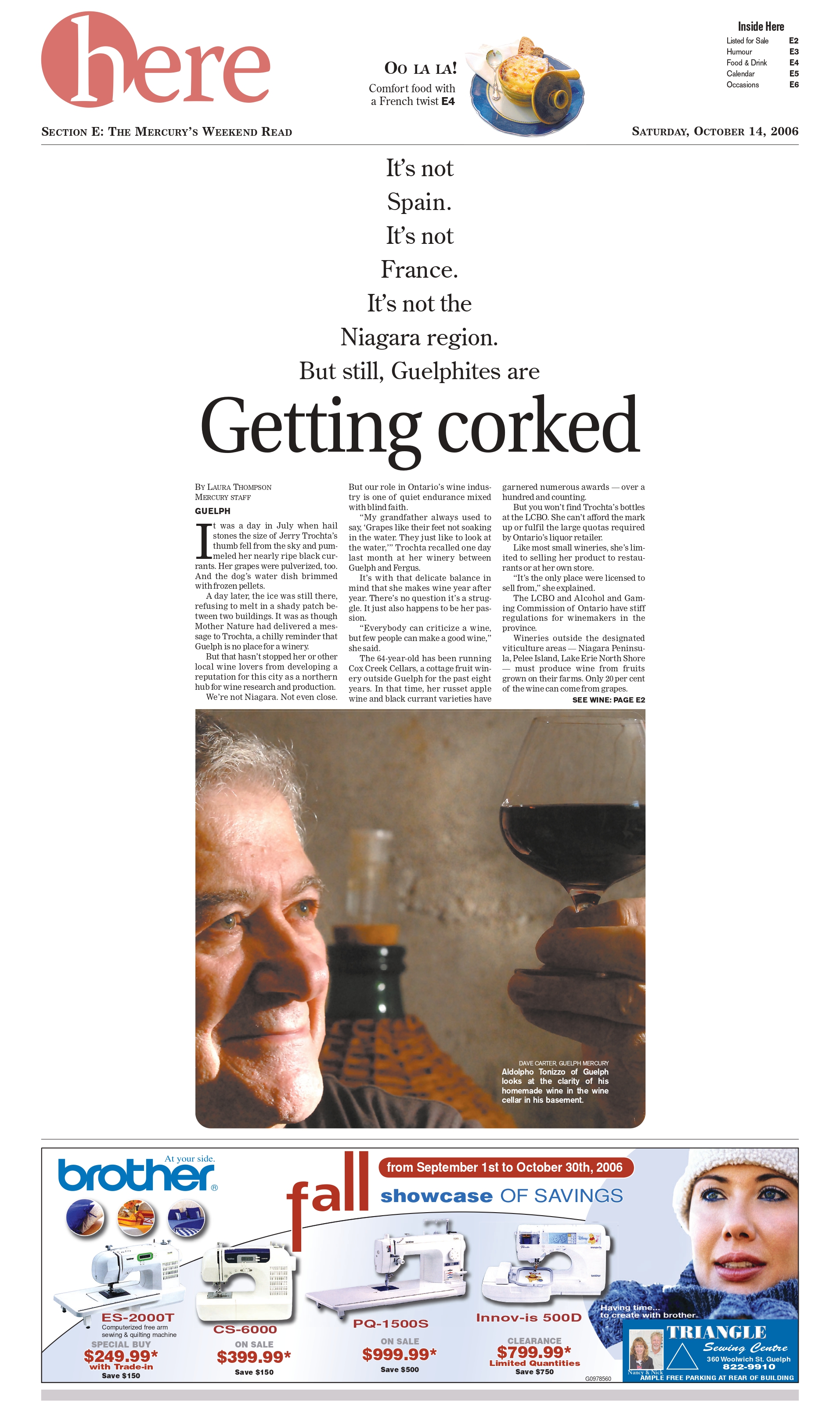
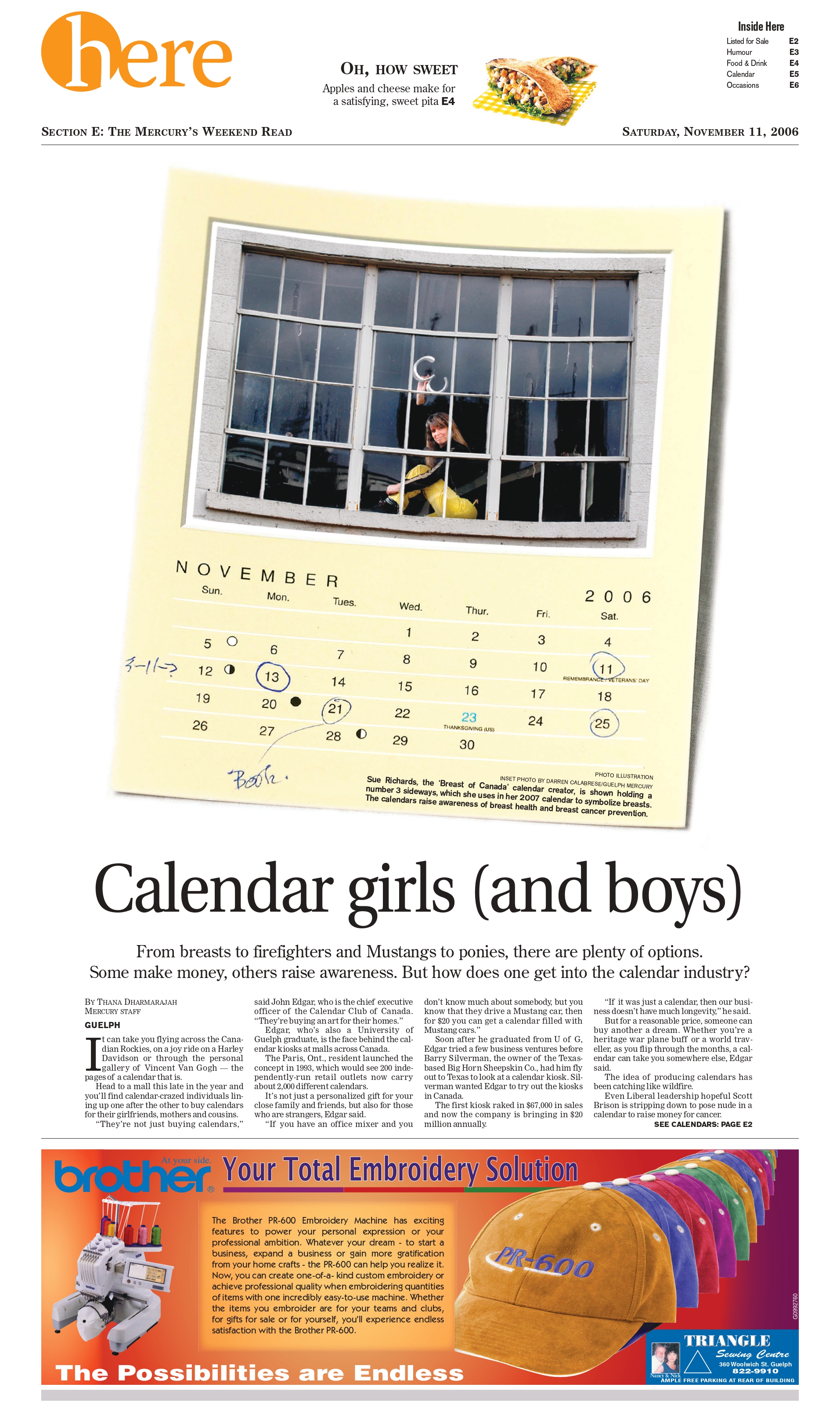
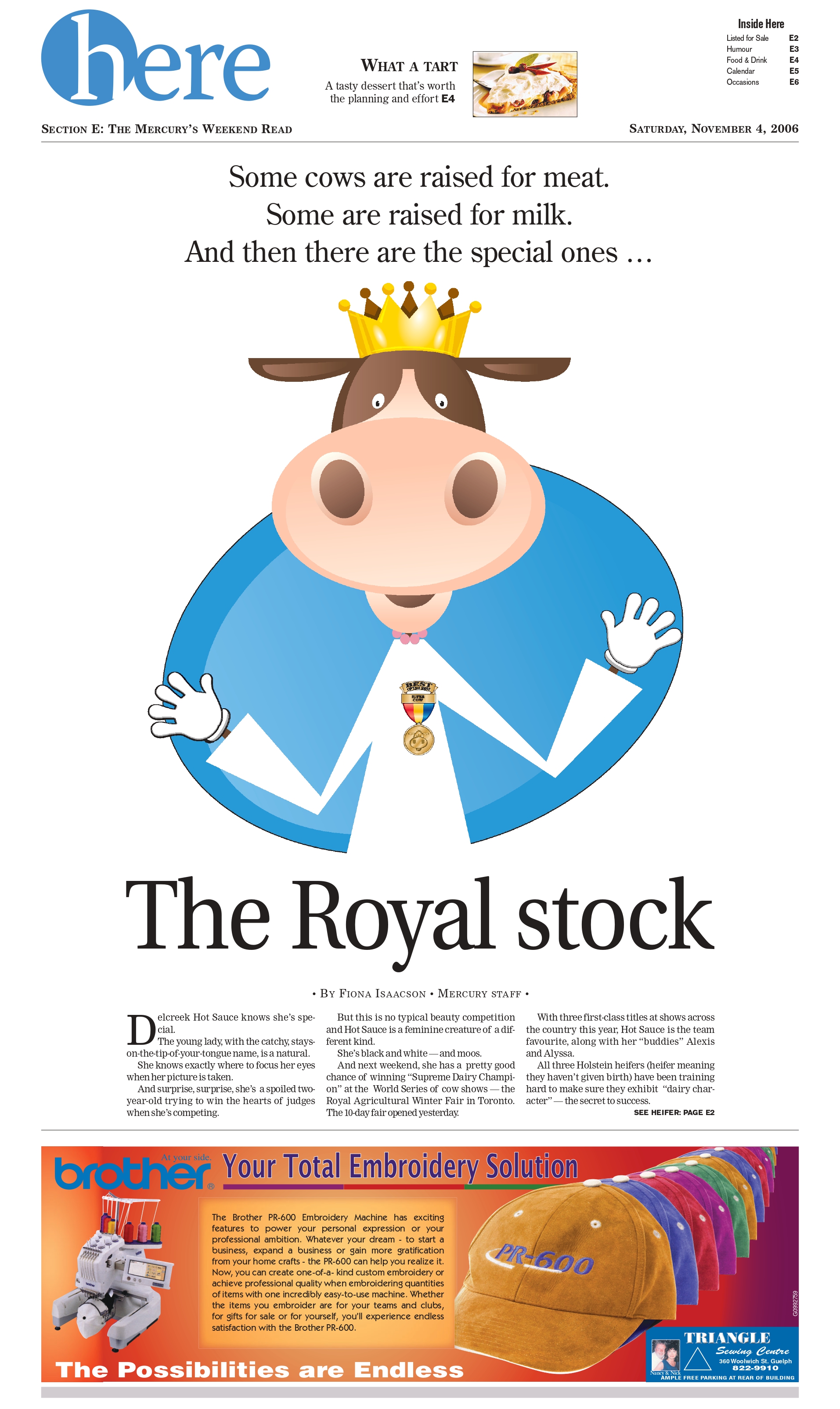
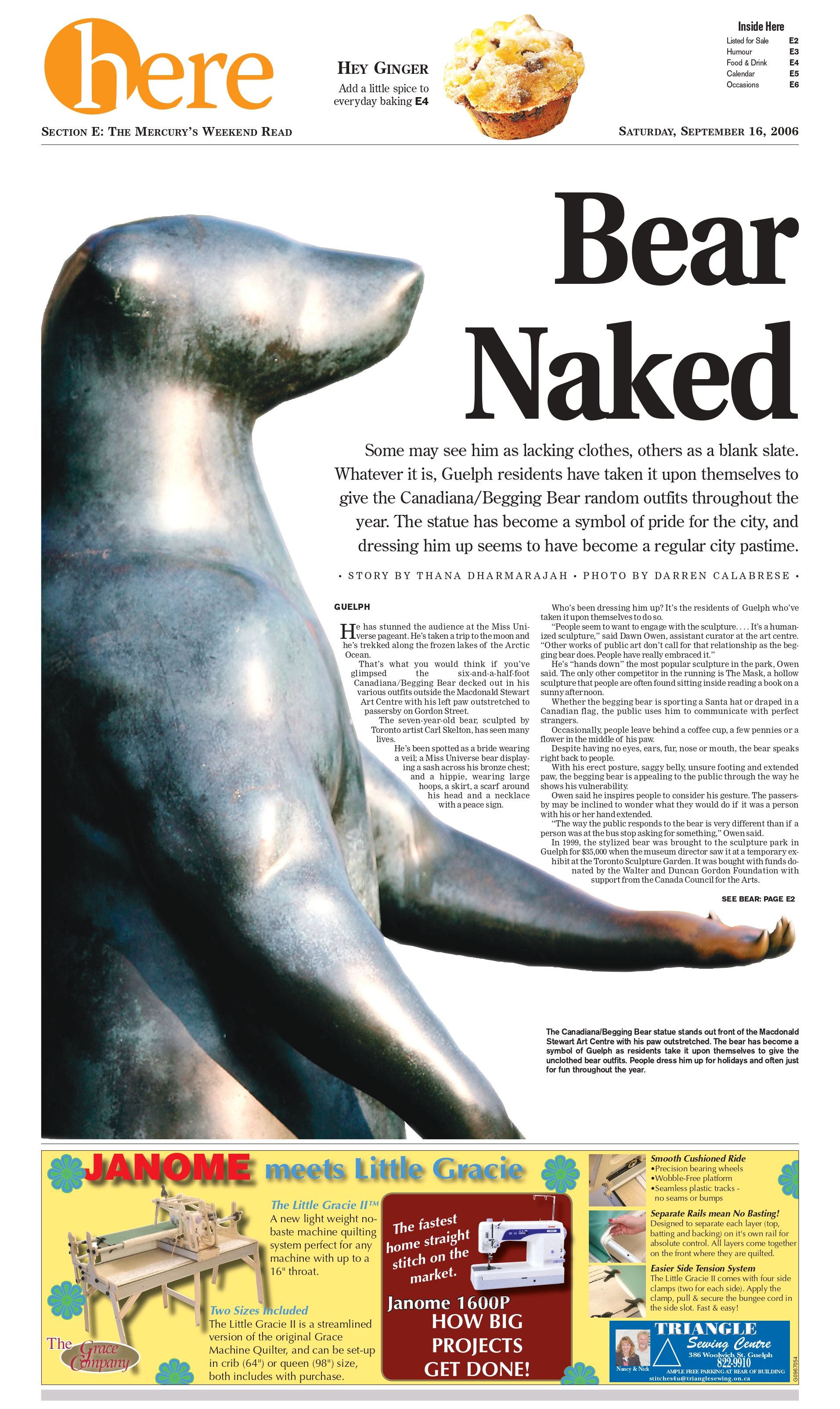
But the city was small (and cold) and the bugs were so, so big (when hot). So I went to test my writing chops in Red Deer, Alberta at the Advocate. Less than a year later, I was off to the promised land: Ontario. First at the Woodstock Sentinel-Review, then to the Barrie Examiner (RIP), then to the paper that firmed up my love for design (because someone told me I was good at it. Spoiler: it was SND), the Guelph Mercury (RIP). I was proud of some of my work in Woodstock and Barrie. Even Fort McMurray. Looking back, pre-Barrie work wasn’t as good as I thought it was at the time. But the Mercury made me. I was given so much freedom and time by my mentor and boss, the legendary Phil Andrews. I oversaw the Here section, a weekend features section all about Guelph. It was for this section that I won my first Society for News Design award, and still the one I’m most proud of as it was for a portfolio of work.
Those are three pages I think were part of my portfolio. I know “Getting corked” was, as it was the one in the book! I made the book (sitting in my soon-to-be-former office, so no pics available). The book that started me down this path. It was a dream come true. I even was fortunate enough to attend SND Boston where I picked up this fashionable … tote bag.
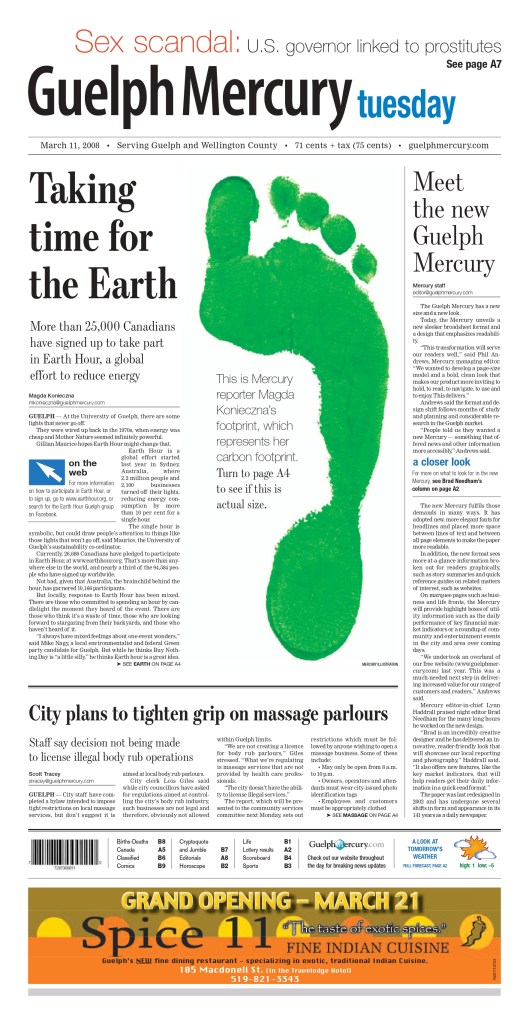
I then had the good fortune (with my newfound design street cred) to be asked to redesign the Mercury, from top to bottom. This was no refresh. I was even tasked with redesigning the flag. That is quite an honour. And scary as hell. Thanks to the Virginian-Pilot (at the time the best designed paper in North America, maybe the world, imho) and the Star-Tribune for the inspiration. Especially to the kind soul at the Pilot who sent me a box full of print copies to help me get further inspired. I was very pleased when the first issue went out (below) and almost all the feedback was positive. That’s almost unheard of! People hate change. But they appeared to like this. To this day, this is one of my proudest career accomplishments.
First day of the new Mercury.
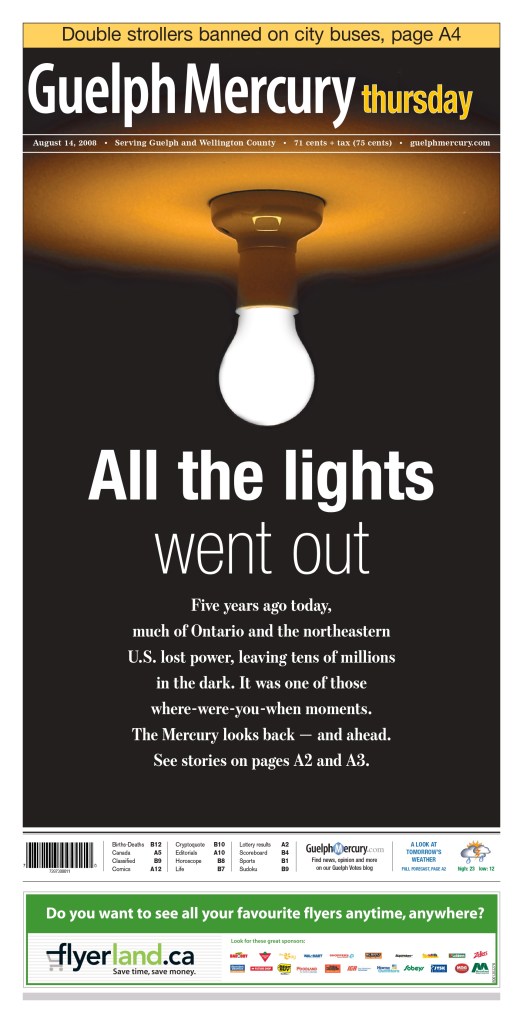
Two years after my first SND award, I won again, this time for a front page that I was given full freedom on, the fifth anniversary of the major blackout that swept through Ontario and much of the northeastern U.S. When I designed it, my boss said he looked forward to seeing that page in the next SND book. And much to my surprise, he was right.
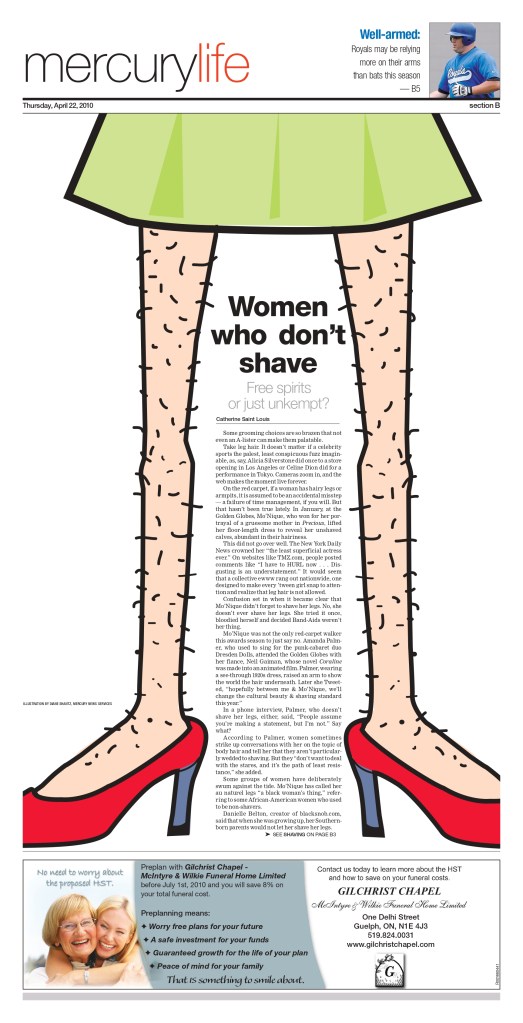
Shortly thereafter, I moved on to the Waterloo Region Record. And shortly thereafter after, so did production of the Mercury. It was a sign of things to come in the industry (and this blog post). But I continued to work on the Mercury from the Record. At the Record I continued designing, but also moved into a very basic art director-type role. I had a vision, drew it poorly on a small yellow sticky note and handed it off to one of the Record’s great designers, Tania Praeg-Geddes and Diane Shantz. And wouldn’t you know it. Two years after “All the lights went out,” with the help of the great Diane, we did it again. We earned the Mercury its fourth SND award in five years (it won another for a page produced by again soon-to-be-former colleague, now at The Canadian Press then at the Mercury, Kate Hopwood). This time the page likely won mostly for Diane’s brilliant illustration. It was much better than the hairy legs I drew on my sticky note. 🙂
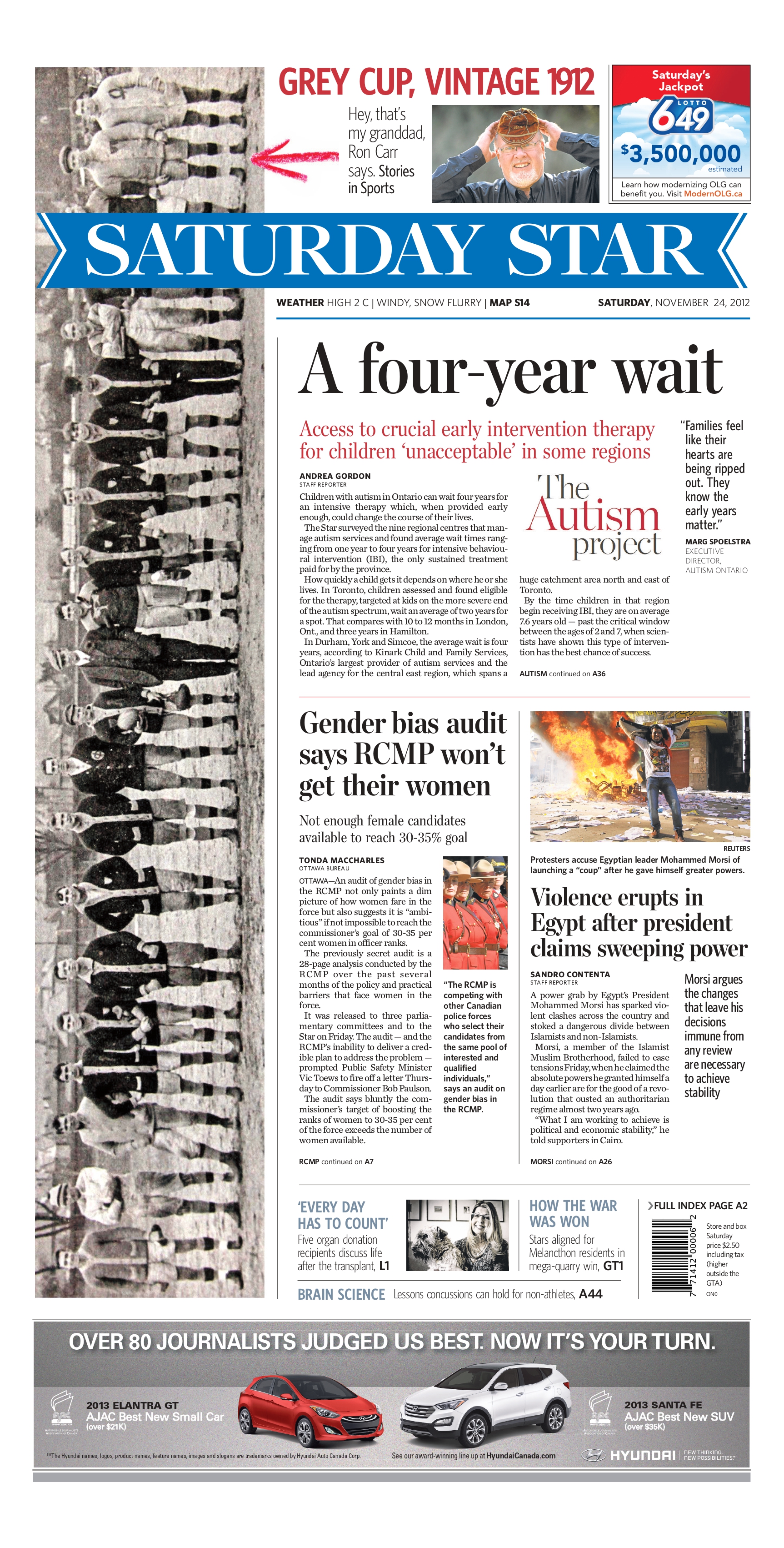
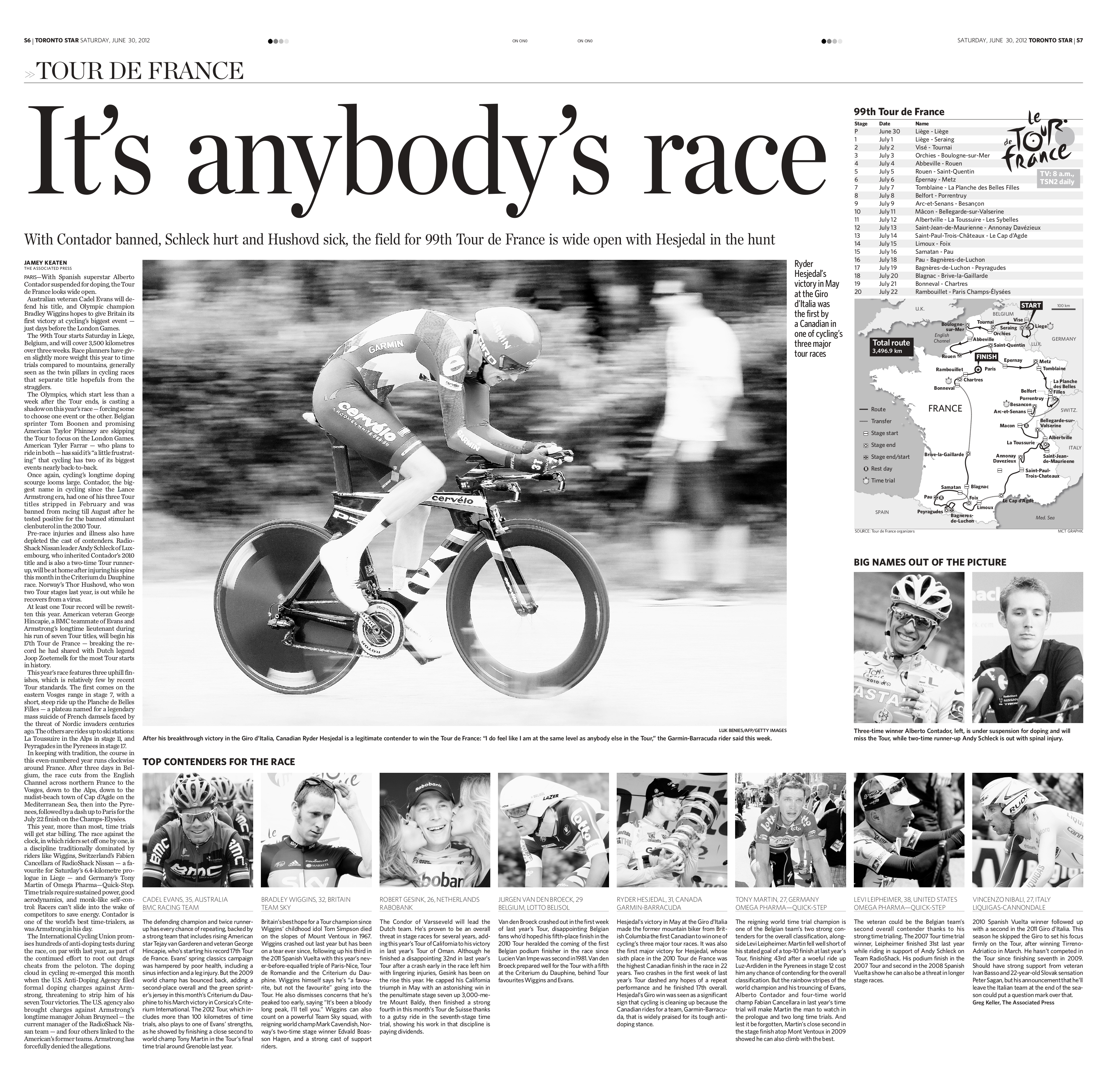
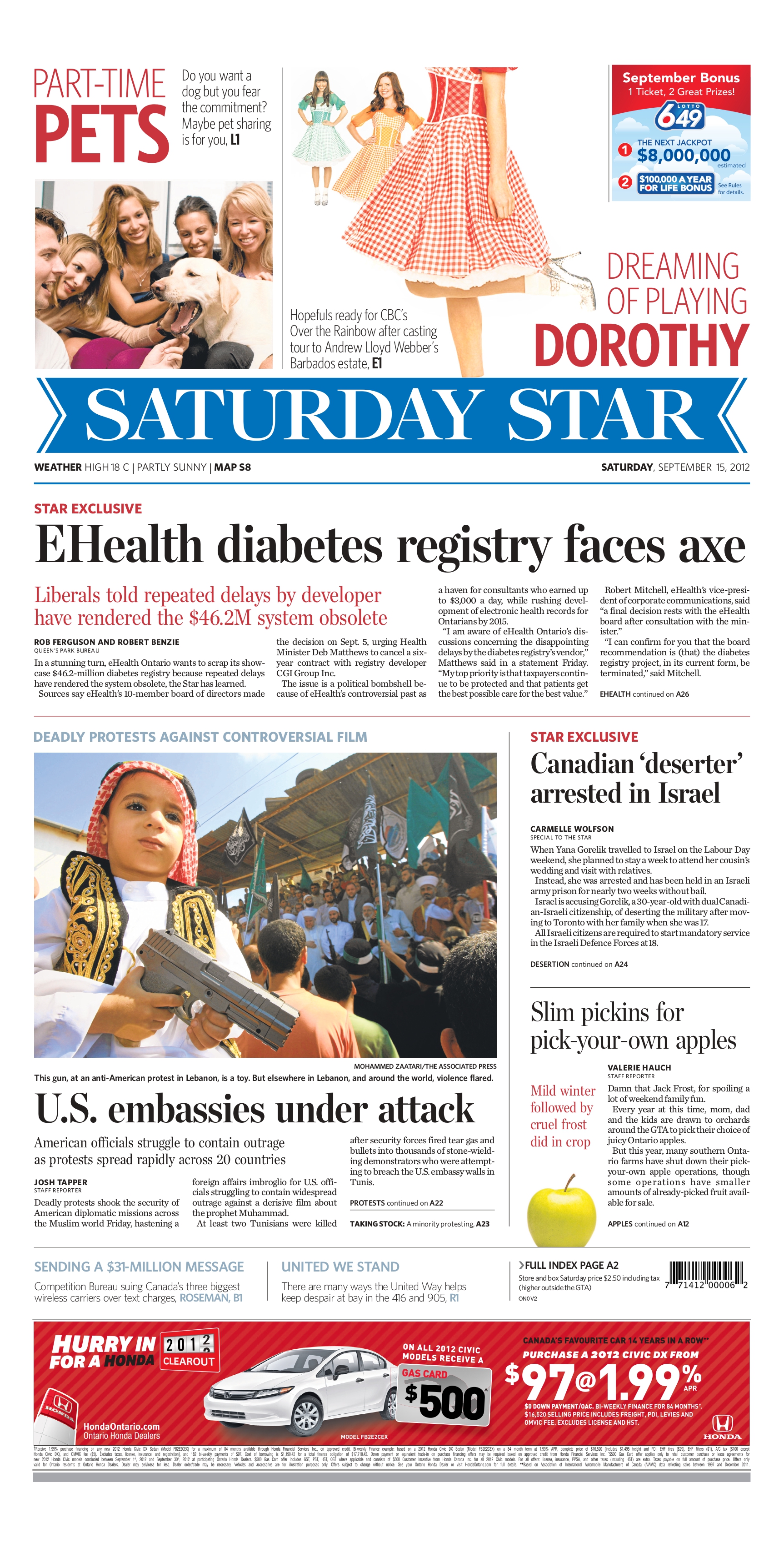
Then came the email from the Toronto Star. They had an opening. I answered the call. I did some work I was proud of at the Star, but my heavy design days were over. Sitting at another bank of desks was a team of designers, whose entire job was to design covers. But I am happy to say I got to do some front pages for what is or was (depending on who you talk to) Canada’s largest daily circulation newspaper. The one on the right below isn’t a super fancy design, but it was my first A1 at the Star. So it’s special to me. I loved my time at the Star. But, as previously mentioned, the industry was contracting.
I was laid off and I moved to Pagemasters North America. It was eight glorious but mostly design-less years as a manager, overseeing a team of incredible editors, helping them grow and develop. So I still had a hand in others’ designs. Even super designer Tammy Hoy occasionally asked for my advice. Five of those years were spent overseeing the Star after they outsourced to Pagemasters North America (see, the Mercury was a sign of things to come in the industry and this post).
And now I depart marking what is likely the end of my journalism journey, at least as an active participant. For now. Anything is possible, but I am excited for what lies ahead. I know I have been so fortunate in this industry. Or as some would say, unfortunate. I made it 20 years. I lived through some not as lean times. I was blessed with opportunities and support. The Mercury was an incubator. It launched many to greatness. As I start looking back, I look ahead. I hope to be able to blog more, and showcase print design talent from around the world, from those who are sticking it out in this industry and doing outstanding work. I will do it here, and hopefully even more often as I will need my print design fix, and on my Instagram. Until then, a journalism cliche …



















 Covers in a dangerous time