From really northwest to regular northwest America, this newspaper designer is making the most of her opportunity at newspaper that loves its design

By Brad Needham

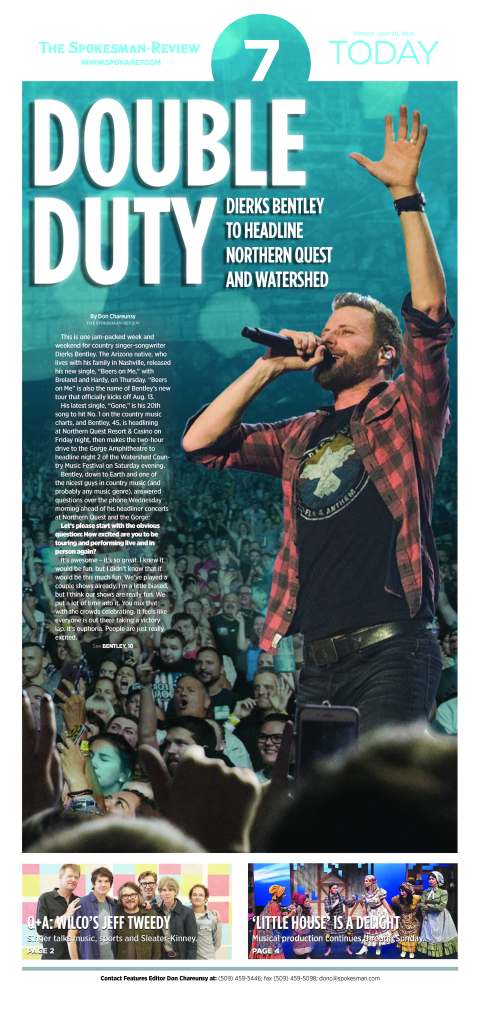
One of the things that frustrates me about trying to promote newspaper design is that it is often so hard to find out who is responsible for all the amazing designs I see. I would love to shoutout all the amazing talent behind the stellar newspaper front pages from around the world. But I can’t just turn to the masthead or page 2 and see, Cover Design by … as one might in a magazine. That’s why I was tickled when I posted a Spokesman-Review arts cover on my Instagram account and I got a response from the paper. They told me they would pass my message onto their designer (including the comment about wondering if the reverse text was readable in print). And then Caitlin Miller, the designer in question, contacted me on Twitter to tell me, yes, indeed, the text was perfectly legible!

The page just popped for me. The contrast. The big display. Smokey Robinson‘s eyes and the joy in his face, which is especially notable in a never-ending pandemic.

I have long been a fan of the Spokesman-Review’s design, particularly their front page. I think it’s one of the consistently best designed newspapers around. They give it their all and achieve solid, and sometimes outstanding, results. I hope I have the good fortune of talking to an A1 (1A?) designer one day (nudge, nudge!). Side note: I love that the Spokesman-Review posts, every day, its front page, other section fronts and historical pages on its website (link to Sept. 23 front page). The more we can celebrate print the better, and they have a lot to celebrate.

Being such a fan, naturally I asked Caitlin if she’d be willing to talk to me. And she said yes! While she’s not been in the industry long, she’s making a splash. And unlike most U.S. designers, her career started further north than this high-kilometre Canadian has ever lived or worked (and I lived/worked in Fort McMurray and Fairview, both Alberta, as well as Prince George and Fort St. James, B.C., which are pretty far north).

Caitlin talks about her growth as a designer. And she talks about working within the framework of your newspaper. Some papers, like the Spokesman-Review, really pride themselves on design. Other papers, particularly in the present print media climate or smaller papers, don’t go big on design every day. Caitlin now gets to work with a team that loves design, one that submits a pile of pages to the Society for News Design‘s design competition every year. And I bet that passion for design is contagious!

Here is our chat. I have sprinkled a few more of her eye-catching Spokesman-Review designs throughout the questions, and end with some pages from her pre-Spokane days in Alaska.

It’s a never-ending learning experience, and I love that.

Caitlin Miller on working in journalism

How did you get into newspaper design?
I fell into it. What got me into print news was a semester working at The Sun Star as the managing editor at the University of Alaska Fairbanks. Certainly, no design experience! My job in that position was strictly editing and guiding writers (albeit at writers’ own discretion of accepting my edits, but that’s working at a college paper for you).

I kept my eye on the local paper as a possible job prospect in Fairbanks for a while. After I graduated, I was working at a hotel and would read the paper daily, including checking classifieds. Finally, a copyeditor position opened. I knew the former editor-in-chief of The Sun Star was working as an editorial assistant at The Daily News-Miner and hit her up. Funnily enough she had deleted my number from her contacts, but when she figured out it was me, she was supportive of my interest and put a good word in. I applied the next day, and a month later I was hired. I learned newspaper design on the job and taught myself a lot of what I now know, but I knew I couldn’t grow staying in Alaska, which is how I found myself at The Spokesman-Review. It’s a never-ending learning experience, and I love that.

However, I knew that I always wanted to work in newsprint. It’s a bit of a family legacy, with my grandfather and his father working in it, respectively in different aspects.

What do you like about newspaper design? And what makes it different?
First, I like that I’m using both sides of my B.A. I hold a degree in English and art and being able to interact with both design and words is satisfying to say the least.

(A writing mentor) opened my eyes to the beauty of page layout; she gave me a reader’s perspective.

I was meeting with a writing mentor at a coffee shop one day, and as we were catching up, she had asked me where I was working, and I answered that I was at the paper and explained my job. We found ourselves in conversation about the benefits of a physical copy (versus web) reading of a newspaper. She opened my eyes to the beauty of page layout; she gave me a reader’s perspective, a perspective I’ve never interacted with before as a designer despite my own reading of papers. But things always look differently from another’s eyes, don’t they? Through her gaze, we discussed the way readers interact with stories, how a jump from the front page to an inside page, or a refer/tease, could bring a reader to stories they wouldn’t have likely known about otherwise. Not everyone thumbs through all the pages of the paper. How many of us non-sports people don’t give sports a single glance? Or maybe a parent only bought the paper to keep record of a story on the front page related to their child. Suddenly, that parent finds himself or herself on Page A5 reading about a column on a local event involving a nonprofit that seeks to benefit cancer awareness.

What was the most fun you have had with a design?
My favourite pages are those with the most agency. In a way, this applies here, also. Those pages that I’m given a feature story or column with lots of art, I like being able to take the lead and do what I see fit with it. I like that editors who give me the content trust my judgment. They also know I’m not afraid to ask questions, so communication between us is so very important, including sending page proofs for them to see and affirm or correct where needed. Pages where I am given lots to work with, and pages with breaking news also are fun to work with. I’m really thankful for templates however, because sometime a page just needs that basic layout and nothing more, and that’s cool.

I hope I can, with the pages I provided, express the “most fun” I’ve had with design. It’s hard to explain otherwise, and these include my favourite pages as well.

Do you rely on one design principle more than others (white space, text as design, colour, cutouts, etc.)?
I do a lot of cutouts. Always have. But, gosh, do they take time. It can really depend on the page I’m working on. Feature-y pages will likely have cutouts whereas hard news pages will likely not, at least from me thus far. Colour does play a role, oddly. Sometimes I look at a page after I’ve completed it and go, “Wow! How did this work out!”—and it turns out that all the photos visually correlate by complete happenstance. I tend to avoid lots of white space, however. But at The S-R, I’m learning the benefits of it. We use it far more than I’m used to, whereas before, I was very adamant on squaring everything off and making sure everything fits tightly on a page.
Tell me about a design you loved that was rejected.
I don’t think I can answer this exactly how you want it answered, simply because it isn’t about something being rejected. I don’t think I’ve had an entire page design rejected before; however, I have had aspects of designs criticized and rejected. It isn’t a good feeling. But talking through it and learning from it is important. Maybe it’s something the design editors were avoiding you didn’t know about. Great. Now you know not to do that ever again. Or maybe it’s a learning experience between you and the more experienced designer who suggests the text be more horizontal in nature and less vertical. Awesome. Now you can take that experience and apply it to future designs that might have similar elements that could benefit from it.

It still feels crummy sometimes having your work criticized. But it’s worth it.

It still feels crummy sometimes having your work criticized. But it’s worth it. The team effort is important, and you can learn a lot from working with others and seeing design through your critics’ eyes.

Are there any designers or publications other than those you have worked at that you are sure to look at?
If I’m in a new city or town, or visiting family, I’m sure to pick up the local paper. It’s hard not to look at design now wherever I go. This includes magazine covers — it’s interesting the crossover between the two, like siblings of sorts. But I look at both general design, and what stories they put where, such as what the designer of that paper chose (or perhaps editors — this really depends on the size of the paper!) for the lead, down the rail, centrepiece, down page, etc. It can say a lot for what the town sees as important, and a lot of time localization is prioritized over national wire stories.

It might be like picking favourite family members, but if you had to pick a few favourite pages, what would they be and why?
I’ll address my career thus far. I’ve noticed with The Daily News-Miner my favourite covers are the ones where I have the most agency. And perhaps the same can be said with The Spokesman-Review. While at the News-Miner, I have a handful of pages I love.

The News-Miner doesn’t like much for creativity, per se, but the Our Town page, a localized feature page that ran weekly, allowed me to kind of do what I want within means. And I loved it. I had a good knack of what was allowed on A1, but Our Town meant I could explore making cutouts, changing fonts, applying gradients. Many of these pages had strong interaction with local audiences who were regular followers of the editor of that page. And, I have to say, there is such satisfaction in knowing how well I did when that editor comes to and tells me the impact I made. I’ve also seen cutouts of various stories from various pages I’ve constructed framed, and that’s a whole other feeling on its own. At the DNM there are other front pages I love for other reasons, ones I’d include in a portfolio, but they certainly don’t hold an impact like the one’s that have made a personal connection with me emotionally. Maybe the emotionality of it sounds biased, but it really can help a person grow as a designer to know what they’re doing is good in some way or another.

As far as my work at The Spokesman goes, I haven’t quite hit that emotional satisfaction yet, but being at a much larger paper might have much to do with that. However, working with the Seven cover at the Spokesman (weekly entertainment feature section) really allows me to explore my skills as a designer, and there is much satisfaction in that. I really can’t wait to see where this takes me.

Tell me a little about your process. How do you come up with ideas?
There isn’t much to say about this. Either I have a good idea of where I’m going with something or I don’t. A lot of times I can look at the content and know exactly what is going where, but I think experience has a role in this. And other times I might spend three hours just trying to figure out and experiment with where I’m going to take a page. I may even sometimes have multiple ideas in my head. It’s interesting, working at The Spokesman is such a different experience coming from a small paper. Before, a lot of decision making was solely up to me, regarding what stories go where and what art should appear where. At The Spokesman there’s an editor for everything, including photo placement.

The Spokesman Review has some exceptional designs. How much pressure is there to continually produce great work? Do you swing for the fences every day?
The Spokesman staff is so supportive. However, while I’m fairly confident in my abilities, I certainly feel a lot of pressure! I took over the design of the Seven cover after a couple of months being with the company. Prior to that our A1 designer was doing the cover and he certainly has far more experience than I have. Chris Soprych is helpful in many ways. There are days where I just don’t have a clue what do with the art I get. Frankly, sometimes it just isn’t good enough to work with to produce an eye-catching cover. But then he shows me how he’d approach it and from that I’m able to learn different approaches. I’m thankful, and this experience is a huge part of why I wanted to join The Spokesman-Review.
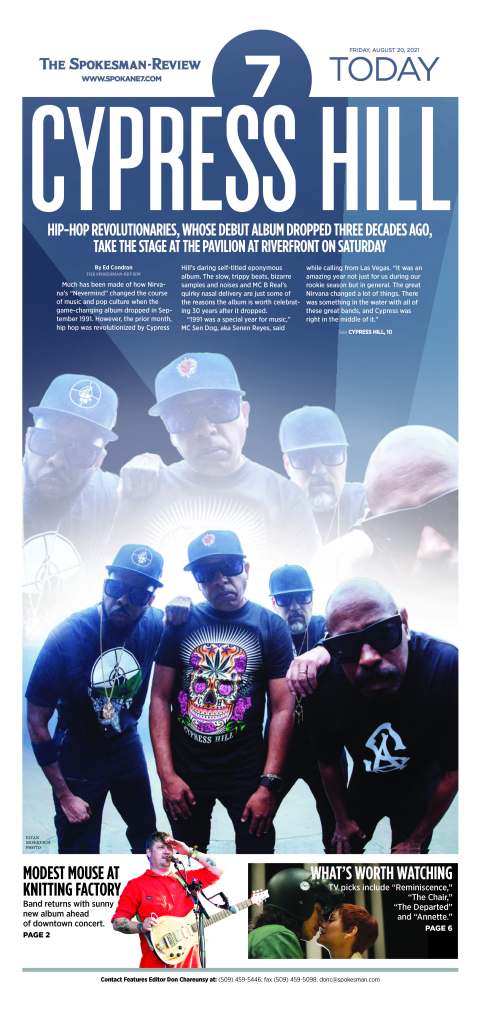
Certainly, communication is important and helps relieve some stress. I’m not the only one who looks at the page or cover. And others’ suggestions can certainly make or break a page in its success. Constructive criticism is always important. And I really enjoy that so many people are involved with the process and looking at the final proof. I’m also coming from a paper prior to The S-R where I was the only set of eyes on pretty much everything, so it’s all been both a learning experience and a huge relief.

For the young and aspiring designers, remember we do this because we love this.

Do you have words for wisdom for young, aspiring designers?
For the young and aspiring designers, remember we do this because we love this. Remember that behind the scenes we still make a difference and affect a reader’s interaction with the paper as whole. We’re not in this for the pay. We’re in it because we love what we do, and we love journalism. But also, for those who may feel stuck at a job that you feel no mobility in, don’t be afraid to extend yourself beyond what’s familiar and apply all over. Call. Talk to editors and tell them you want the job. It may seem old school, but working in newsprint is, believe it or not, still old school. Basically, don’t be afraid to chase your dreams, bug people and be adventurous!

Fave designs

Below is a selection of Caitlin’s favourite designs. She explains what made each of them special. We’ve seen the Spokesman-Review pages. That’s where she is now. This is where she began. “I really feel like the Seven covers for The Spokesman-Review show my potential as a designer in contrast to what I was more so limited to designing at my former job.”

My one issue with this page is the text wrap around the columnist’s mug has a weird break that I didn’t catch until months after when I was going through my portfolio and applying to other papers. Jorgy Jorgensen played a huge part in the Alaska community and touched a lot of people’s hearts. This page brought many people joy and the columnist received many thanks from the community for making it happen. It’s really special to be a part of the community in this way, even being behind the scenes. 

This cover page was the moment I realized the power journalism has in a community and how a page designer can contribute to making an impact.

This cover page was the moment I realized the power journalism has in a community and how a page designer can contribute to making an impact. It was also the moment when I knew I found the right career for me. There was a lot of excitement that led up to this page: it was the weekend and unplanned; our 12-page paper needed to be expanded into a 16-page paper, ads had to be moved, everything that was supposed to go on the front page got moved inside. At the time the governor of Alaska had vetoed the state budget, an action that would in turn affect all parts of the state and everyone of all ages. Many were upset by this — Alaska had been facing years of budget cuts already. I knew when I sent that cover I did something. And sure enough, I woke up the next day and discovered that at a protest, Fairbanks residents who didn’t have posters or signs to hold, used our Override editorial front page.


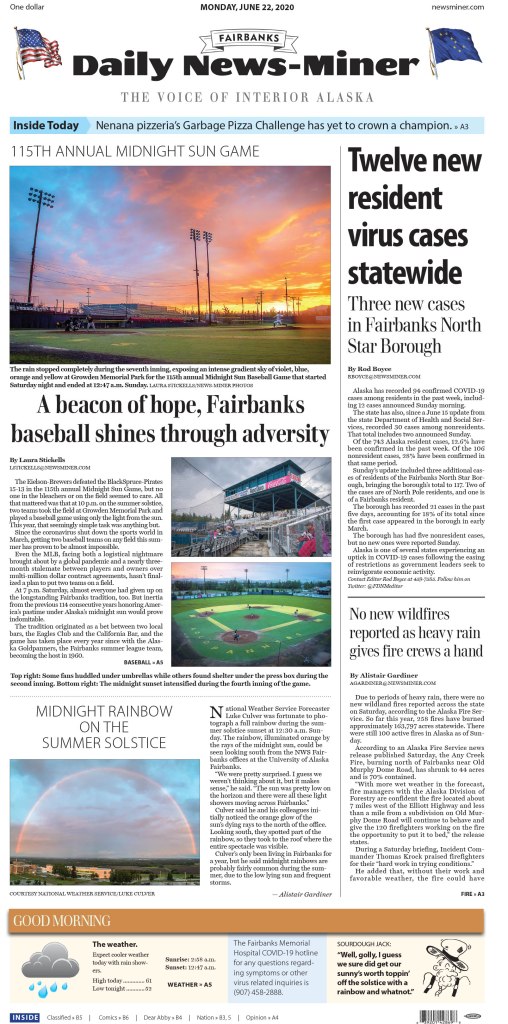
I feel like these pages really captured how the COVID-19 pandemic affected people (pages above and below). We weren’t expecting there to be a Midnight Sun Game that summer. The team that usually hosts the annual tradition cancelled the game due to the pandemic, but a couple of teams from the area came together to make sure it still happened. It was really a “beacon of hope” for a lot of people in a time when so many traditions were cancelled. I think Laura Stickell’s story shows the importance of community and how coming together plays a large part in human morale. It was our sports writer’s last day with the News-Miner and she sure went out with a bang. Great story, great photos.
Want to be featured?

I am always looking for newspaper designers to talk to, whether you’re at a college paper or the Washington Post. Reach out to me through the comments or at bradneedham@gmail.com.
By Brad Needham

In 1999, I started journalism school at Mount Royal University in Calgary, Alberta. I had big plans. National Geographic photographer. Maybe foreign correspondent in war-torn countries. By the time I graduated in 2001, everything was on track. Except the job. In 2002, I set up a meeting on the other side of the country with a well-known Canadian photographer. Maclean’s, here I come, I thought. My best friend, C.J., and I set off on a road trip. Thousands of kilometres, one week, and a 1991 Chevy Sprint Turbo. Bubbles. And now I ask you to come along. Jump in the way-back machine, imagine yourself in a sky blue Sprint Turbo (the Turbo is worth mentioning every time. Every. Time. Just ask C.J.’s brother), and join me on my cross-country, 20-year journalism lookback journey. I don’t like to celebrate myself often, but I also don’t leave my profession often. After this, I will return to regularly scheduled broadcasting in this blog by focusing on designers still in the biz, and those who are lightyears more talented than I am. I peaked in 2010 (there might have been a higher peak, but the journalism world was having none of it, as it started to contract around this time).

Anyway. Bubbles. The journey began in Calgary. A couple of provinces in between, mostly fine, and then Ontario. Many routine police stops later (driving late at night with Alberta plates in Ontario) and almost no time to sleep, 36 hours later in total, we made it. I had my meeting. I brought my best stuff. I was proud. The verdict? Some potential. He loved the photos later in my portfolio, and said about the one for which I nearly had my head run over by race horses: “you were just there.” Yes, I was. And it was a damn fine photo (if I ever find my pre-digital portfolio, I will add the pic here). Alas, maybe photography wasn’t my path.

Enter Fort McMurray. The daily newspaper, the Today, offered me a job as an editor/designer. I moved up there (on a map, as the Friendly Giant would say, look up, look waaaaay up). It was there, as I have mentioned a few times in this blog, that I discovered the Society for News Design’s Best of Newspaper Design books. And I found my new love. Newspaper design (in case the book title didn’t get you there).

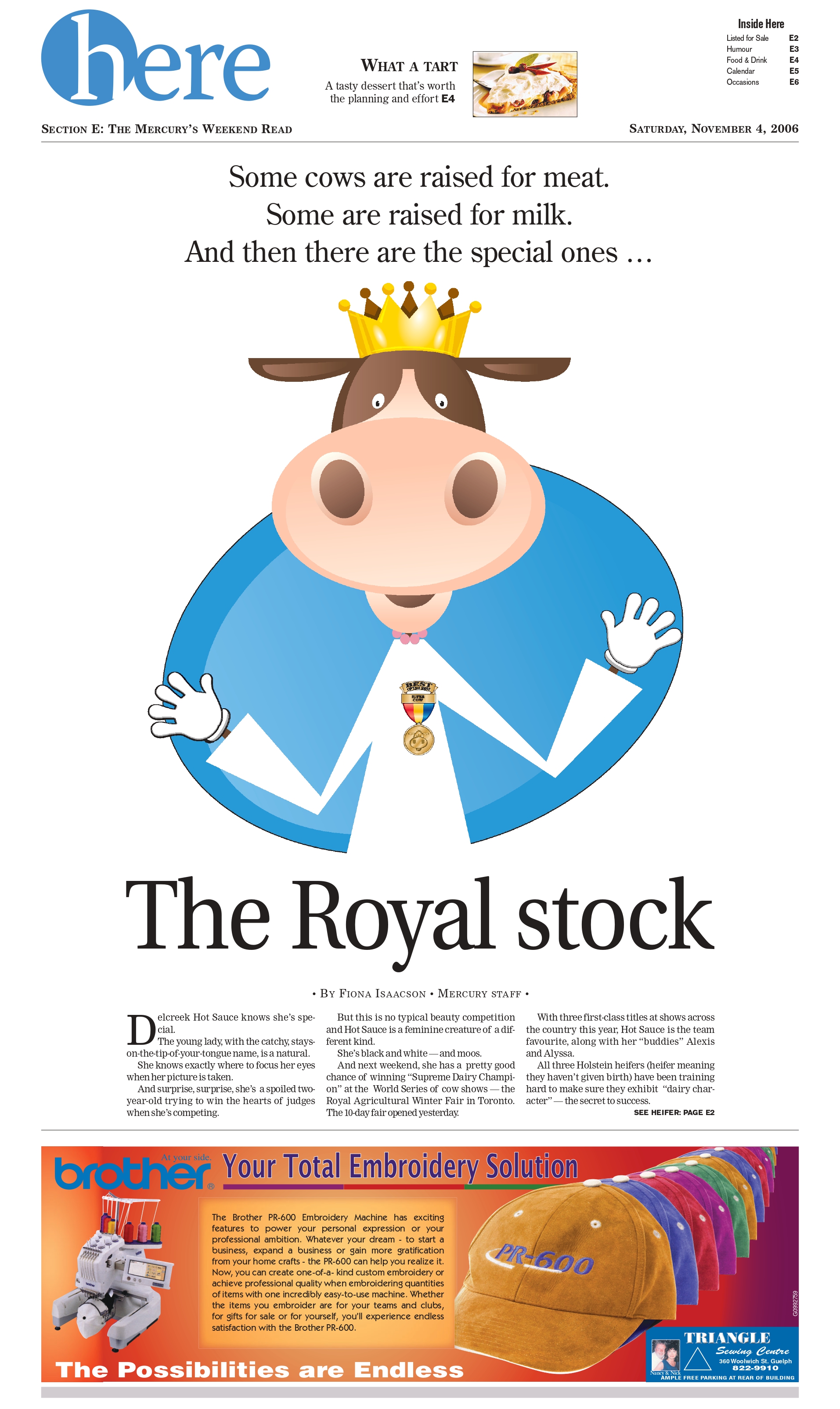
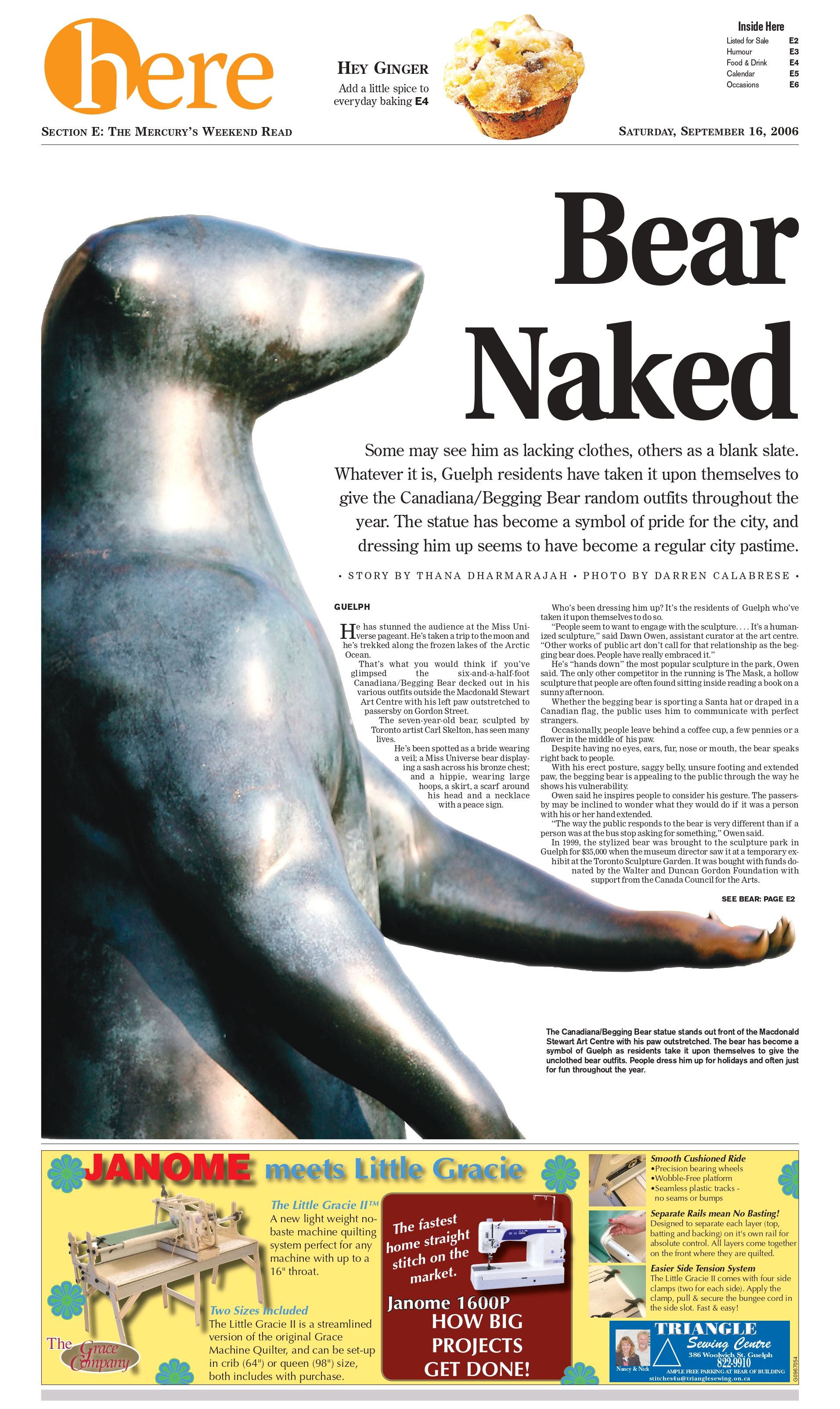
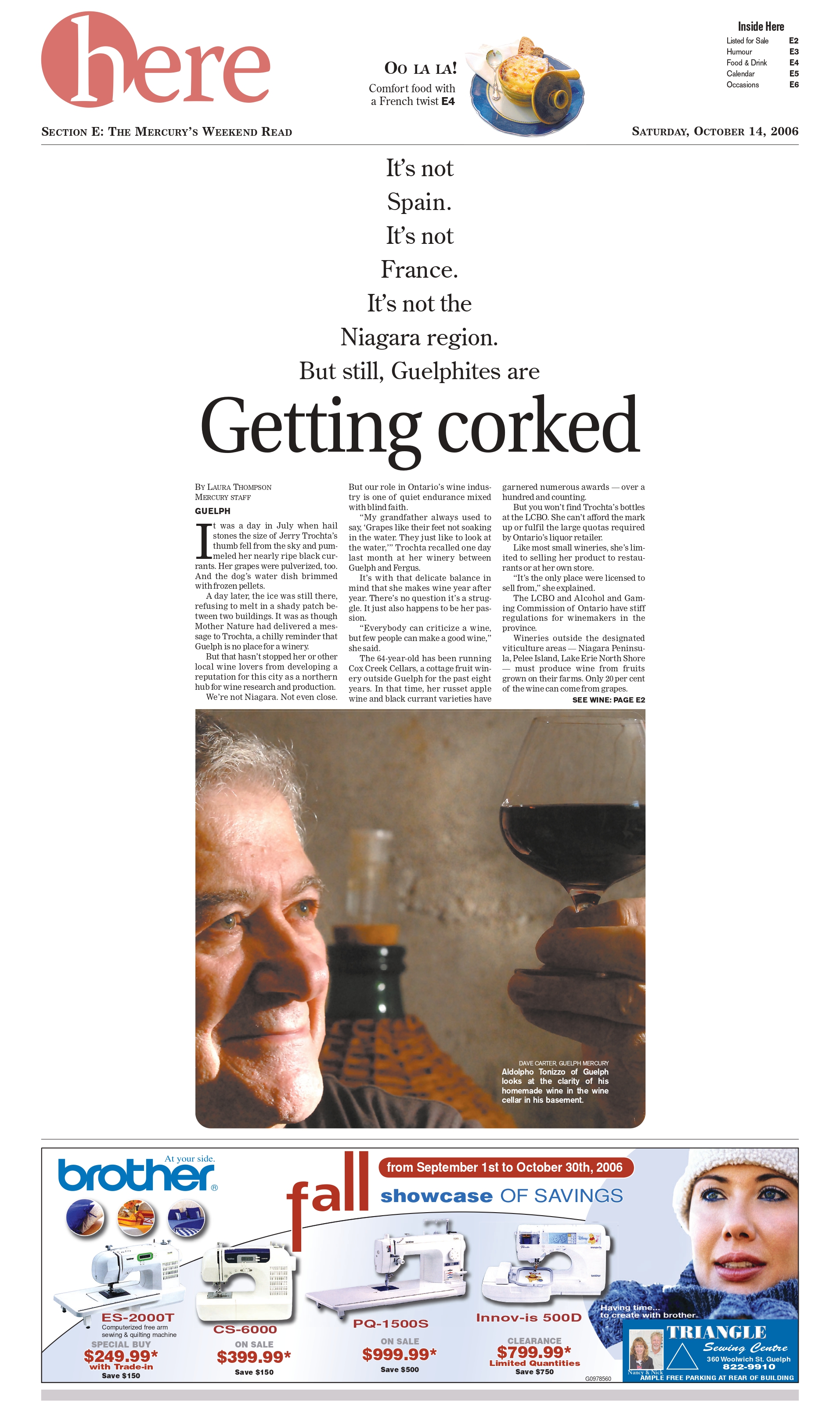
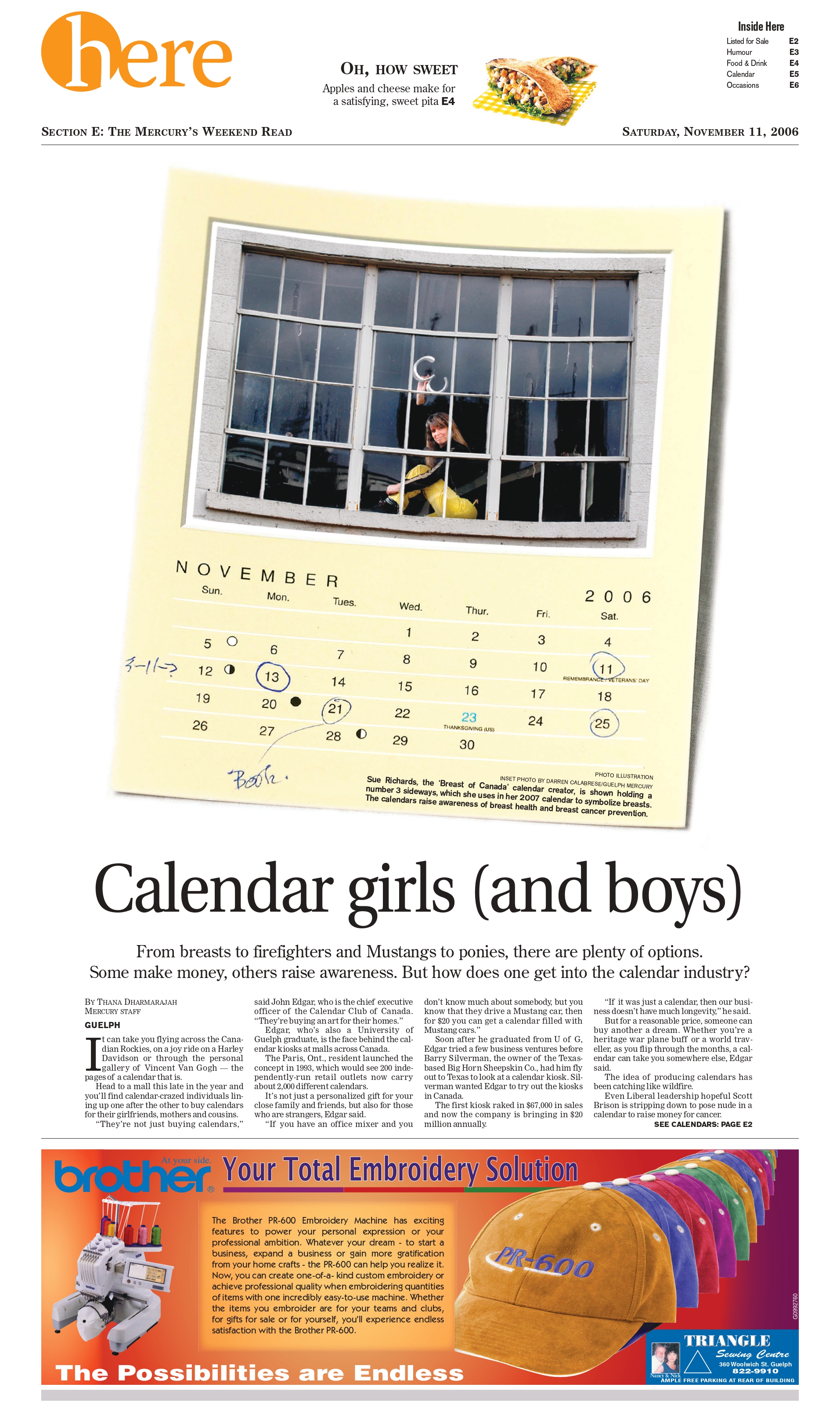
But the city was small (and cold) and the bugs were so, so big (when hot). So I went to test my writing chops in Red Deer, Alberta at the Advocate. Less than a year later, I was off to the promised land: Ontario. First at the Woodstock Sentinel-Review, then to the Barrie Examiner (RIP), then to the paper that firmed up my love for design (because someone told me I was good at it. Spoiler: it was SND), the Guelph Mercury (RIP). I was proud of some of my work in Woodstock and Barrie. Even Fort McMurray. Looking back, pre-Barrie work wasn’t as good as I thought it was at the time. But the Mercury made me. I was given so much freedom and time by my mentor and boss, the legendary Phil Andrews. I oversaw the Here section, a weekend features section all about Guelph. It was for this section that I won my first Society for News Design award, and still the one I’m most proud of as it was for a portfolio of work.

Those are three pages I think were part of my portfolio. I know “Getting corked” was, as it was the one in the book! I made the book (sitting in my soon-to-be-former office, so no pics available). The book that started me down this path. It was a dream come true. I even was fortunate enough to attend SND Boston where I picked up this fashionable … tote bag.

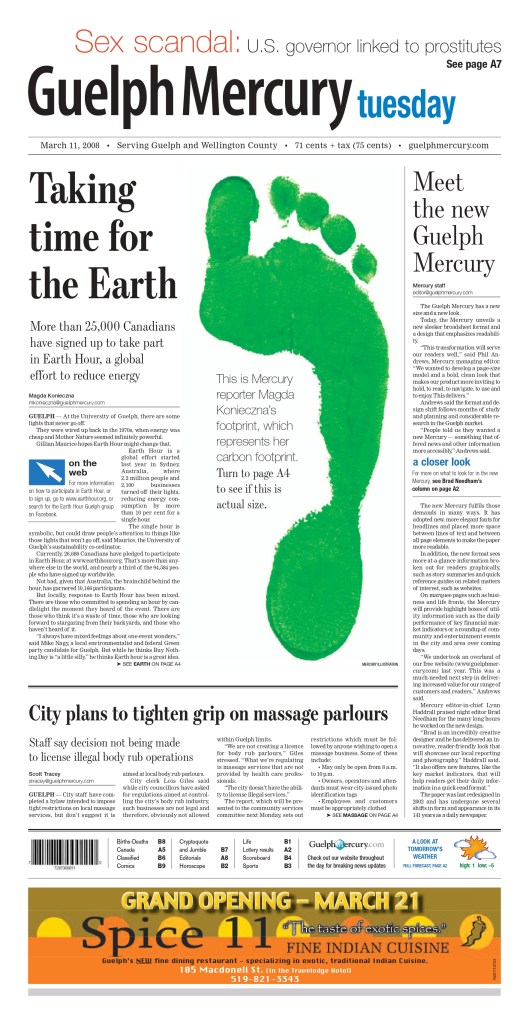
I then had the good fortune (with my newfound design street cred) to be asked to redesign the Mercury, from top to bottom. This was no refresh. I was even tasked with redesigning the flag. That is quite an honour. And scary as hell. Thanks to the Virginian-Pilot (at the time the best designed paper in North America, maybe the world, imho) and the Star-Tribune for the inspiration. Especially to the kind soul at the Pilot who sent me a box full of print copies to help me get further inspired. I was very pleased when the first issue went out (below) and almost all the feedback was positive. That’s almost unheard of! People hate change. But they appeared to like this. To this day, this is one of my proudest career accomplishments.
First day of the new Mercury.

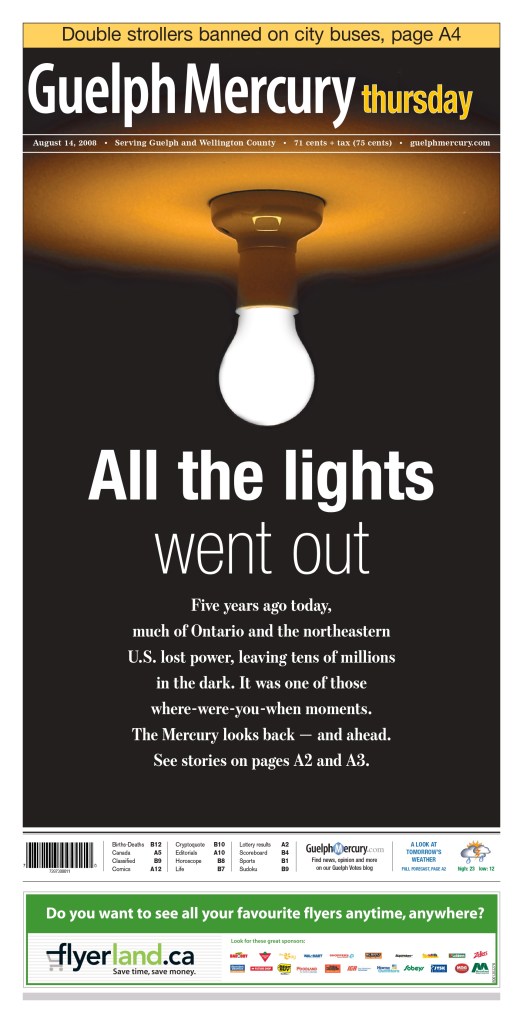
Two years after my first SND award, I won again, this time for a front page that I was given full freedom on, the fifth anniversary of the major blackout that swept through Ontario and much of the northeastern U.S. When I designed it, my boss said he looked forward to seeing that page in the next SND book. And much to my surprise, he was right.

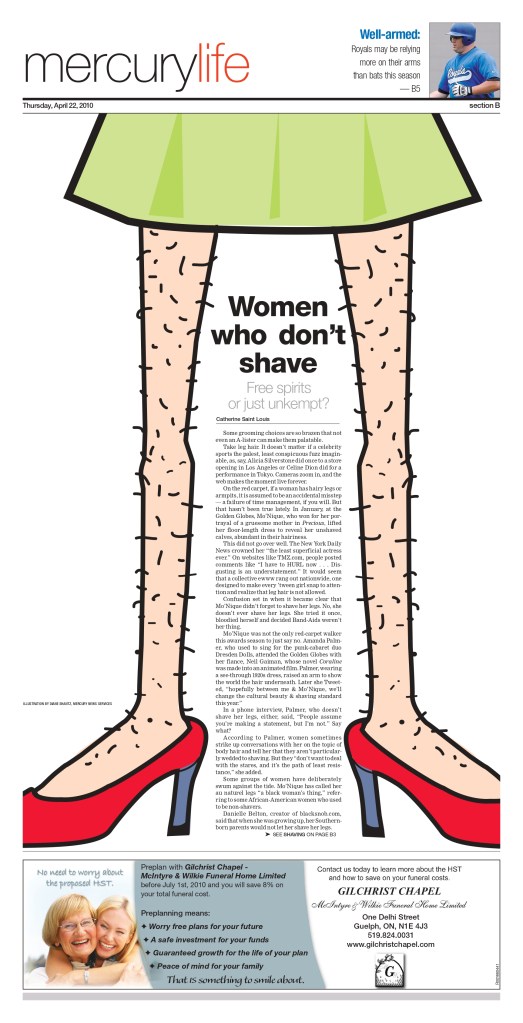
Shortly thereafter, I moved on to the Waterloo Region Record. And shortly thereafter after, so did production of the Mercury. It was a sign of things to come in the industry (and this blog post). But I continued to work on the Mercury from the Record. At the Record I continued designing, but also moved into a very basic art director-type role. I had a vision, drew it poorly on a small yellow sticky note and handed it off to one of the Record’s great designers, Tania Praeg-Geddes and Diane Shantz. And wouldn’t you know it. Two years after “All the lights went out,” with the help of the great Diane, we did it again. We earned the Mercury its fourth SND award in five years (it won another for a page produced by again soon-to-be-former colleague, now at The Canadian Press then at the Mercury, Kate Hopwood). This time the page likely won mostly for Diane’s brilliant illustration. It was much better than the hairy legs I drew on my sticky note. 🙂

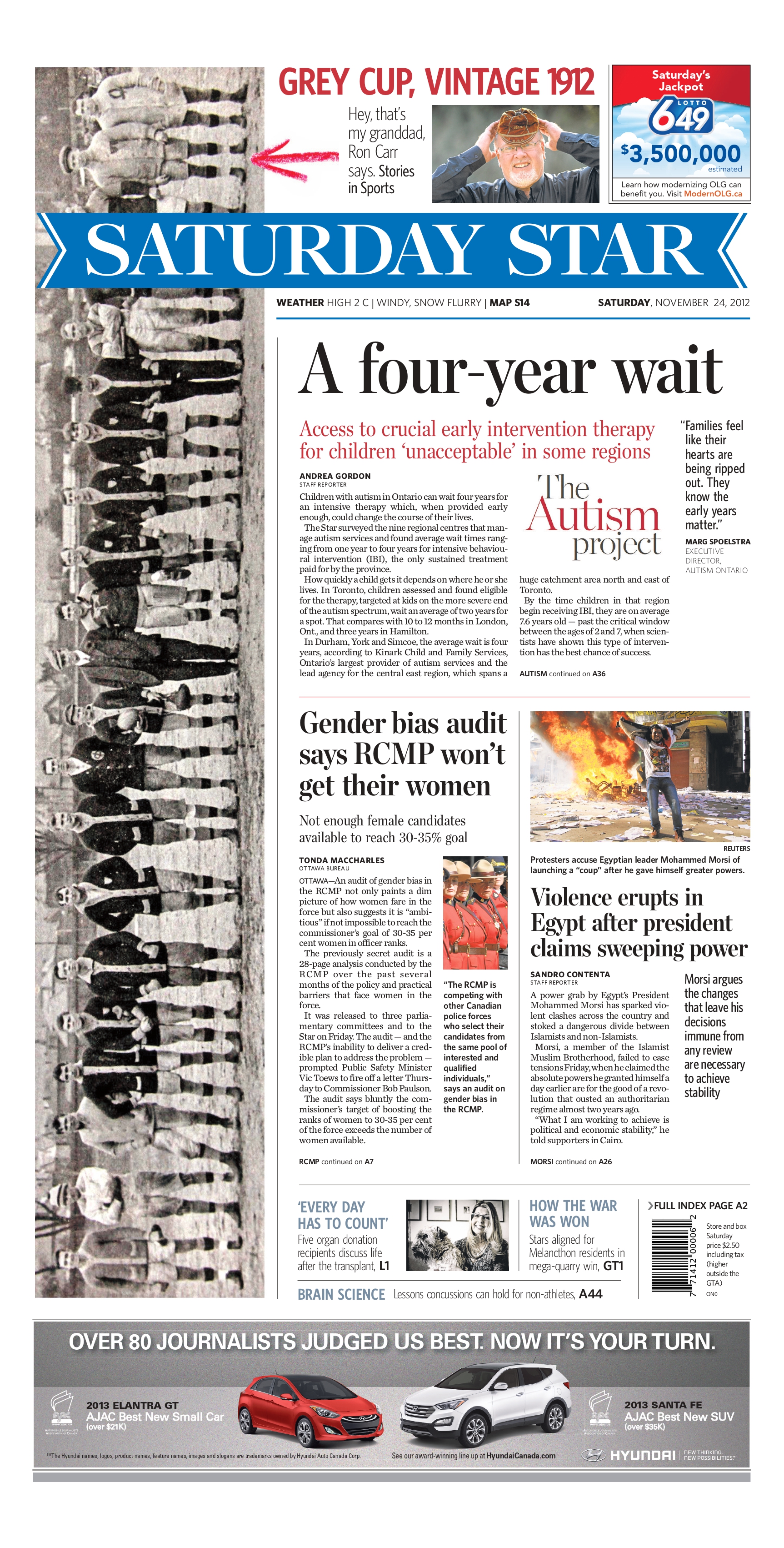
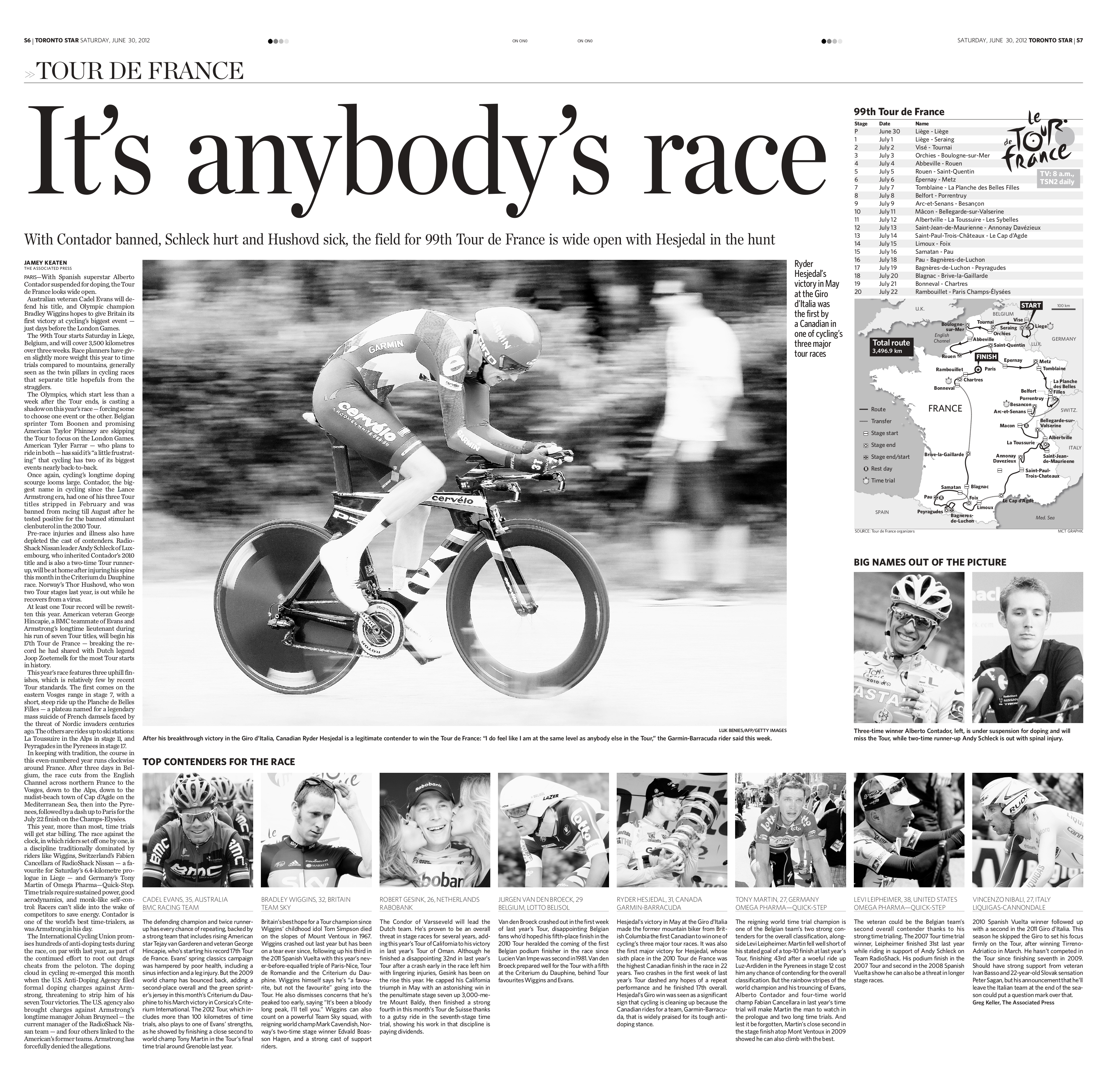
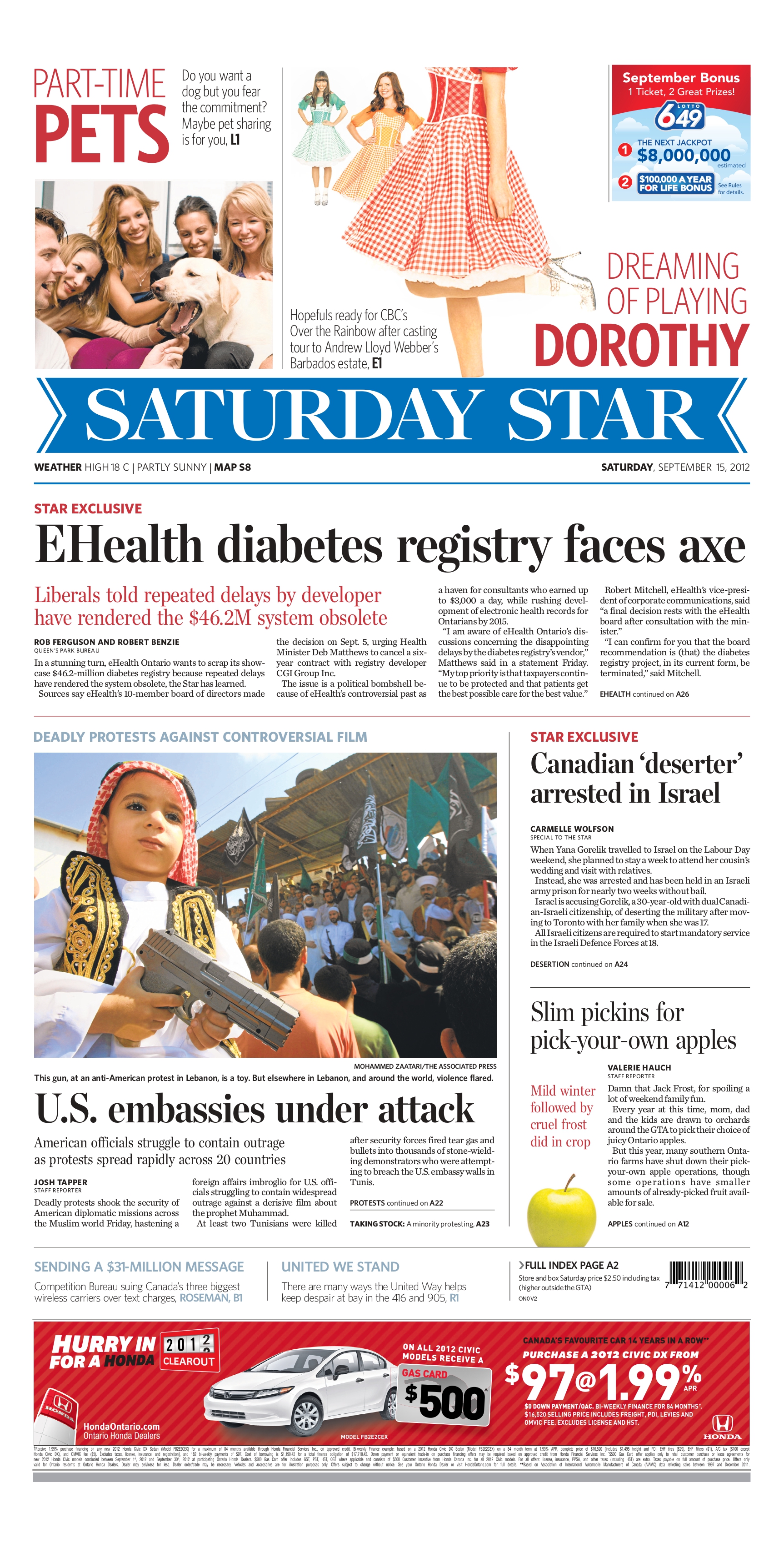
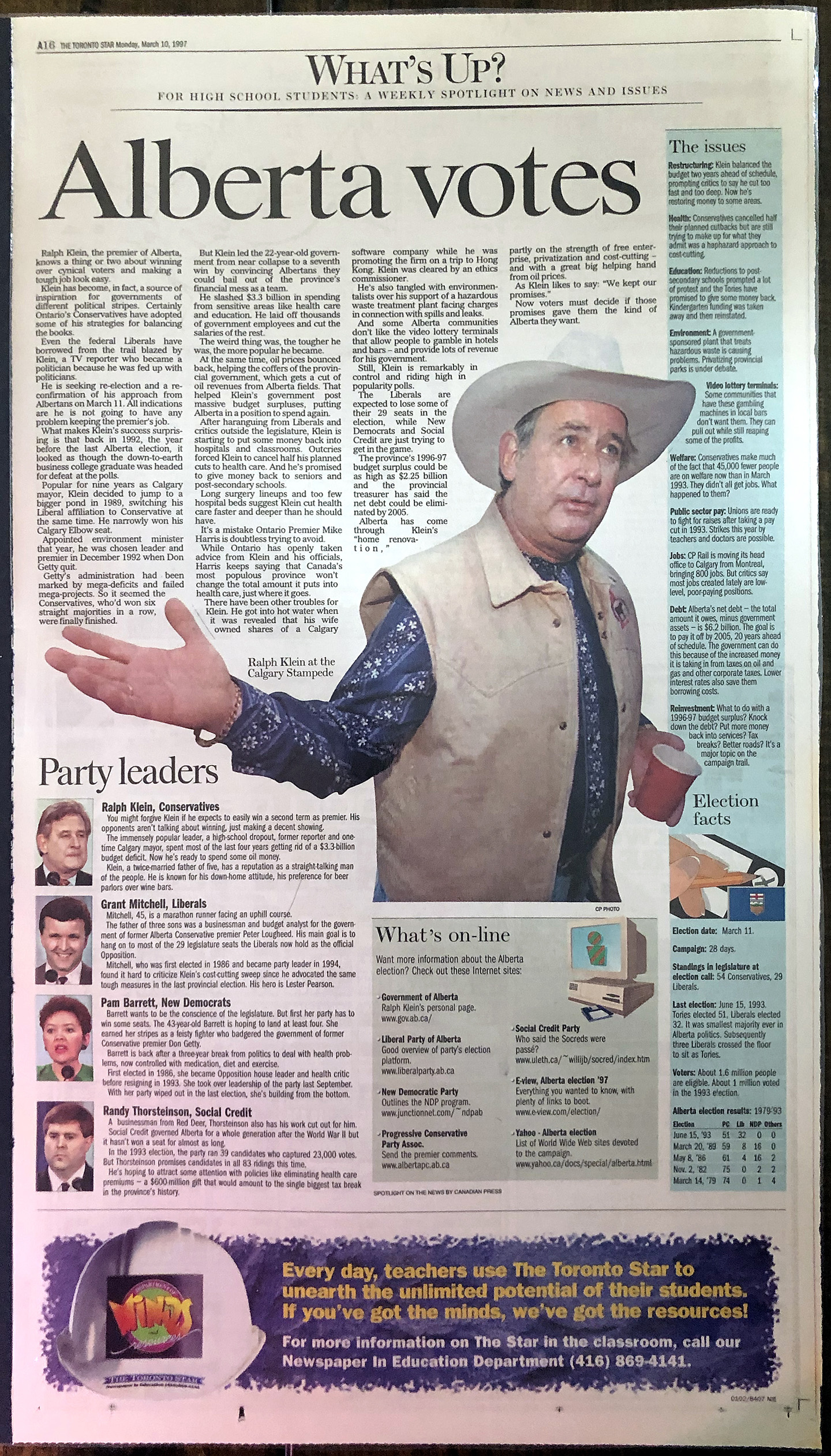
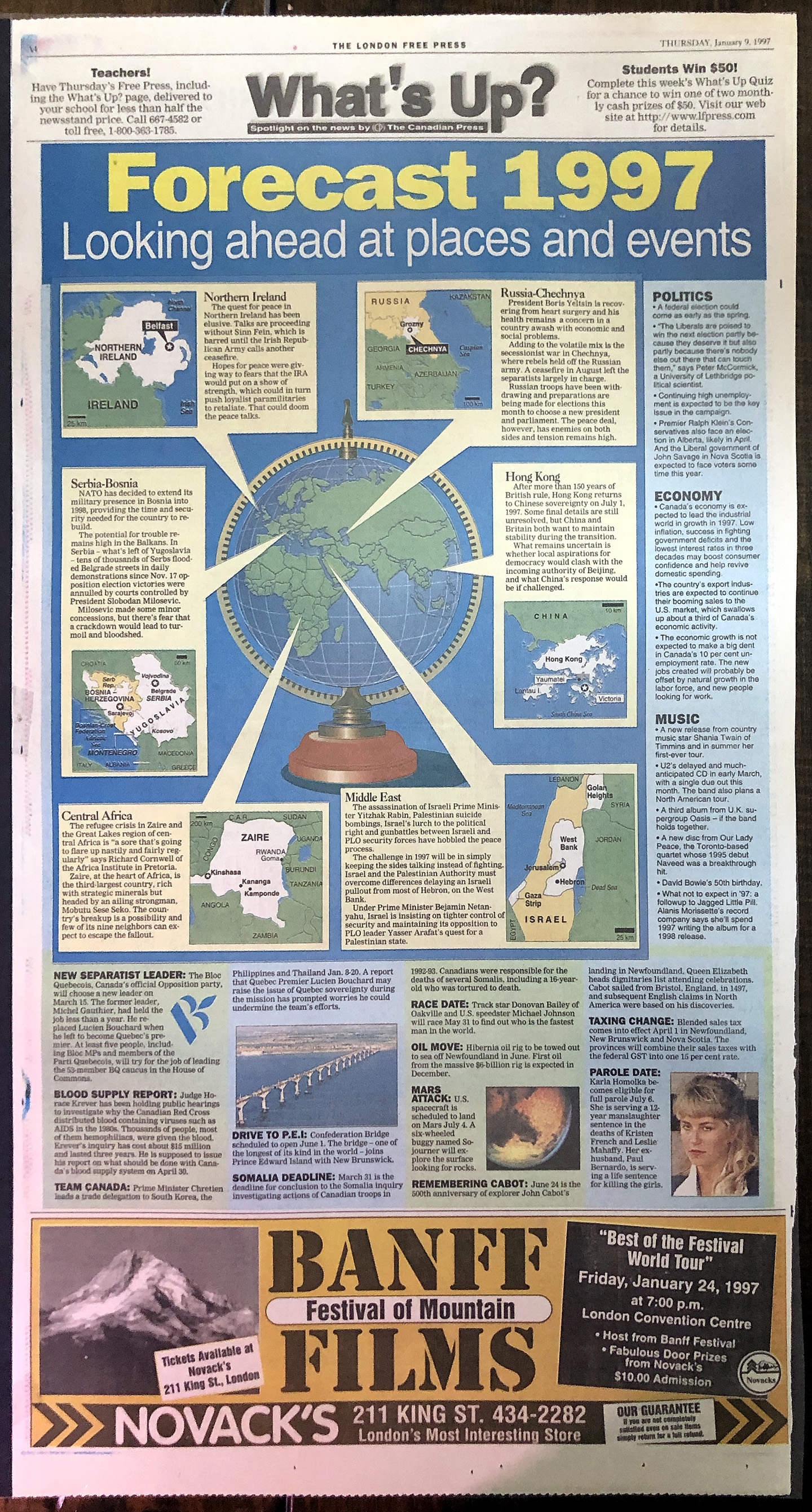
Then came the email from the Toronto Star. They had an opening. I answered the call. I did some work I was proud of at the Star, but my heavy design days were over. Sitting at another bank of desks was a team of designers, whose entire job was to design covers. But I am happy to say I got to do some front pages for what is or was (depending on who you talk to) Canada’s largest daily circulation newspaper. The one on the right below isn’t a super fancy design, but it was my first A1 at the Star. So it’s special to me. I loved my time at the Star. But, as previously mentioned, the industry was contracting.

I was laid off and I moved to Pagemasters North America. It was eight glorious but mostly design-less years as a manager, overseeing a team of incredible editors, helping them grow and develop. So I still had a hand in others’ designs. Even super designer Tammy Hoy occasionally asked for my advice. Five of those years were spent overseeing the Star after they outsourced to Pagemasters North America (see, the Mercury was a sign of things to come in the industry and this post).

And now I depart marking what is likely the end of my journalism journey, at least as an active participant. For now. Anything is possible, but I am excited for what lies ahead. I know I have been so fortunate in this industry. Or as some would say, unfortunate. I made it 20 years. I lived through some not as lean times. I was blessed with opportunities and support. The Mercury was an incubator. It launched many to greatness. As I start looking back, I look ahead. I hope to be able to blog more, and showcase print design talent from around the world, from those who are sticking it out in this industry and doing outstanding work. I will do it here, and hopefully even more often as I will need my print design fix, and on my Instagram. Until then, a journalism cliche …
-30-

By Brad Needham

When I got access to all the entries to the Society for News Design best in print newspaper design competition, I was like a kid in a candy store. It was such a delight to see some of the best pages from around the world. But as a proud Canadian (slightly dampened by our slow progress on COVID-19 vaccinations, particularly for essential workers), I quickly searched for Canadian entries. I was both tickled to the see the incredible creativity that flowed from home, but also a little saddened to see there was little variety in entrants. Lots of entries. Very few titles. Dominated by the Globe and Mail, a selection from the Toronto Star and some from Le Devoir.
When I entered the contest in 2007 and 2009, I entered as a designer for the now-shuttered Guelph Mercury. We had a circulation of just over 10,000 at the time, if I recall correctly. We were the little engine that could. Sadly I didn’t see that this time. Two of Ontario’s design heavyweights (despite being relative lightweights in circulation), the Mercury and Barrie Examiner, have both closed. Other papers are being done in internal or external production centres. To be very clear this doesn’t mean there isn’t some incredible and award-worthy work coming out of these places. You only need to look at my profile on Tammy Hoy to see what is being done. But there is less time for most places to spend on design. And they’re not entering anymore, as media organizations shift their focus to digital (I assume that’s why?). Hopefully that will change for SND43. I hope to spread the gospel to Canadian newspapers so that there are more titles next year.

But I digress. As much as I like to think everyone is here to read my witty insights and elegant prose, I know it’s beautiful newspaper pages that drive this blog!

So first, here are some from the Globe, with very brief bits about what I like. As with most beautiful pages, they speak for themselves. But as I learned at SND42, there is so much to say about why these pages are excellent.

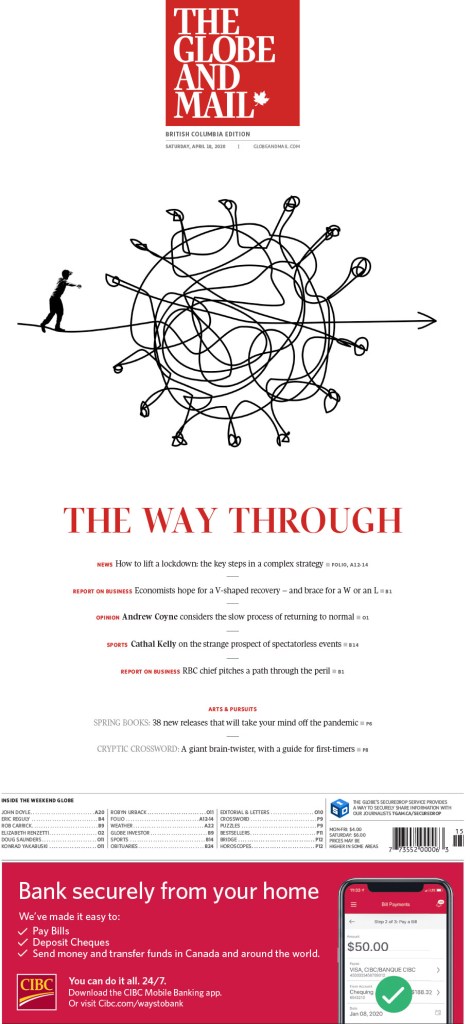
The Globe and Mail, The way through

As a subscriber to the Globe and Mail, I loved this page the second I peeled it out of the plastic bag (maybe two if it was raining — or, gasp, snowing — that day). It is hard to come up with a novel concept when it comes to the unmistakable shape of the COVID-19 ball, with its protein spikes always threatening to hook on to something. But this was new (for me, though as you can see here another newspaper did something very similar, proving how hard it is to take a unique approach in newspaper design). A tangled COVID knot, showing the almost unnavigable path through this complicated situation. Beautiful and well used white space. Of course it’s a Saturday Globe cover, and I’ve come to expect nothing less, but this was one of the standouts even among the weekly excellence.

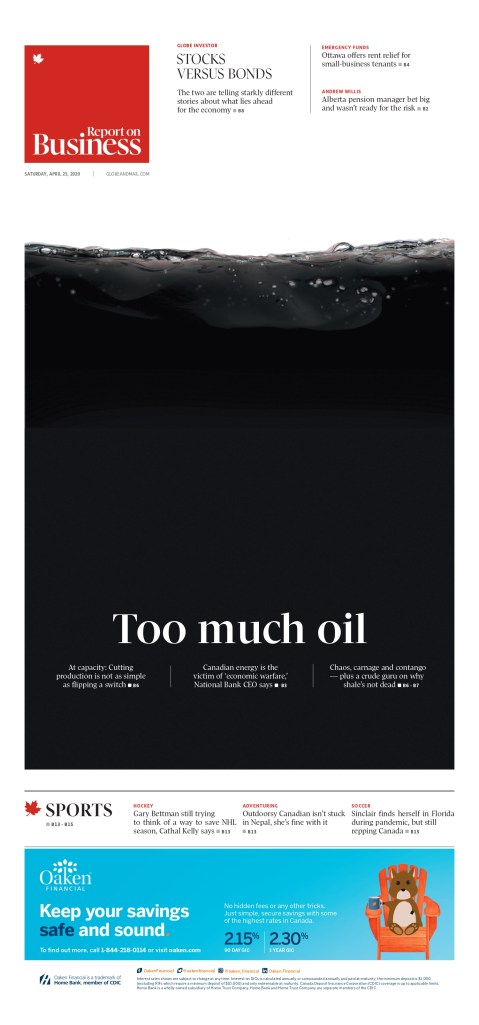
Globe and Mail, Too much oil

At first glance even a seasoned designer might not see this idea as novel. Reverse white text on a black background. But this isn’t just to make it pop. This page works, it rises to a new level, only because it’s about oil. Too much oil. The black has a real purpose. And you can see the oil swishing at the top. It’s someone taking an old idea and making it new, giving it purpose. It’s a bold use of space.

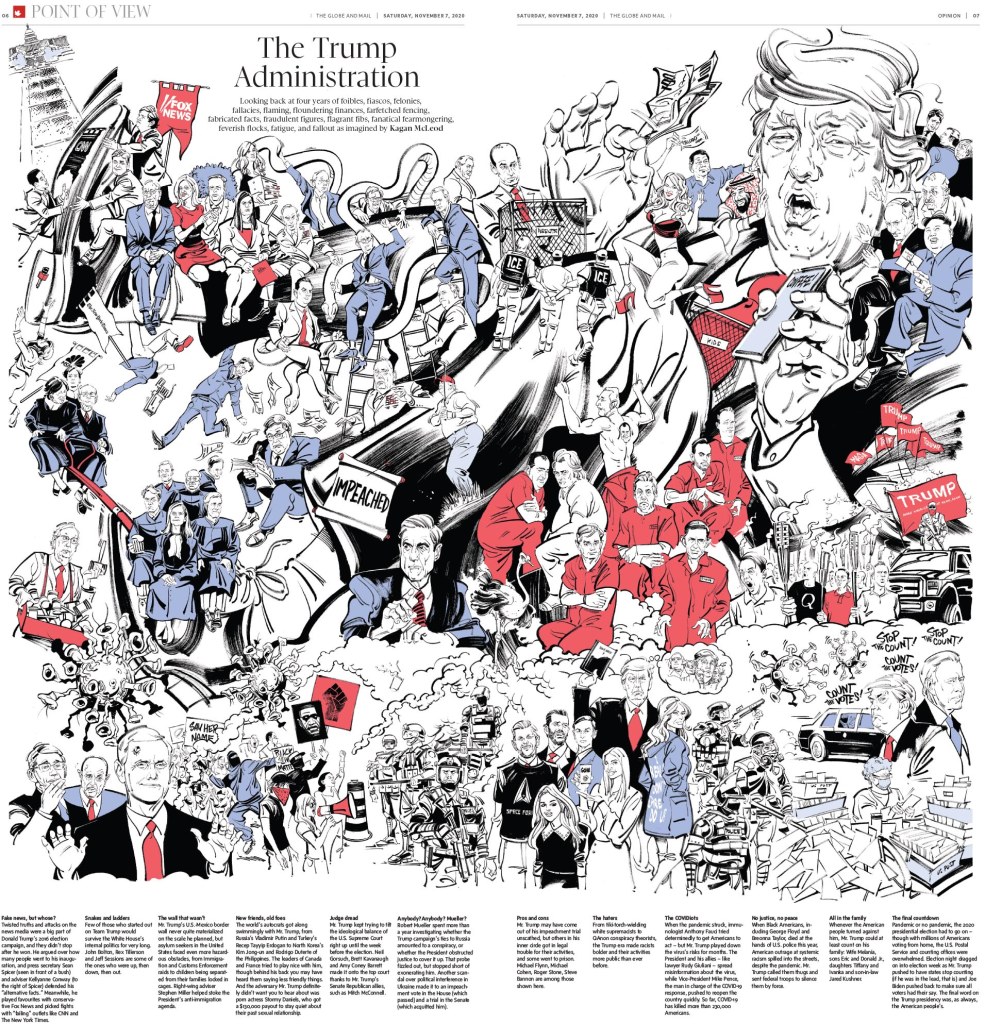
Globe and Mail, The Trump Administration, illustrated by Kagan McLeod

This page is almost entirely driven by its illustration by the incredibly talented Kagan McLeod (who also did the National Post cover illustration to mark Prince Philip’s death). There is so much happening. It’s so busy, but in a good way. Like a Where’s Waldo picture, you can spend so much time taking in all the different ideas and details. The text is played respectfully, letting the illo do most of the talking.

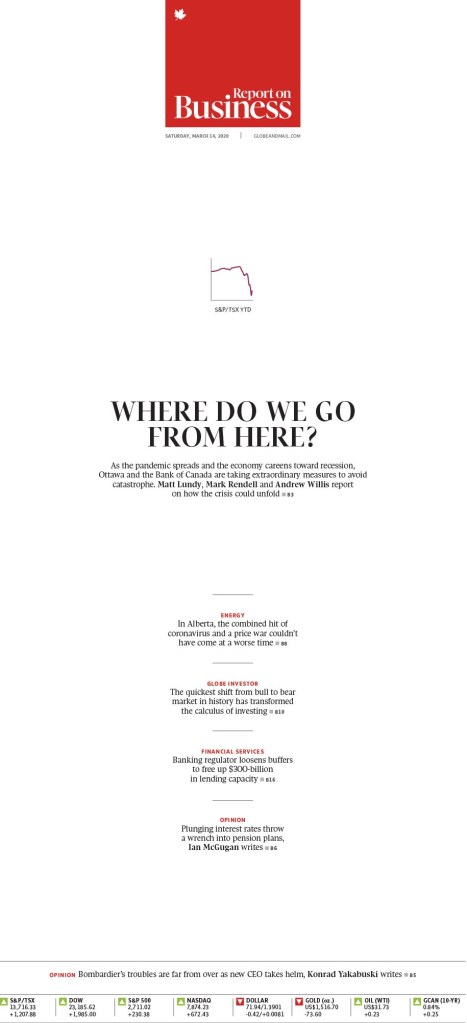
Globe and Mail, Where do we go from here

While the Globe had many more outstanding pages, this is the last I’ll look at. I like it, again, because it takes an old idea and makes it new. I see lots of graph-driven pages. But usually those graphs dominate the page in order to make them stand out as main art. It’s a graph after all. But in this case, the graph is tiny. I mean, it is a graph after all. But that makes it stand out even more. It’s a tiny focal point. But your eye goes there. And it illustrates a rapidly shrinking number. Once big, now also tiny. And another Report on Business cover. I love to see so much creativity on business pages.

Toronto Star

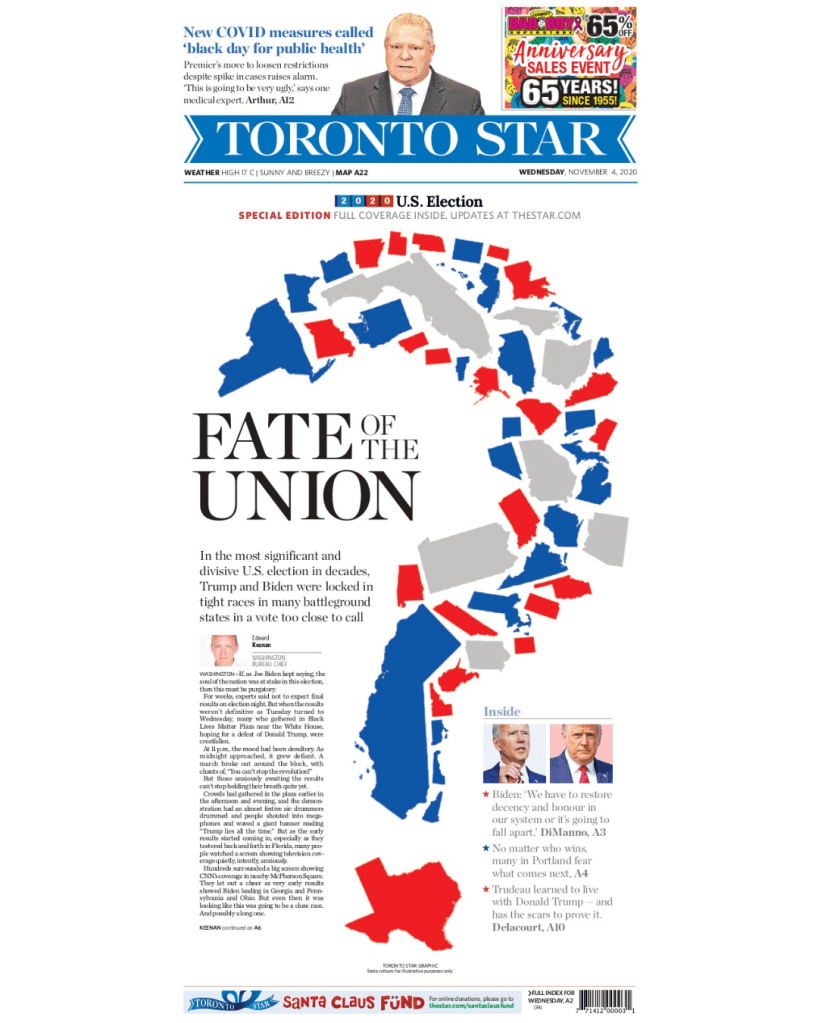
Toronto Star, Fate of the Union

Some in Canadian media will recognize this Toronto Star page, as it was also nominated for a National Newspaper Award for presentation/design. On top of COVID-19, George Floyd and Black Lives Matter, there was an election for the ages in the U.S. And one complicated by COVID. Often results are late. Often a country is divided. But in 2020, both reached new levels. Mail-in ballots meant delaying your press start by three hours likely wouldn’t net you results. The question mark made up of the states was such a creative way to illustrate this. Red, blue, too early to call. Fate of the Union is such a great headline as this was one of the most important election in U.S. history. And the world was watching.

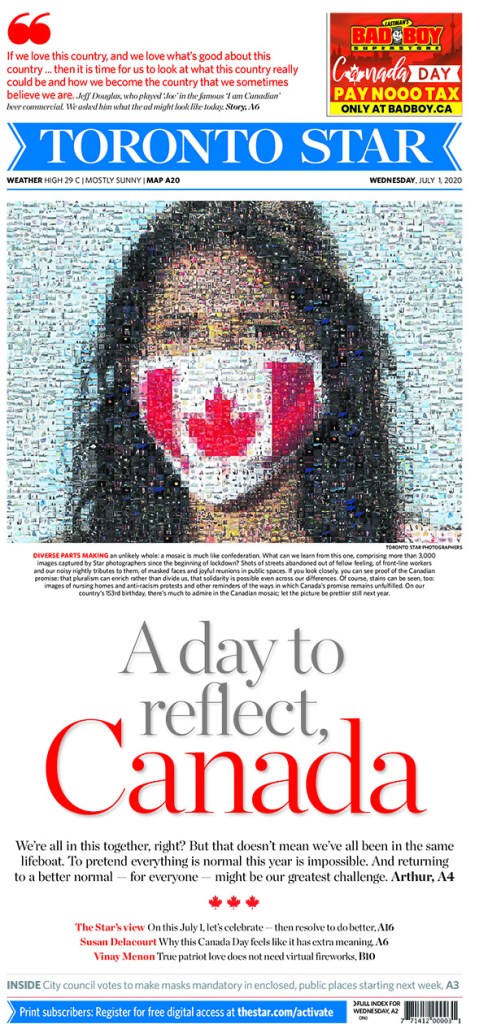
Toronto Star, A day to reflect, Canada

The work that must have gone into this page is extraordinary. It takes 3,000 images from Star photographers since the beginning of the pandemic lockdown and makes up one image of a woman wearing a Canadian flag mask. And the head works so well with the mosaic. But again, it comes down to how much work and the thought process that must have gone into this. It’s mind boggling.

Le Devoir

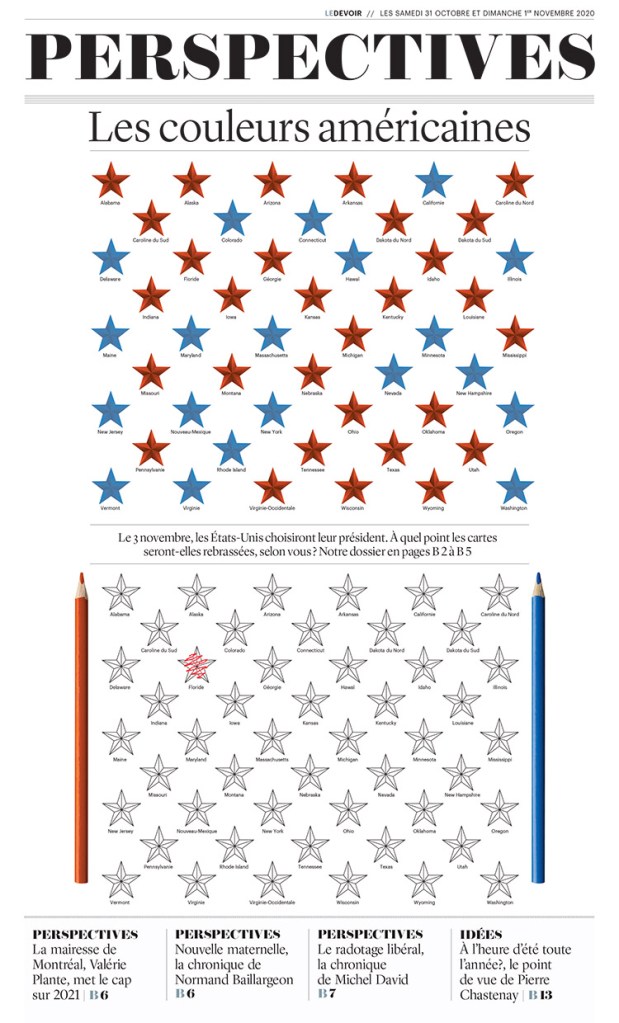
Le Devoir, American colours

This Le Devoir page is a fun and different approach to the U.S. election. Going into it it was anybody’s guess. The polls were so close. So Le Devoir highlights that with empty stars, ready to be coloured in, complete with pencil crayons.

Thanks, Canada

There were more great entries from each of these papers. I salute the effort they put in, as well as papers like the National Post and others, which didn’t have entries as far as I could see. Print is still kicking in Canada, and while it might not be as vibrant as that in the States and other countries around the world, it’s still alive. I hope 2021 will see more entrants, and, more importantly, more bold and inspired print designs. If newspapers want to show readers they still care, they need to make an effort. And I will be here to celebrate it when they do.

Have thoughts? Share them below.

There are average newspaper pages and there are good newspaper pages. And there are almost unbelievably great newspaper pages. That is what the Society for News Design is all about. If you read this blog, you likely know all about SND by now. Over the course of a few days last week I was fortunate enough to be a facilitator in the SND42 Best of Print Design competition. I got to listen to some of the greatest minds in the visual design space talk about some of the best pages in the world throughout 2020, a tumultuous year to say the least. The judges spoke. They gave their awards and their medals. And for the most part I agreed with everything. In many cases their keen observations bowled me over. While I didn’t get to look at all of the more than 3,000 entries, I did try to look at as many as I could. I wanted to share some of the pages I was secretly rooting for, yelling at my muted computer when the team captain asked if anyone else had anything to say.

Here are a selection of pages from this year’s competition that blew my mind, mostly from the news category my team was judging, but not all. I haven’t included any of Canada’s best here, as that will be separate post.

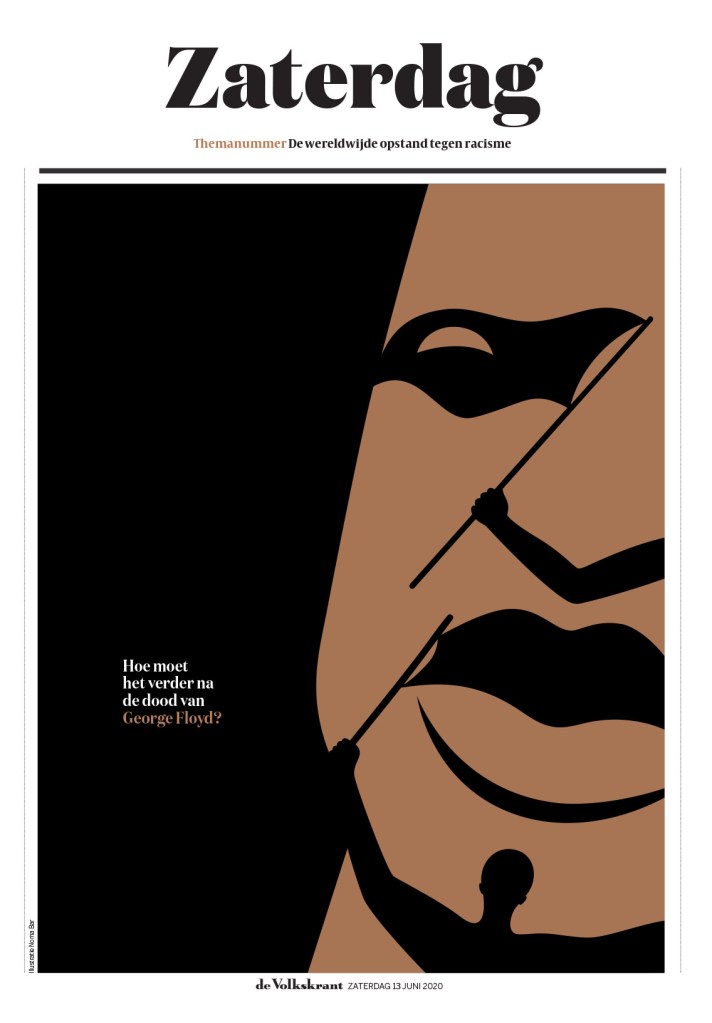
De Volkskrant on George Floyd

This page is timely again after the conviction of Derek Chauvin on all charges, including two murder charges, in the death of George Floyd. This page certainly didn’t get past the judges. It was much talked about. It does so much, capturing the iconic image of George Floyd, but also movement it sparked in one illustration (by Noma Bar). And that’s just the beautiful illustration. The rest of the page is strong too. The words are small, deferential. They don’t take away from the image. This captures the power of print.

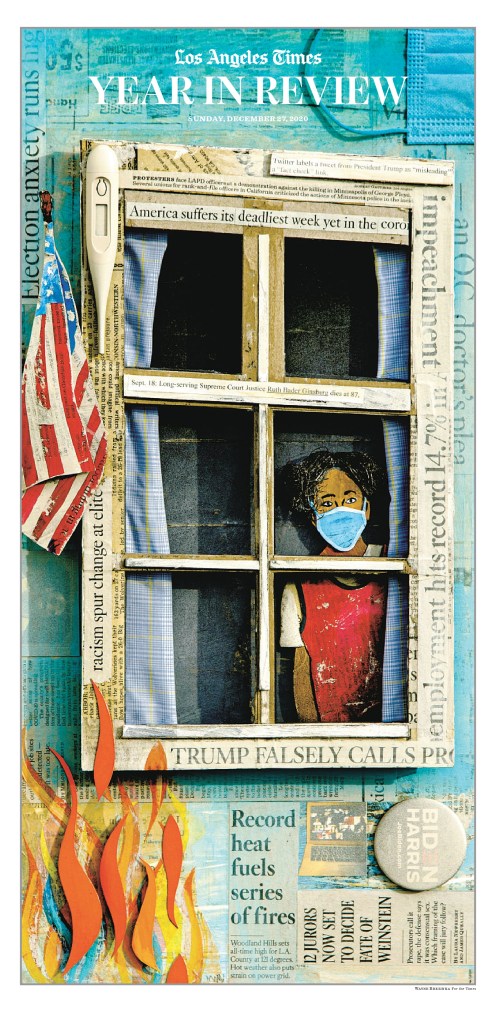
LA Times year in review

I hope to get the chance to talk more about this page with someone who was involved in it in a future post. But this was the first page that took my breath away. Not only do I find it to be such a striking image (illustration by Wayne Brezinka), it in itself is a celebration of print, with newspaper clippings pasted throughout. It looks like a crafting project, just better than any crafting project I’ve ever seen (though my daughter does some killer crafting).

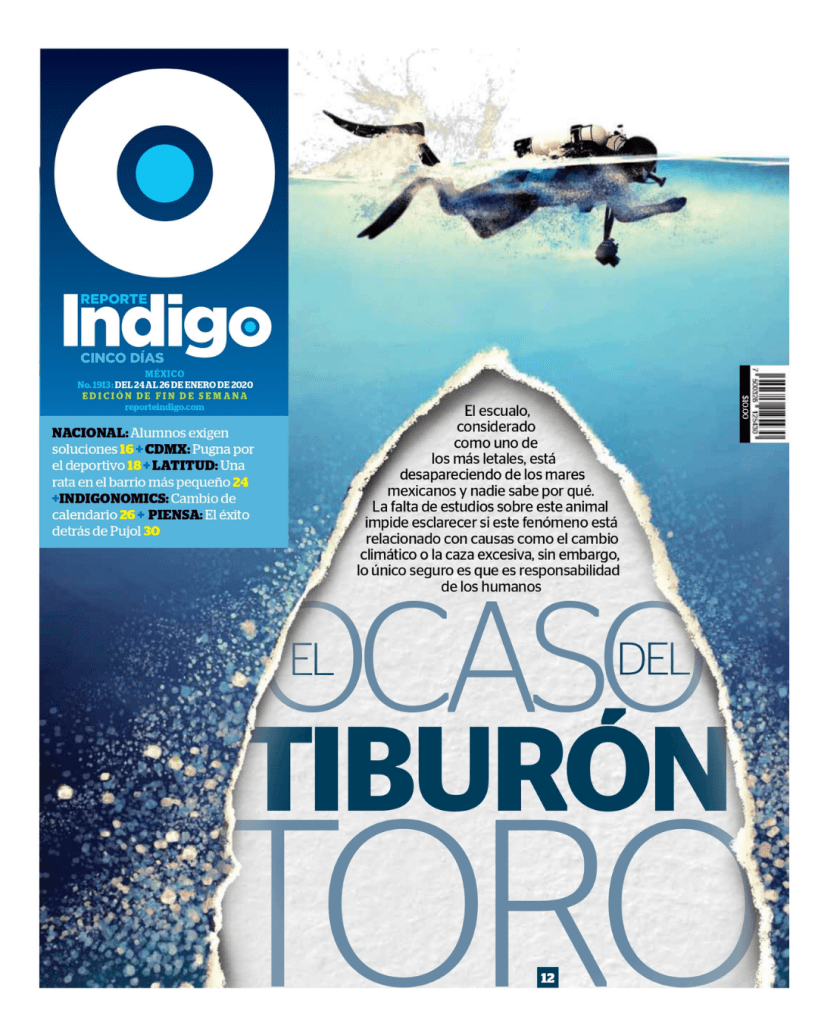
Indigo’s disappearing sharks page

This page did so much for me. As I listened to the discussion as to whether it should be a medal contender, I found myself loudly voicing my opinions while muted (facilitators aren’t allowed to weigh in, but I did in spirit). I loved the text, the tear, the obvious shark that is not there, which was the point. It’s about disappearing sharks. The 3D effect. The colours. Despite being about a depressing topic, as many of the pages are (hence their power), the design made me happy.

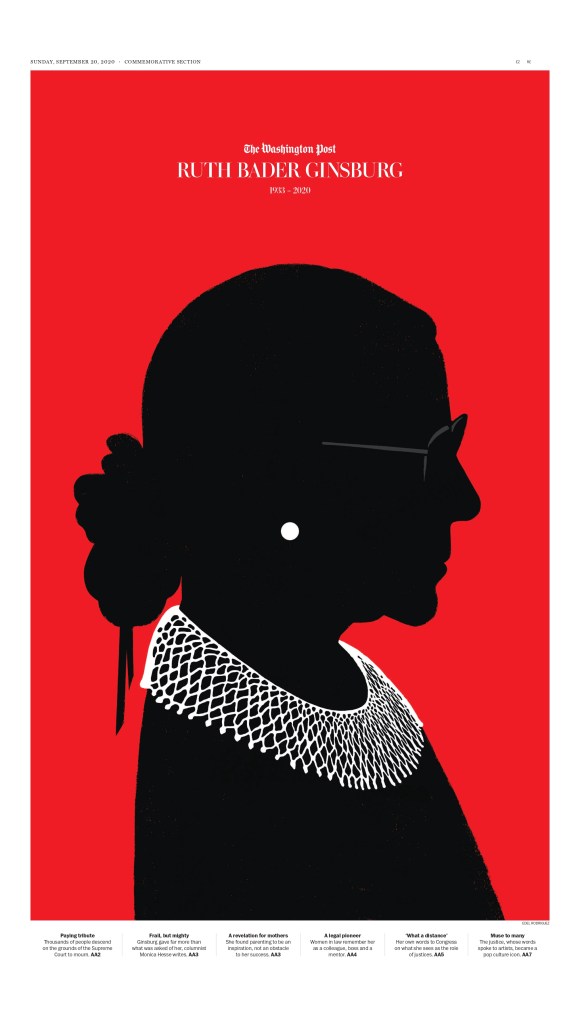
Washington Post, RBG

I don’t need to say much about this one. It’s stunning. It’s powerful. It’s simple. It’s respectful. The silhouetted look is the focus. The words are small, and don’t take focus away. The earring and the collar. The slight but necessary hint of glasses. This page is more about the illustration (by Edel Rodriguez), but the respectful treatment of it makes it a complete package. They could have used a photo of Ruth Bader Ginsburg. They could have used a more traditional illustration. But neither would have the power that this did. I saw this one the day it came out and it struck me then just as powerfully as it did when up against the world’s best. Read more about it here.

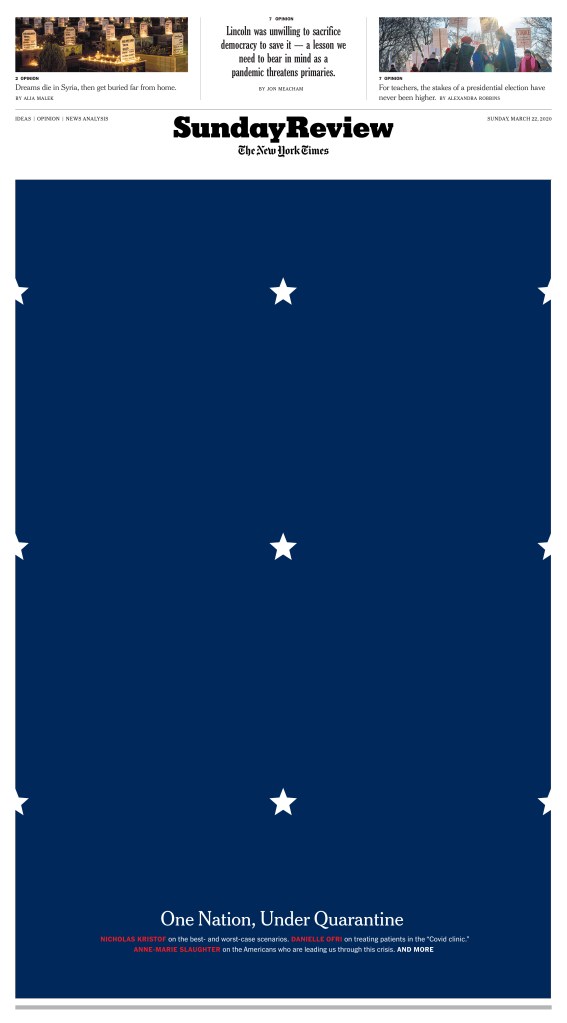
New York Times, One Nation, Under Quarantine

When I saw the wall of grief page from the New York Times, I thought that was the pinnacle. It was so powerful. Could there be a stronger NYT page? Enter SND42, and One Nation, Under Quarantine. This page is so strikingly simple and complex at the same time. Playing off the flag, a symbol of unity. The Stars close together, separate but united. But not here. Quarantine drove Americans, drove everyone, apart. The stars normally so close now evenly spaced, physically, socially distancing. It’s such a symbolic visual.

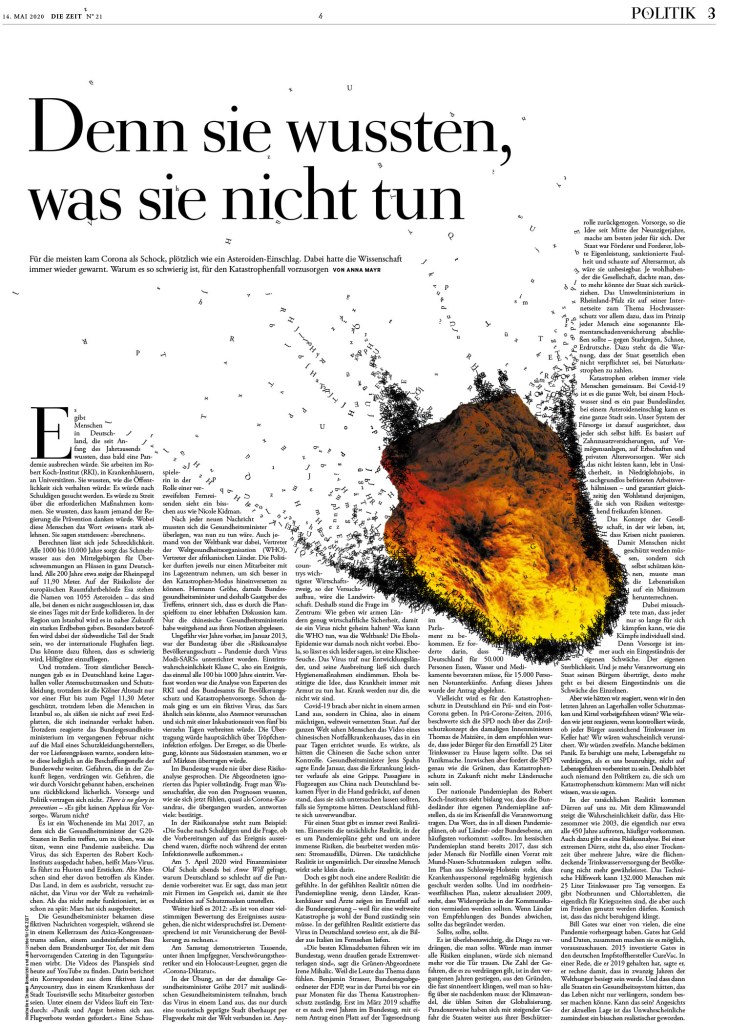
Die Zeit, COVID’s impact

This page has a lot of text. It could almost be considered too grey. But the visual of the meteor tearing through the page changes that. Letters flying around. A disease like COVID wasn’t unexpected. It was predicted. Like we might be able to predict a meteor’s path. But we didn’t prepare. And thus the impact has been devastating, like this meteor tearing apart a piece of regular life, a newspaper. The meteor is tight to the text. With almost any other illustration it would be too tight. But that’s the point. It’s still burning through. The impact still being felt. And the text is still readable, so key to design. A page can be the most beautiful thing in the world. If the design affects readability, you’ve lost most of your readers.

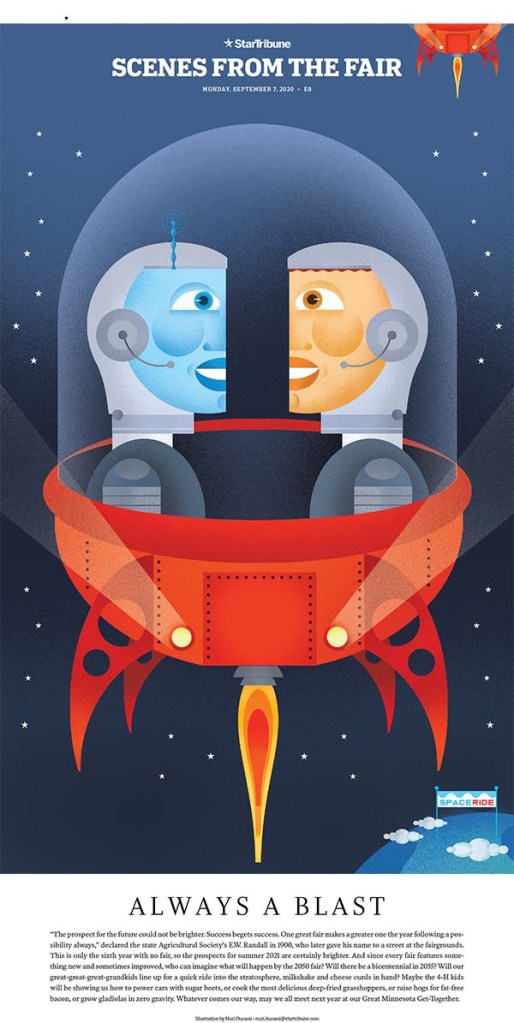
The Star Tribune had so many great pages. It’s such a hub of design and creativity. So with pages on George Floyd and COVID-19 and the U.S. election, why did I choose one about the fair? Because it makes me happy. It was a tough year. There were so many big and hard stories. But when I saw this page (there are many just like it), I smiled. It brought out the kid in me. Not only is the illustration lovely (by Nuri Ducassi, whom I had the good fortune of working with at the Toronto Star), the page itself is just wonderfully designed. Simple, effective and fun.

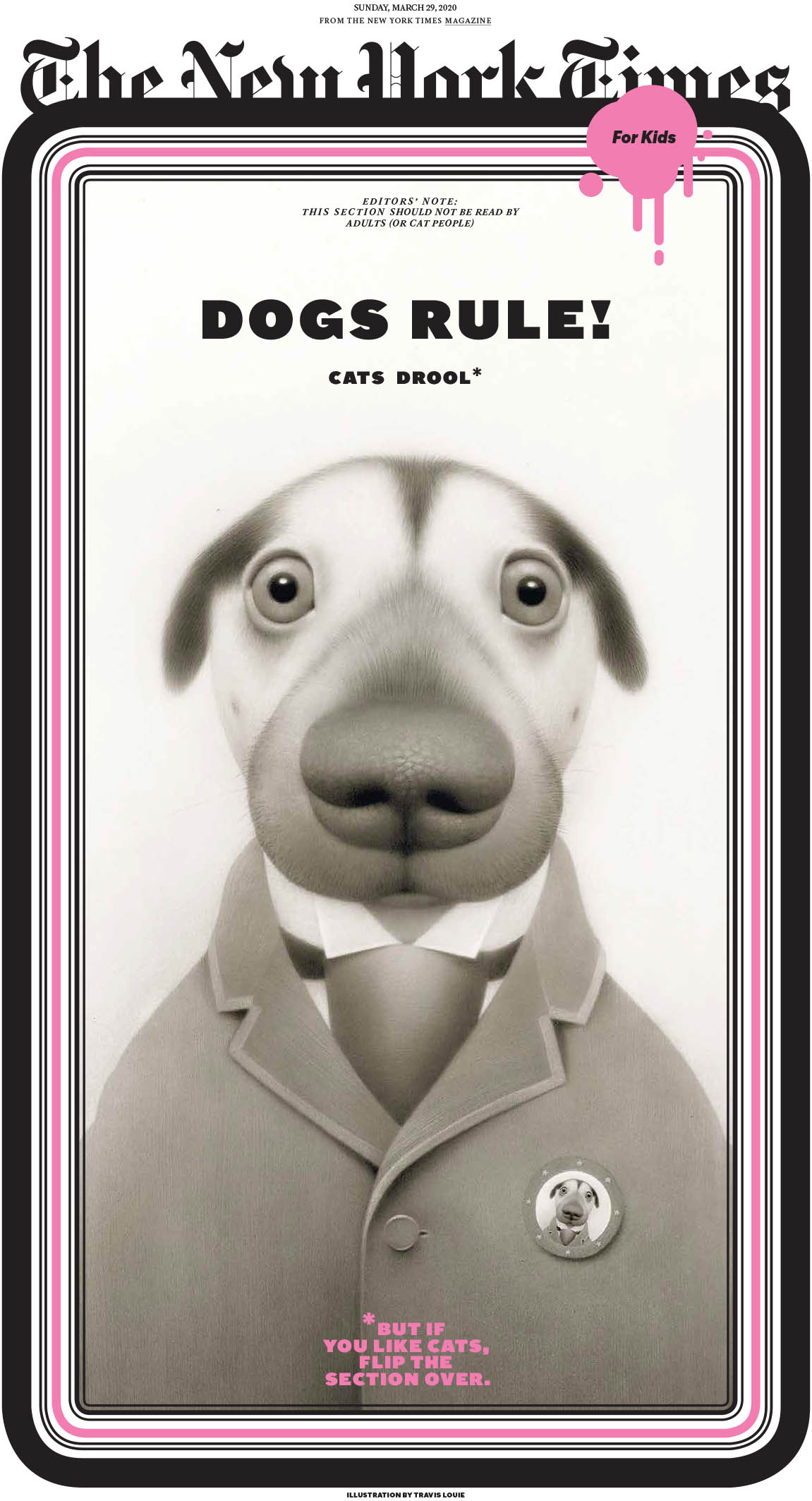
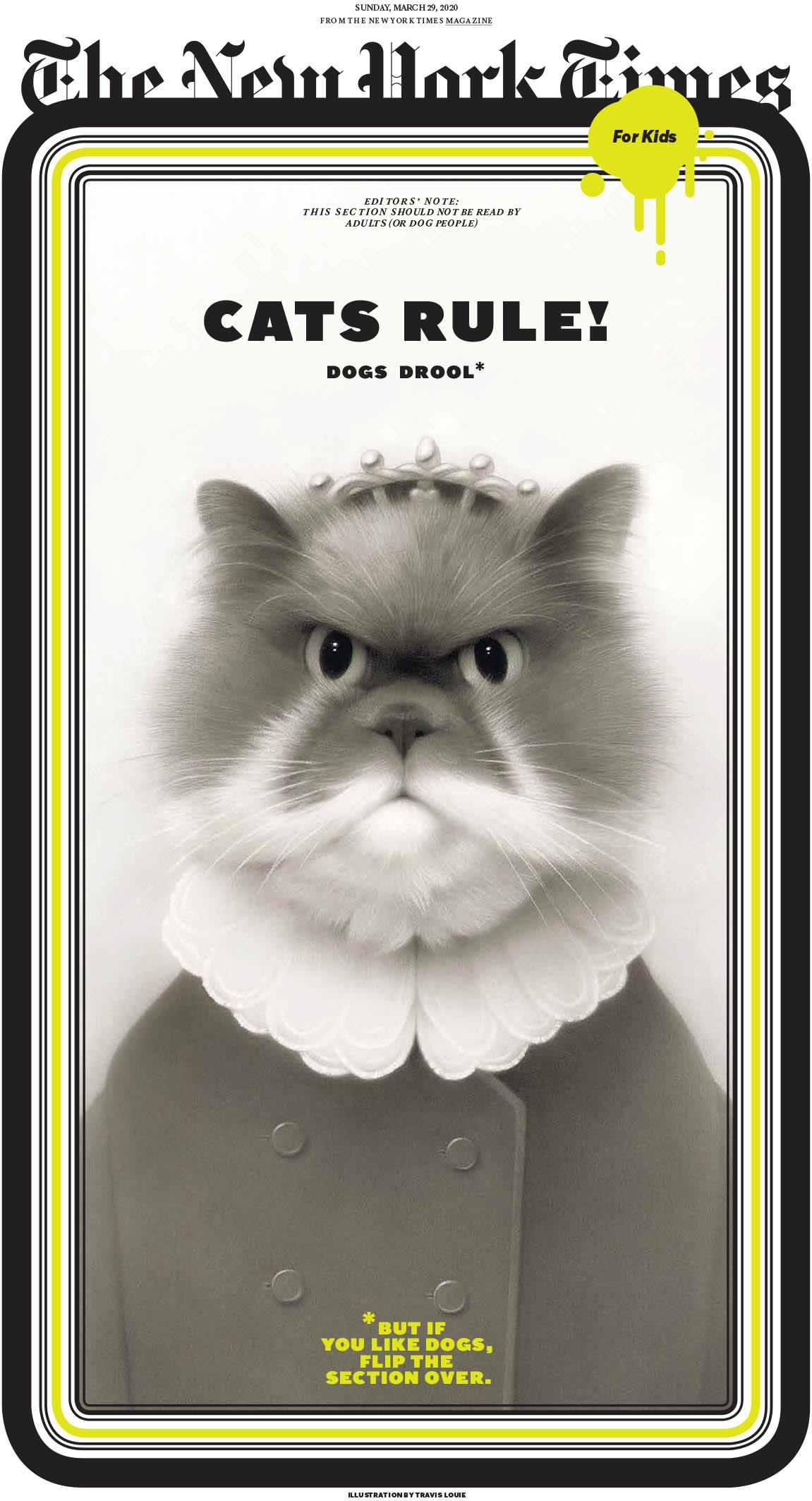
Speaking of simple fun, these New York Times pages from its kids section are just that. Fun. And who doesn’t love the age-old debate about which is better (and which drools), cats or dogs. But I think we all know the answer. Feel free to share in the comments below, but really, do we need to? We know (wink, wink). Again, pages driven by brilliant and beautiful illustrations. But a great concept. And a smile.

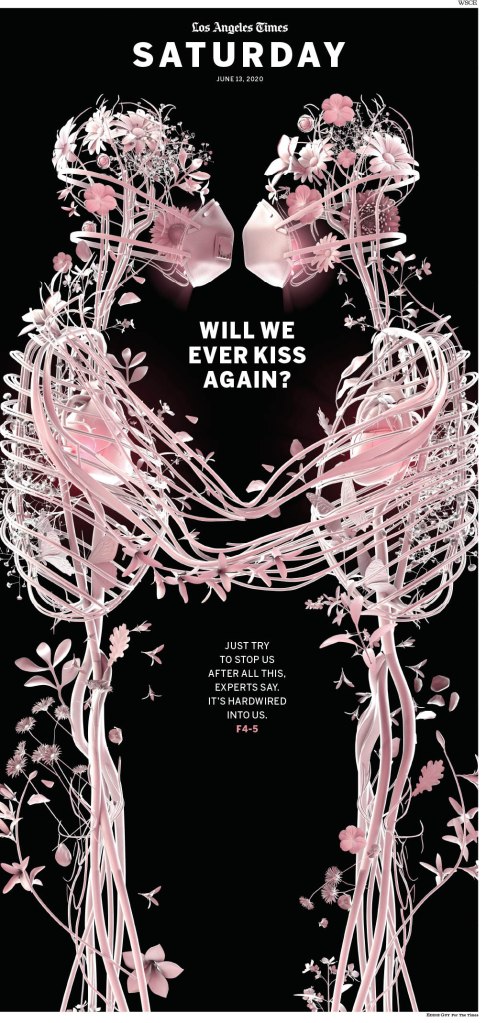
LA Times, Will we ever kiss again?

Last but certainly not least, the kiss. Another LA Times page driven by an illustration, but what an illustration it is. This haunting image by Eddie Guy is beautiful. How else to explain it? It gives me chills. And it’s even more impactful now, I’d argue, more than a year after the pandemic was first declared. Vaccinations are rolling out, there is a sense that we could return to some version of normal, but it’s been so long. and it’s been so hard. The biggest loss in all of this, after the tragic lives of so many lives, is personal, human contact.

There were so so many more incredible pages. It was astounding to see so much creativity in one place. I have some that rival these above on my scale of favourites. There was just so much talent on display. But I will seal this one with a kiss.

I hope that SND42 will be the gift that keeps on giving. I plan to talk about the amazing work that came out of Canada, and with any luck I will talk to some creative types who played a role in some of the pages that got so much love in the competition.

A compilation of partial covers by Raina Toomey

By Brad Needham

Newspaper design. There is not much more anonymous. Even the front page. Many magazines will list who designed the cover on or near the masthead. That is not standard practice in the newspaper world. In the past designers could compete for awards, but even those are disappearing. The Ontario Newspaper Awards dropped its design category (though I will urge them to bring it back here…). There is a presentation category that captures print and digital at the National Newspaper Awards. But other than the Society for News Design awards (still the pinnacle of print design awards), there isn’t much left. However, often those who get into design do so to be behind the scenes. So perhaps some don’t want to throw their hats into the ring of competition and have their names up in lights. Leave that to byline-hungry reporters (we thank you for your content).

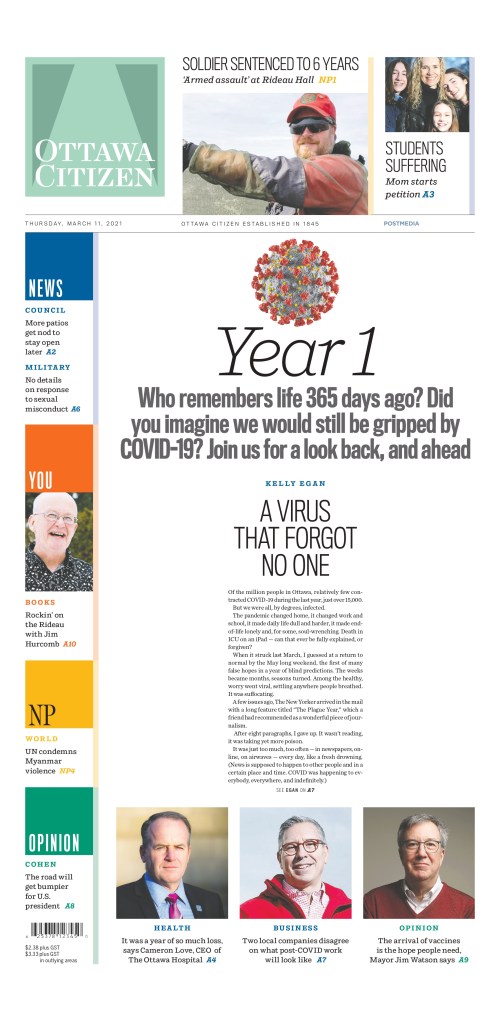
But the role of this blog is to shine a spotlight on both the publications and, when possible, people behind the designs. In this post I speak to Raina Toomey from the Postmedia Production Centre in Hamilton. It is the primary print production centre for Postmedia. I have long heard Toomey’s name. And unknowingly, I have seen her work (because it’s so anonymous). It was only luck that I stumbled upon something designed by her when I was doing a post on COVID-19 papers. She was responsible for what was probably the page of the year, in at least Canadian newspapers, on the anniversary of the declaration of the pandemic, March 11, 2021.

Ottawa Citizen, March 11, 2021

I was happy to hear that she would be interested in talking to me about more of her designs. I love to look at a body of someone’s work, rather than one piece, to see themes and differences. I asked Raina some questions about her career in design. I found that she and I had a lot of similarities. We both started in editing. We both love simplicity in design. We both work in media production centres. Without further ado …

How did you get into newspaper design?
I studied print journalism in college because I loved writing and, at the very wise age of 19, decided it was journalism or teaching and I didn’t want to be a teacher. (I shake my head at myself now, of course.)

In my second semester of college, I started working part-time as a copy runner (essentially, a gofer) at the Ottawa Sun, took on freelance work for them and did my job placement there in the fourth semester as a reporter. That was when it firmed in my mind that I really hated reporting and talking to strangers at some of the worst points in their lives. I was hired as their TV editor, which involved a mix of interviewing, writing features and basic layout. That evolved into the new position of production editor for the Today section, laying out and copy editing the Sun’s arts and life pages. Being the Sun, that meant a lot of bells and whistles and splashy design.

Readers’ time is valuable. Effective newspaper design informs as much as it attracts.

Raina Toomey

From there, I moved to the Sun’s news rim as a copy editor, then to the senior slot editor, slotting and drawing the news and business pages.

After 17 years at the Ottawa Sun, I made the move to broadsheets and the Ottawa Citizen as a copy editor on the news desk. By the time I left the Citizen four years later, I was their A1 editor and had worked on a number of special projects, including design and being a builder of their content management system.

I transferred to Postmedia Editorial Services in Hamilton, where I am the production editor for the hub that produces the chain’s 10 major market publications (nine broadsheets, one tabloid). The position offers a lot of variety, and I’m somewhat of a jack-of-all-trades. My specialties involve developing efficient print workflows across the chain, newsroom technology, planning and newspaper design. I work on everything from day-to-day production – layout, editing, clearing pages, design of pages that break away from the ordinary – to the design and production of special coverage such as the Olympics and elections, to rolling out and training staff on our content management system and other technology.

What do you like about newspaper design? And what makes it different?
I love the flexibility of newspaper design, in that it goes beyond pure esthetics. Newspaper design demands a special skillset that blends news sense with creativity. It needs to draw the reader in, while remaining true to the subject matter. It must be more than visually pleasing; it has to be readable. Yes, use a pullquote, but only if it draws in the reader in a contextual way. Info boxes, numbers packages, sidebars all have to be treated as part of the whole and add value. Readers’ time is valuable. Effective newspaper design informs as much as it attracts.

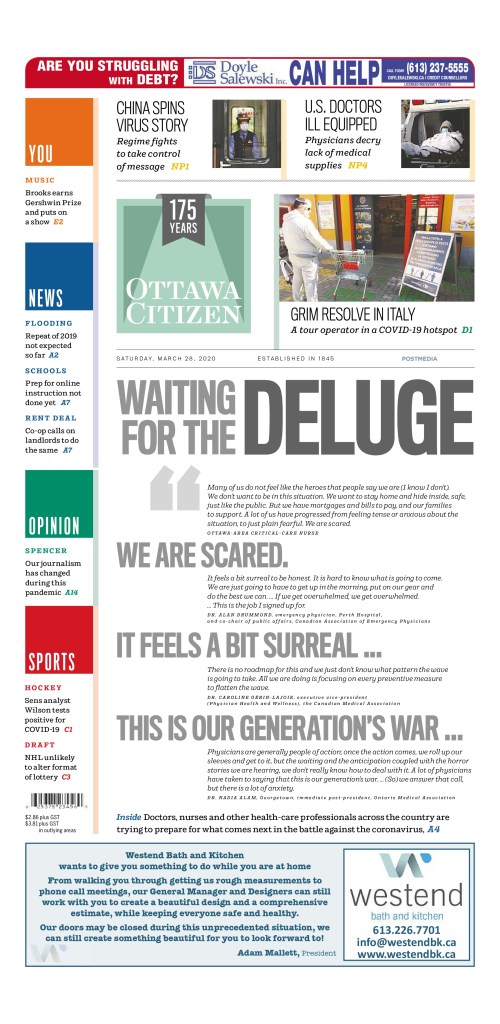
Ottawa Citizen, March 28, 2020: a text-driven cover.

What was the most fun you have had with a design?
I think the most fun I’ve had with design is when I’ve been forced to make something out of nothing – where the art is lacking or of poor quality, but the story is important and needs to make a splash. I am not fond of using clipart unless there is no other option, so it is satisfying to devise a type attack or interesting play of lacklustre art that manages to make things pop.

Do you rely on one design principal more than others (white space, text as design, colour, cutouts, etc.)?

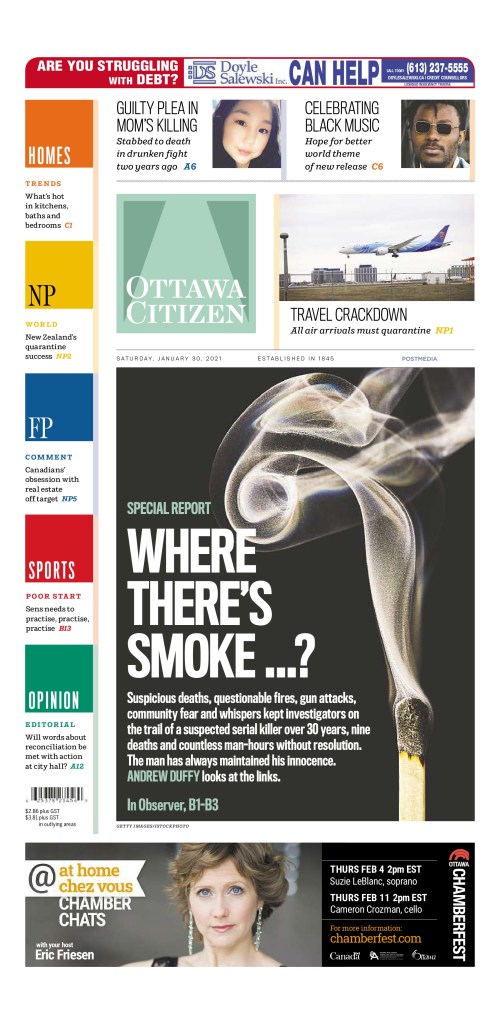
Ottawa Citizen, Jan. 30, 2021. A simple cover with just three headshots as art.

Simplicity is important to me. I like the conscious use of white space, as well as the judicious breaking of rules in limited instances. The Postmedia design has what some have called rigid rules – headline hierarchy, how and when colour should be used in text, no text on photos, no cutouts or close crops – but that is only for the day-to-day design. Sticking to the rules in the majority of situations adds more power and impact to a design when a decision is made to deviate from the rules.

Tell me about a design you loved that was rejected.
One paper had a lifestyles section front about wedding dresses. The main art was fairly small, and restricted to above the fold. I sized the art way up, so the model went from the top of the page all the way to the bottom, approved a close-crop and extended the train across the bottom of the page. It was stunning. The editor insisted the photo be sized back down so the entire gown could be above the fold.

I feel I’ve grown a lot as a designer and a journalist since my early days, and expect to learn more – and improve – in the years to come. If I don’t, that would be a sad state of affairs.

RAina Toomey

Now, in my opinion, above the fold/below the fold is outdated thinking, even when it comes to A1. First, the bulk of the circulation for most papers is based on home subscribers, not single-copy sales at the corner store or gas station. Secondly, someone who is going to pick up a paper along with their gas and lottery tickets will not be choosing their purchase as they would decide which tomato to buy at the grocery store – they want to buy that newspaper. Lastly, this was an inside section; by default, the reader would have to unfold the paper to even read it, and would see the dress in its entirety.

Are there any designers or publications other than those you have worked at that you are sure to look at?
I love the design of the National Post’s Weekend Post. It’s very magazine-like, and showcases the way great design can maintain a consistency in style while doing some pretty out-there design. Lovely.  

How do feel now about the first handful of pages you were proud of? Still love them? Wonder what you were thinking? Wistful for times gone by?
I don’t do a lot of looking back. I consider design a constantly evolving skill. What I did years ago is indicative of where I was at that point in my career, and that’s fine. I feel I’ve grown a lot as a designer and a journalist since my early days, and expect to learn more – and improve – in the years to come. If I don’t, that would be a sad state of affairs.

I do appreciate that technology has reached the point where the designer can touch all aspects of their creation – no sizing wheel, no getting camera-ready versions of images shot for paste-up, no painstaking close crop work with an X-Acto knife.

How is it different working in Hamilton vs. working directly in the newsroom? 
In some respects, working at a hub offers more variety, challenge and flexibility than working in a traditional newsroom. While our newsroom colleagues may feel that those at the hub are separate from them, and not as invested as they are in stories that matter to their readers, that is not the case in reverse. Many staff at the hub take pride in the work they do for “their” paper or papers and feel they are contributing in a meaningful way to the papers’ success. This past year of working from home has likely offered our colleagues a glimpse of what it is like to work outside the newsroom and still be part of the important work we do as journalists.

The logistics of working at a production hub are different, and that can largely be chalked up to technology and how economics have changed the business of presenting the news.

In past years, when every large newsroom had in-house designers, print design was as much a part of the discussion for special projects as the writing and photography. Now, that kind of start-to-finish collaboration often only occurs for digital presentation. It’s possible that some newsrooms consider print design to be outside their scope, since their paper is no longer put together in-house. It is also simply the way things are as we move more fully into the digital world.

Unlike traditional newsrooms of the past, the production hub has to balance creativity and workload. Where once a designer in a large newsroom might have a week or weeks (or longer) to create something spectacular, a designer at a hub has to work under much tighter time constraints and deal with a greater volume of pages. Some newsrooms try to involve the hub as much as possible, giving advance notice and filing early when they require something with flare. They may have suggestions or a vision, or they may just hand it over without offering guidance. Other newsrooms aren’t as aware of the time needed to make something sparkle, or face staffing constraints that don’t allow much turnaround time. Everyone everywhere has to do more with less.  

It might be like picking favourite family members, but if you had to pick a few favourite pages, what would they be and why?

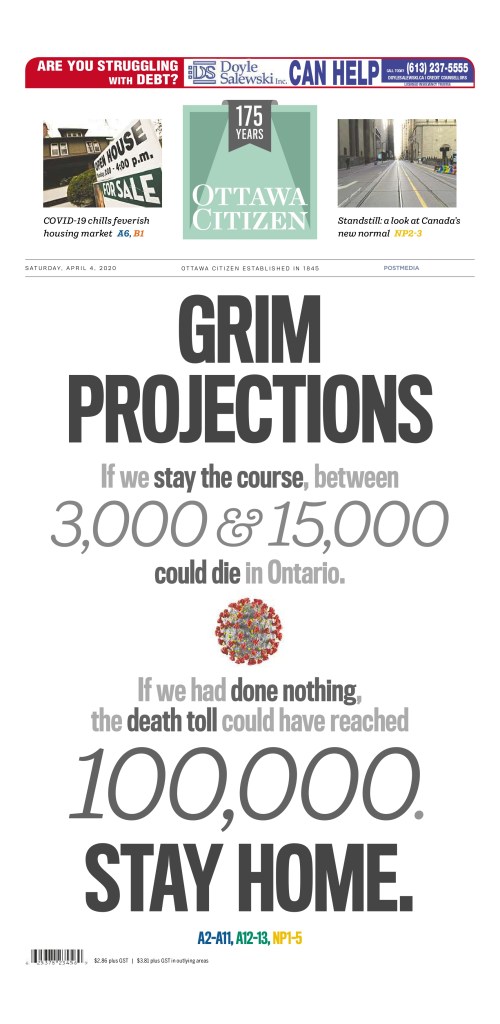
Ottawa Citizen A1, Saturday, April 4, 2020

An example of the power of a type attack using shades of grey and a mix of Postmedia’s bold block line style font with the serif style we use for big numbers in display. The page also broke from style in that there was no main art, only a small close-crop of the now-familiar computer-generated image of the coronavirus. Saturday A1s usually are colourful, teaser-driven pages, so the calculated, drastic deviation from style served to emphasize the seriousness of the province’s message.

Ottawa Citizen A1, Saturday, Jan. 30, 2021

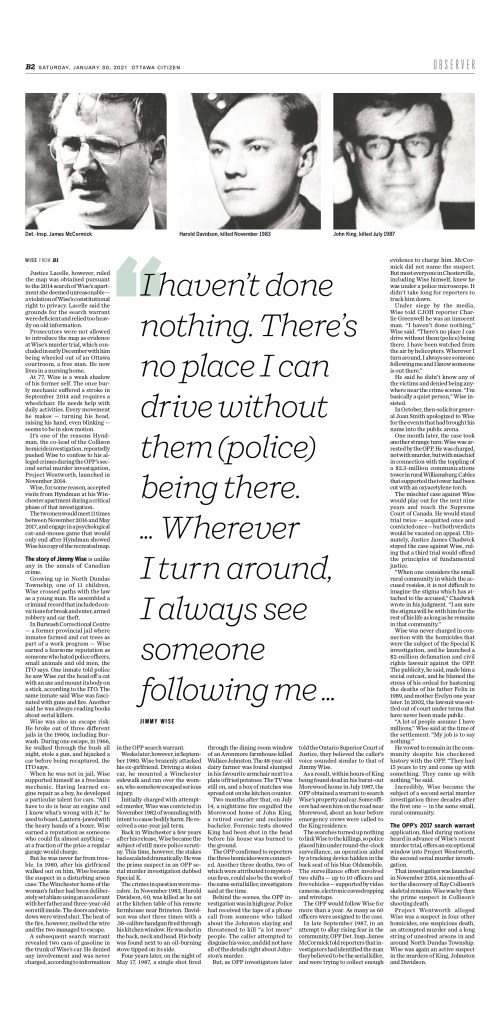
While I usually avoid using clip art whenever possible, this page presented a challenge in that the only art available was largely poor-quality headshots of the suspected serial killer and his victims, and those were used with the three-page feature inside. Andrew Duffy’s incredible piece strung together suspicious deaths, fires, shootings and rumours as police spent 30 years trying to get the evidence to convict a man who has always maintained his innocence. This design broke from style by using clip art of a smoking match (to convey the link to fires and a trail gone cold) and putting large, bold type for both the head and deck on the black background of the image.

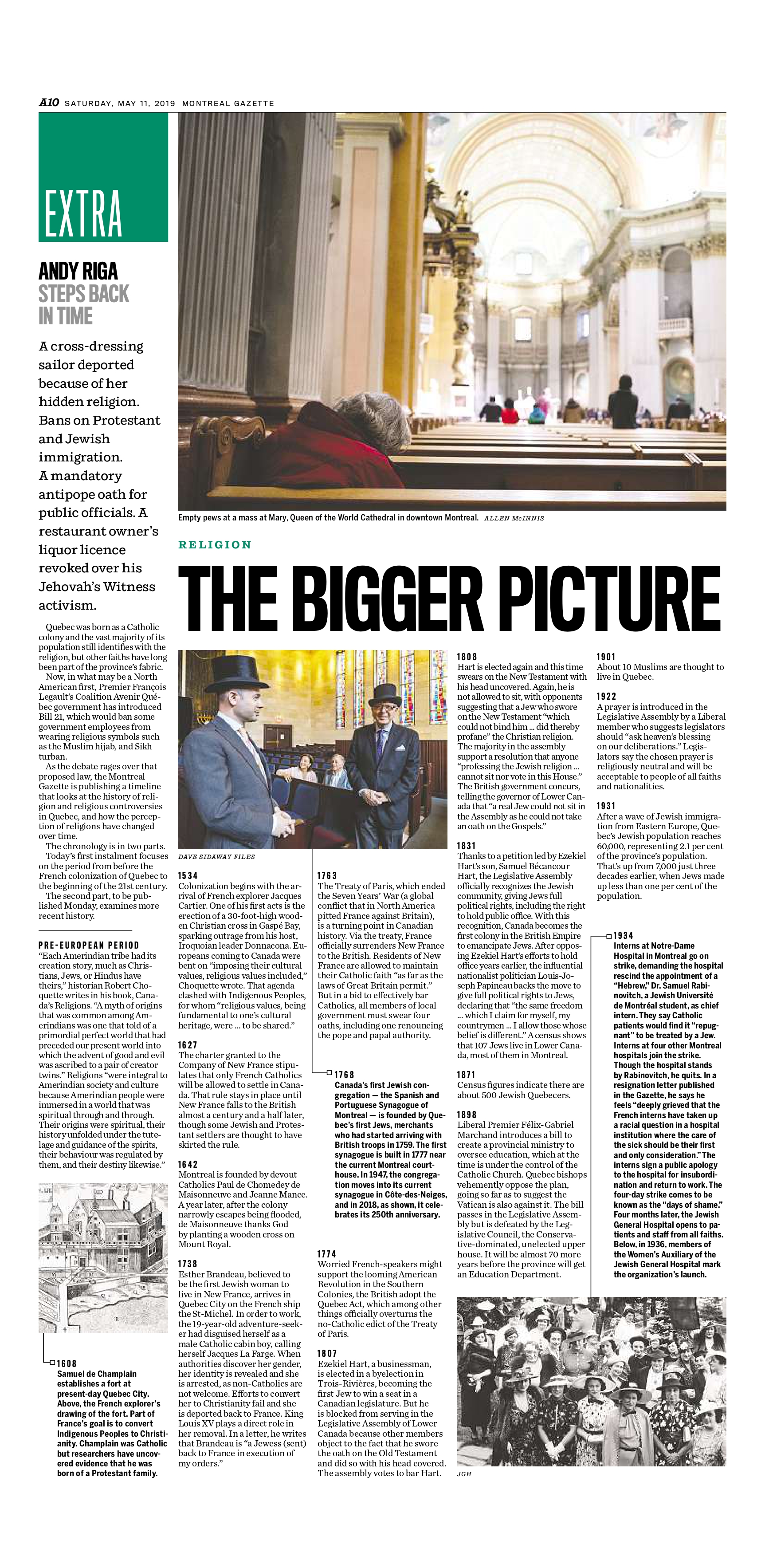
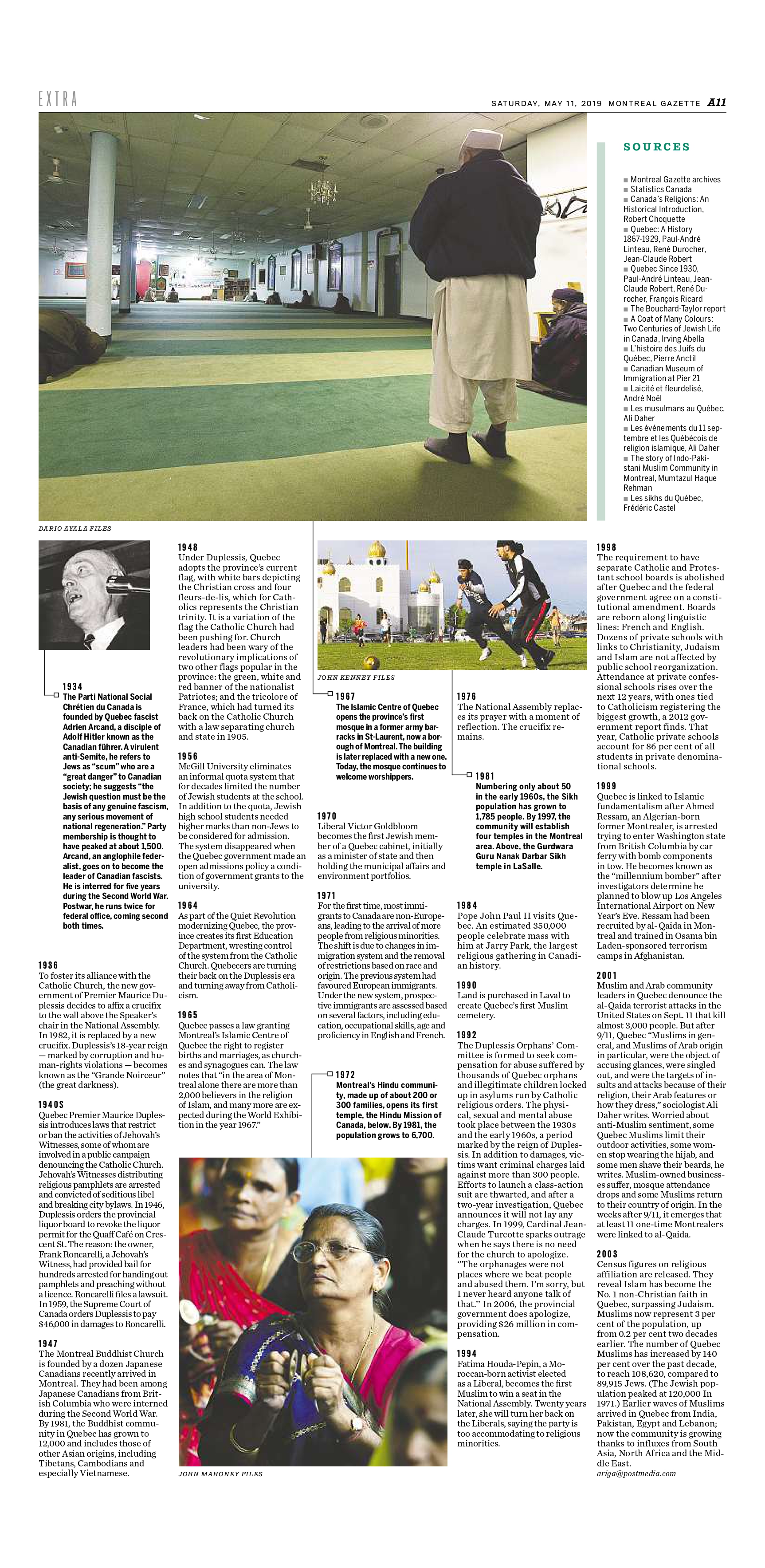
Montreal Gazette, A10/A11, May 11, 2019

It’s difficult to separate politics from religion in Quebec. In a two-part series, Andy Riga looked at the intertwined history of two integral pieces of identity for many Quebecers. The first part ran May 11, 2019, and consisted of a piece that took some time to figure out – what would be the best way to present a narrative feature in a format similar to an illustrated timeline? If styled like a usual timeline, our sans infobody style, it would be dense and difficult to read at that length. I used archival images, special formatting derived from existing styles in our design and, my favourite, white space to make key moments in the timeline stand out.

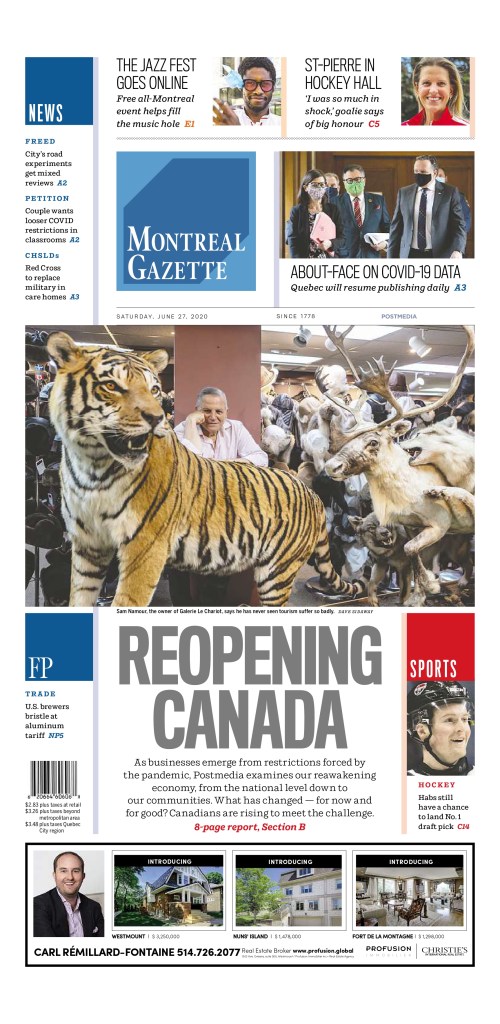
Montreal Gazette, Reopening Canada package, A1, B1-B8, June 27, 2020

Every major-market paper in the chain ran a Reopening Canada package June 27, 2020. With a mix of local and shared content, the sections required a cohesive look that would tie everything together and say, “Here is something you need to read.” Our section squares are usually set solid colours reserved for standing sections. I created a special red square with a Maple Leaf watermark to use on the section front and smaller on each page in the section. Pages were limited to a maximum two stories, features or alternative story forms, every one labeled in red – not one of our usual accent colours – to indicate the specific economic sector, such as aerospace, retail, restaurants, arts and culture, etc … Each page featured a large pullquote beside the inside square, a style most often restricted to the OpEd pages.

Thanks, Raina! Thus ends the Q&A portion …

I agree with Raina on her choices, particularly the Grim Projections page. It uses text so boldly to send an important message. Stay home. That’s it. And as I said up top and in a previous post, I love the design on the anniversary of the pandemic declaration.

Here are a couple more I really dug from the samples she sent.

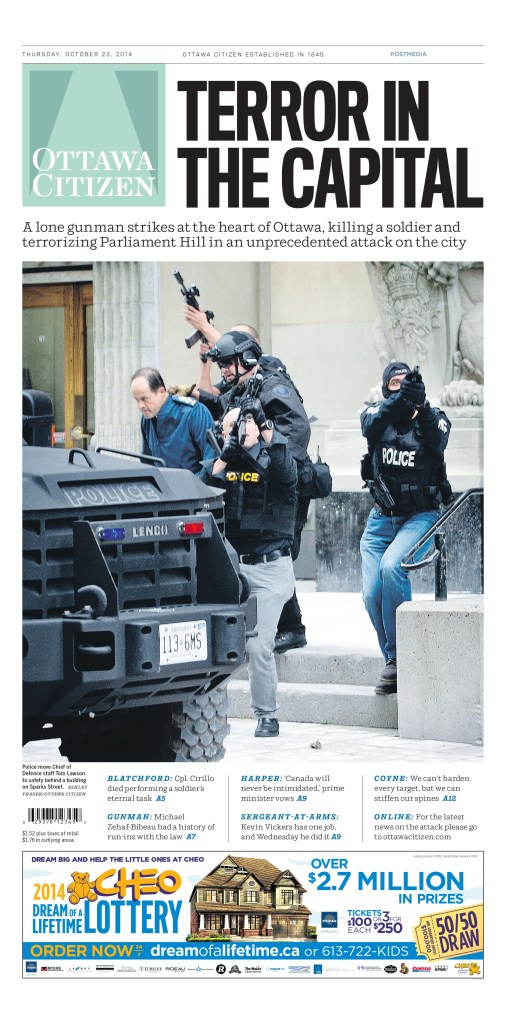
Ottawa Citizen, October 23, 2014

I love this one for three reasons I always go back to. It’s a big day, and nothing captures a big day like a powerful newspaper front page. It’s simple, which I always appreciate, but especially on big news days with emotional, sensitive content. The story is the story. The page needs to capture the gravity without taking away from it. It can be hard to not go too far on a design. And the strong image.

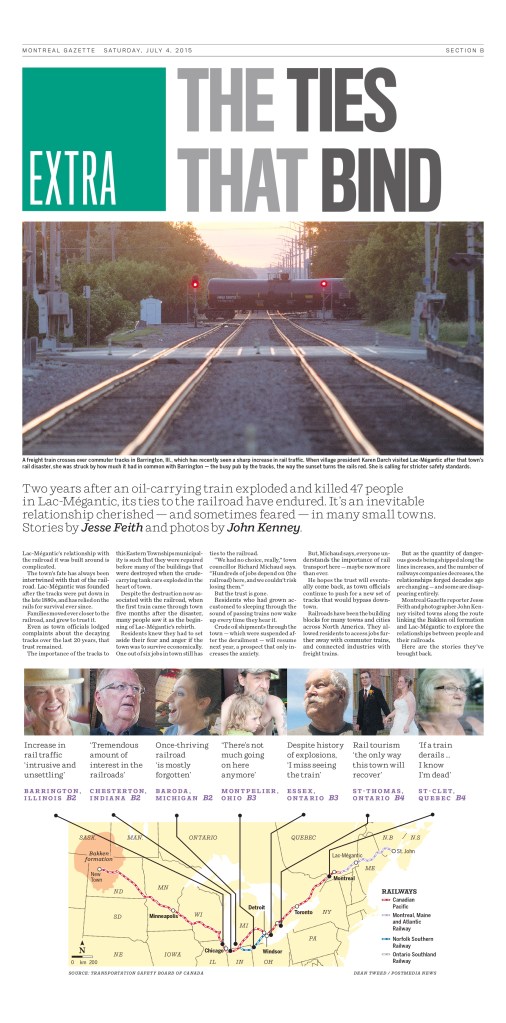
This is another design I like for being simple and informative. A good, big, bold headline. Clear throws to the inside. A helpful map. And again, this was about an important and sensitive topic, though a retrospective kind of look, rather than the day after coverage.

Many staff at the hub take pride in the work they do for “their” paper or papers and feel they are contributing in a meaningful way to the papers’ success.

Raina Toomey, on working outside a specific newsroom

There were so many others to choose from. Raina had a number of wonderful designs (some beautiful graduation pages, capturing and celebrating graduation in a pandemic in the Calgary area, and more), and I also very much appreciate her approach to and philosophy on design. We share so many similar views. Not only that, we both work in a similar environment. While the Postmedia Production Centre is part of Postmedia, it’s still outside the newsrooms, which creates a new dynamic with editors. The same is true at PMNA, though we are an outsourcer (that said, PMNA is owned jointly by three organizations, two of which we have done or still do layout and editing for: the Globe and Mail and Toronto Star). But even with a different relationship, outside the newsroom, Raina has found a way to shine (as have the editors at PMNA).

But a special thank you again to Raina Toomey. Thanks for continuing to give it your all in an industry that doesn’t value print design as it once did. The results are evident. And I know many still appreciate it, though maybe few as much as I do.

By Brad Needham

There is something special about design in student newspapers. Student newspapers often push boundaries that mainstream newspapers cannot. The designers have less experience, which isn’t a bad thing. While skills can be refined with experience, enthusiasm can also wane with the restrictions major newspaper designers face. It’s why I look back so fondly at my time at the Guelph Mercury, where I had essentially free rein to do whatever I wanted. It made for much bolder designs (and a few fails!). The same could be said about my time in student newspapers at the Reflector at Mount Royal University in Calgary. I had so much fun.

There are so many reasons to celebrate student papers and the creativity behind them. One, they tend to be very good. Two, they are often bolder. Three, young aspiring journalists or designers or even those doing this for reasons not related to journalism deserve some time in the spotlight in an industry that is making that considerably harder.

But the main reason I wanted to do it? Because there are still student newspapers. Print products. Newspapers fellow students hold in their hands. So many schools have gotten rid of theirs, which is so sad, both as a lover of print media, but also as someone who hires young people to work on print products. The skills are getting much harder to come by as schools close their papers in favour of online-only publications.

So I issued a callout on Twitter to those in this realm. I was tickled to hear from Lua Presidio, the visuals editor from the Ubyssey Publications Society at the University of British Columbia. The Ubyssey is always doing exciting things. Their covers are always dynamic and bold. And the theme is generally carried on throughout the issue, not just a one-off design to blow out the cover as is often the case in traditional newspapers.

I asked Lua some questions. Here they are, in no particular order (other than the order in which I wanted to present them)! The first question presented was the last question I asked. But I agree so strongly, I moved it up. Designers, print designers especially, so often go unnoticed nowadays. Organizations like the Ontario Newspaper Awards axed its design awards, and the National Newspaper Awards pit print designers against digital designers. Thank goodness for the Society for News Design, which still loudly and proudly celebrates print design.

“We really are putting our hearts and souls into making these. I see some amazing work out there that I would love to see get more recognition.”

Lua Presidio, on celebrating design in student media

What got you interested in this, and why did you reach out after my tweet?
I thought it was a cool opportunity to showcase the work of student journalists who aren’t actually dealing with words. Not many organizations are paying attention to that when it comes to student journalism (understandably so since very few newspapers have full-time visual staff), but we really are putting our hearts and souls into making these. I see some amazing work out there that I would love to see get more recognition. (The Eyeopener and The Gateway are two of my personal favourites — amazing design teams).

What goes into designing a cover and an issue? What is the process?
The design process and what it takes varies a lot. It depends on what type of issue/project we are working on, the time frame we have to complete it, and if any breaking news arises for the day/week we publish. For regular issues it’s usually a week’s worth of preparation where we decide which article should be featured on the cover. We choose an article based on relevancy. Then, the editor for that article and I work together with the Photos Editor to come up with a concept for that cover. If the concept is around a photo, the Photo Editor will take care of it. However, if it’s around an illustration or photo modification, I am responsible for it. Usually I try to pitch out these covers to have a variety of styles and people featured on our pages, but depending on the week I end up doing a large sum of the designing of covers. If it is a bigger project like the gender issue, “Performance,” the process is very different and much longer, but still relies on the collaboration between editors.

I’ve noticed the theme from the cover carries on inside for many issues I looked at. Has that always been the way?
Generally yes. I like to keep styling consistent and when deciding on anything for an issue, cover is usually what comes last because I always want the cover to reflect the content and not the other way around. The cover should make readers want to pick up the issue, but it shouldn’t be more interesting than the content itself.

Why did you select the editions you did? What do you like about them?
I sent you three editions that I think tell a complete story with the cover.

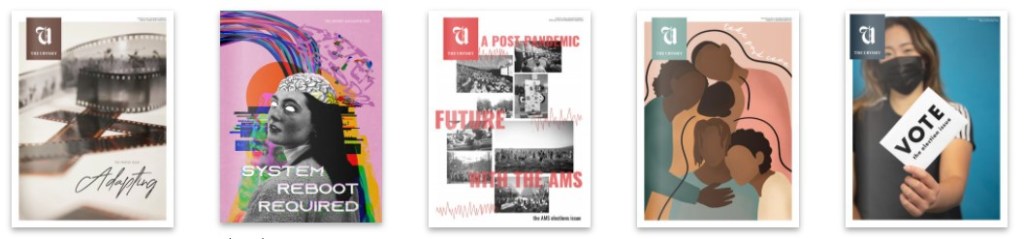
Ubyssey Gender cover by Lua Presidio and Elizabeth Wang

The Gender issue had an extensive preparation behind it and it’s one of the issues I hold closest to my heart although looking back at the inside design I wish I had done things differently.

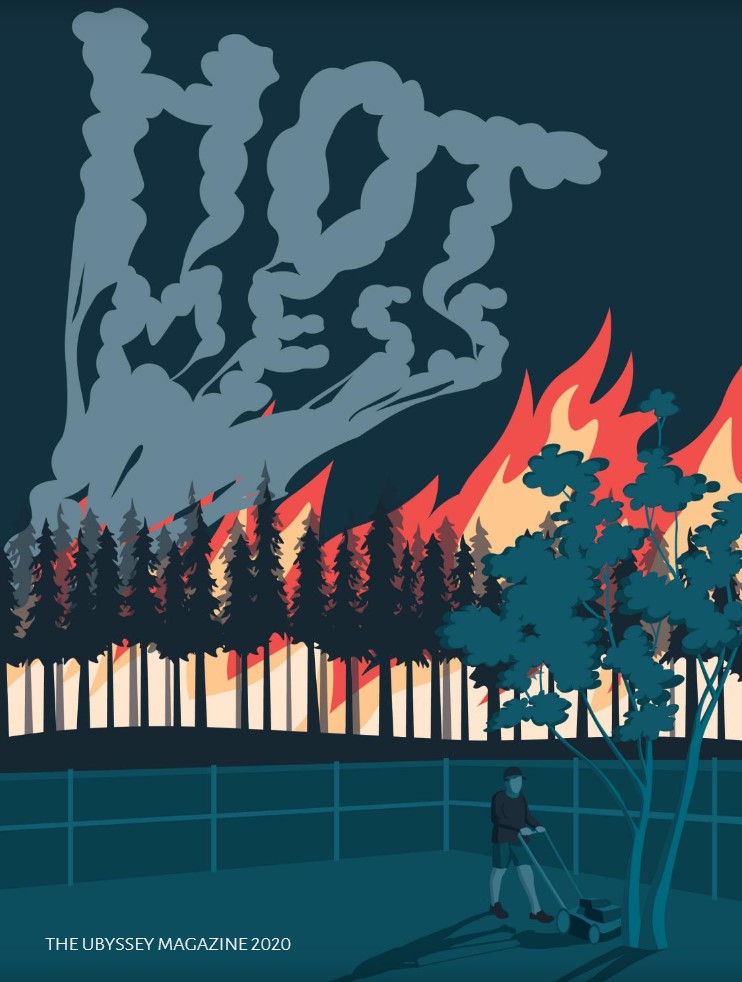
Ubyssey climate cover by Alex Vanderput

The 2020 Magazine “Hot Mess” I love because it’s a meme reference that was transformed into this beautiful illustration most people don’t even recognize as the meme. And yet, the sentiment of the world burning while we do nothing really captures some of the themes present in the issue. The 2020 Mag was about climate change and hot mess was a very quick, catchy way we found for describing the entire world situation.

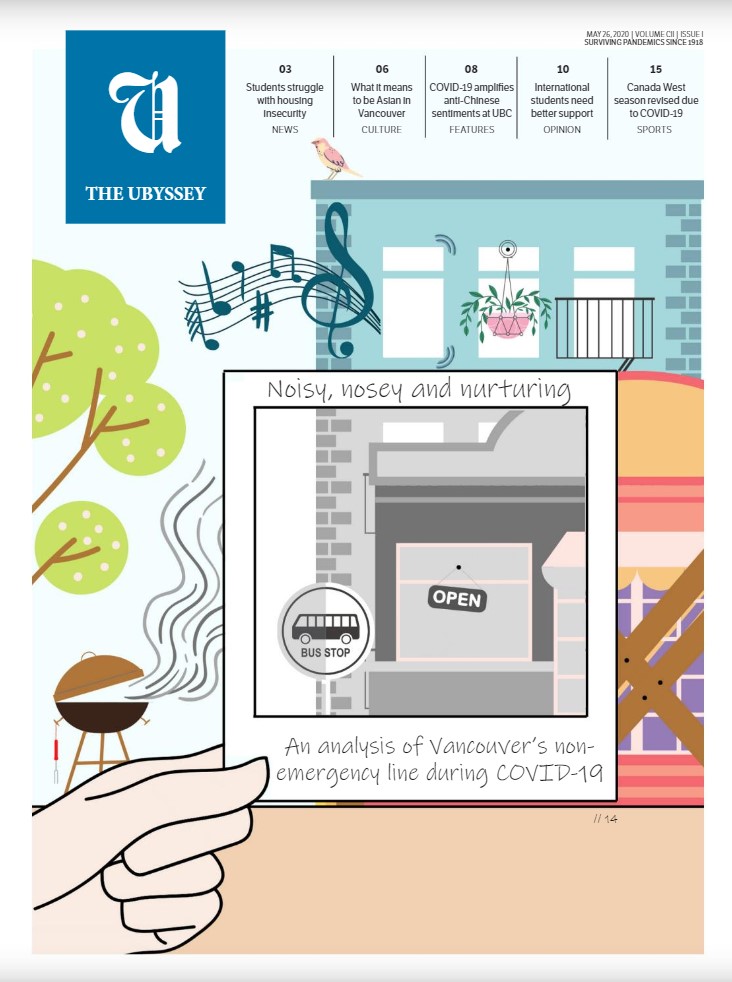
Ubyssey May 26 (COVID) cover by Eisha Sharda

Finally, our May 26 issue is one of my favourite representations of the before and after that the pandemic has brought about. The article talked about some of the positive aspects of the pandemic, and I think the cover reflects those positive aspects well without ignoring some of the difficulties that were also brought about during the pandemic. There are other covers that I also love and could have shared, but they were some of the ones I designed myself, and I don’t love to toot my own horn that much.

Tooting horns

I have no problem tooting horns. I wanted to show off a few other covers and pages that I really enjoyed, the first by Jasmine Foong, and the next two by Lua.

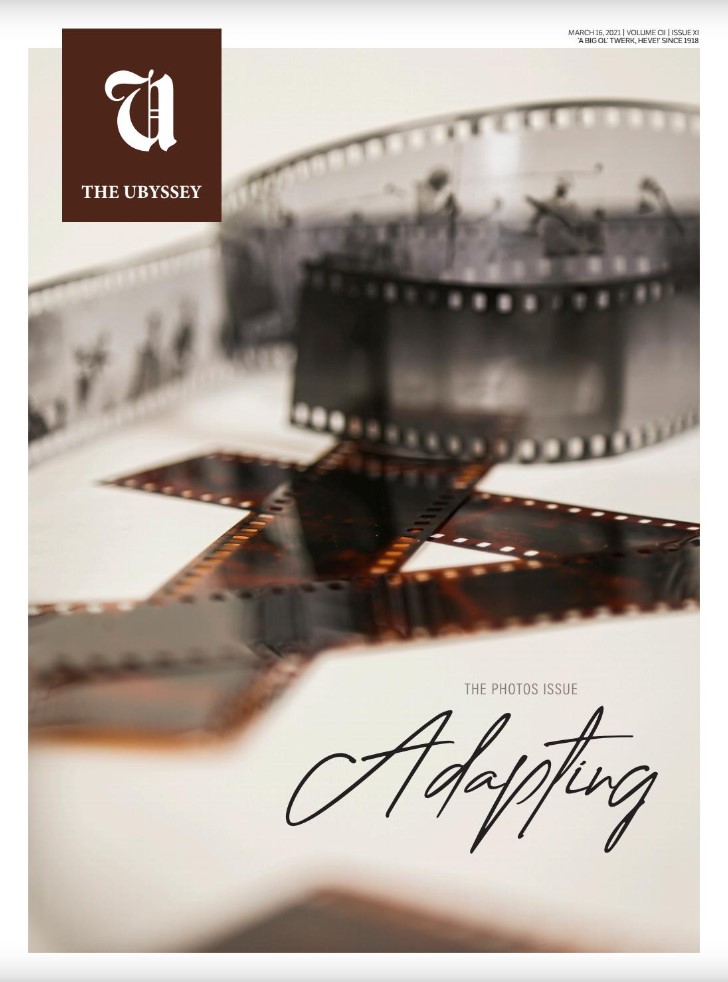
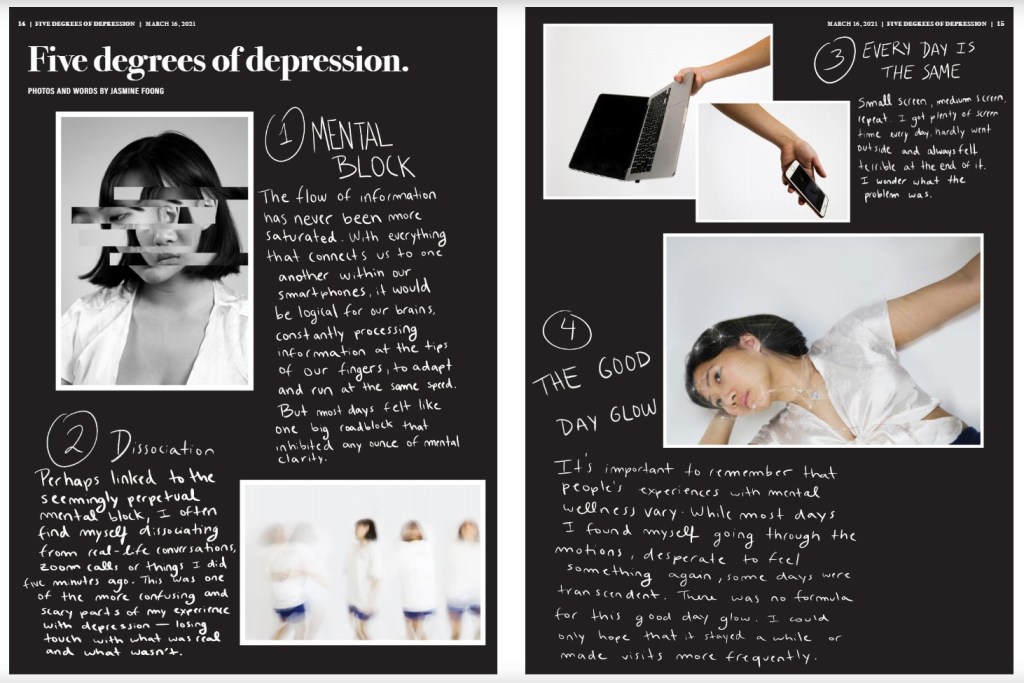
Ubyssey cover by Jasmine Foong

I just find this cover visually pleasing. Plus it brings back memories. My original career path was photographer, and I was a film guy. Digital photography was just in its infancy when I was in university. I remember my professor putting the strap around my neck to ensure that his wildly expensive, heavy 1MP camera didn’t shatter on the ground at my feet. I also love this as it’s so fitting to this blog. Adapting. To survive newspapers have had to adapt. And that has led to moving money from print to digital. So while designers are working with less (time, money, updated software) they are still killing it. This cover is an example. It’s actually relatively simple. A picture. Depth of field. Sepia tone. But I love it. Confession: I love simplicity in design. If you can be simple and have it work, that’s magical. Things like white space, not coloured boxes. A simple photo, not a cutout. Text as your art, no photos. Amazing. This cover makes me wistful, and if a cover can evoke emotion, it’s working.

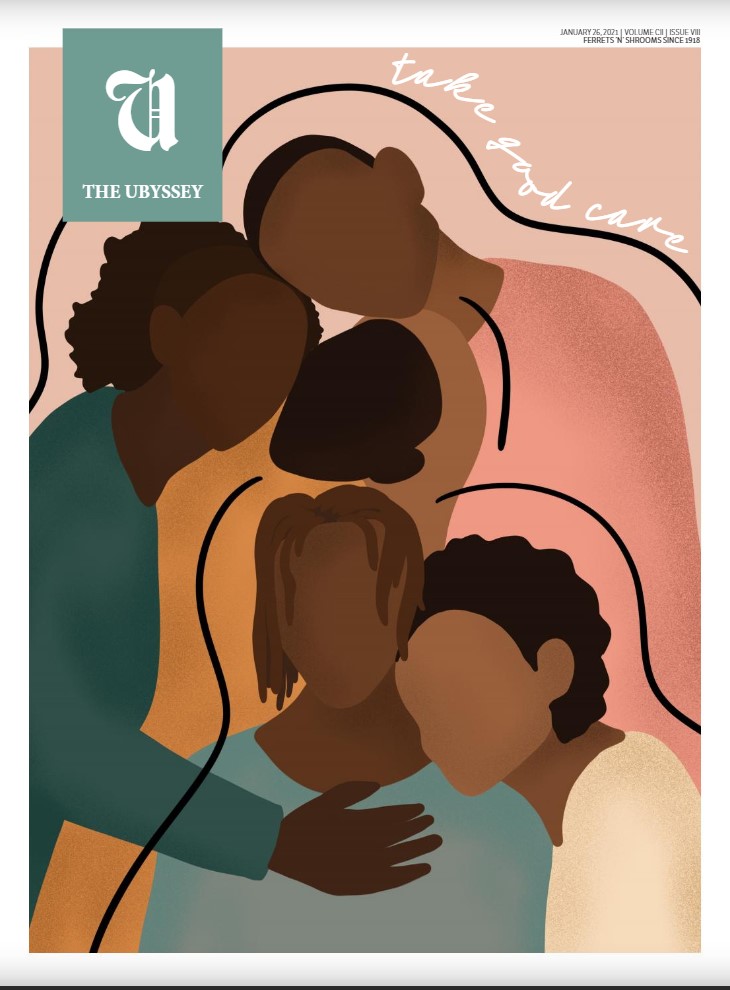
Ubyssey cover by Lua Presidio

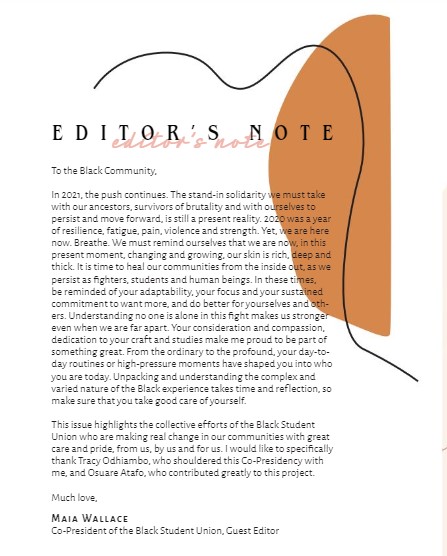
This seems like a simple illustration and in a way it is. There are no features, no fine detail. But that’s why it’s so great. It’s almost featureless, which is the new trend in illustrations, and rightly so. So people can see themselves in the image. But on this cover, this is where the almost comes in. There is one feature that binds. And that is that all these otherwise indistinguishable people are Black. Despite the figures not having an identical skin tone, the reader knows they are meant to represent the Black community at UBC. That was the focus of this issue. As the editor’s note says, addressed to the Black Community: “In 2021, the push continues.” Here is the message below.

Ubyssey inside pages by Lua Presidio

This is what student newspapers are about. This is the kind of thing you can’t do at a big newspaper. There are some design rules broken. The font is not perfectly and easily readable for two reasons. It’s reverse text and the font isn’t simple. But I like it. It tackles a big subject with a non-standard but powerful (yet relatively simple) design.

I hope to do more on student newspapers. As long as they are around and people are having fun designing them, I plan to celebrate this budding newspaper creativity, in hopes that it continues on past post-secondary education and into the traditional media world.

By Brad Needham

Behind every successfully designed newspaper page is a talented designer. And often a slew of other people. As part of this blog, I plan to feature designers. I want to find out what makes them tick. What gives them that creative spark. Newspaper pages can be like art. Sometimes designers have oodles of time to bring these designs to reality. But sometimes it’s a day. Or less. Either way, I applaud them.

I hope to run a profile every month, of either an established designer with a deep portfolio, or an emerging designer, with a few great portfolio pieces and a boatload of potential.

In the first instalment, I bring you the great Tammy Hoy, a Canadian Press and Pagemasters North America designer. Disclaimer: I am the managing editor at Pagemasters and I have worked with Tammy for eight years. That is not necessarily why I’m featuring her, but it’s why I know very well the depth of her talents. But I will be writing what I know! So early on, dear reader, you may notice people with connections to me! I hope to find designers to feature from further afield as well, but Tammy is a great choice regardless. A quick look at her website, tammyhoy.com, anyone could quickly see a whole lot of visually mastery.

In these features, I will do a Q&A, and let the designers do most of the speaking. So I will stop talking for now. Without further ado …

A collage of newspaper pages by Tammy Hoy.
A screen grab from tammyhoy.com showing designs by Tammy Hoy.

Designer profile: Tammy Hoy, Pagemasters North America/The Canadian Press

How did you get into newspaper design?
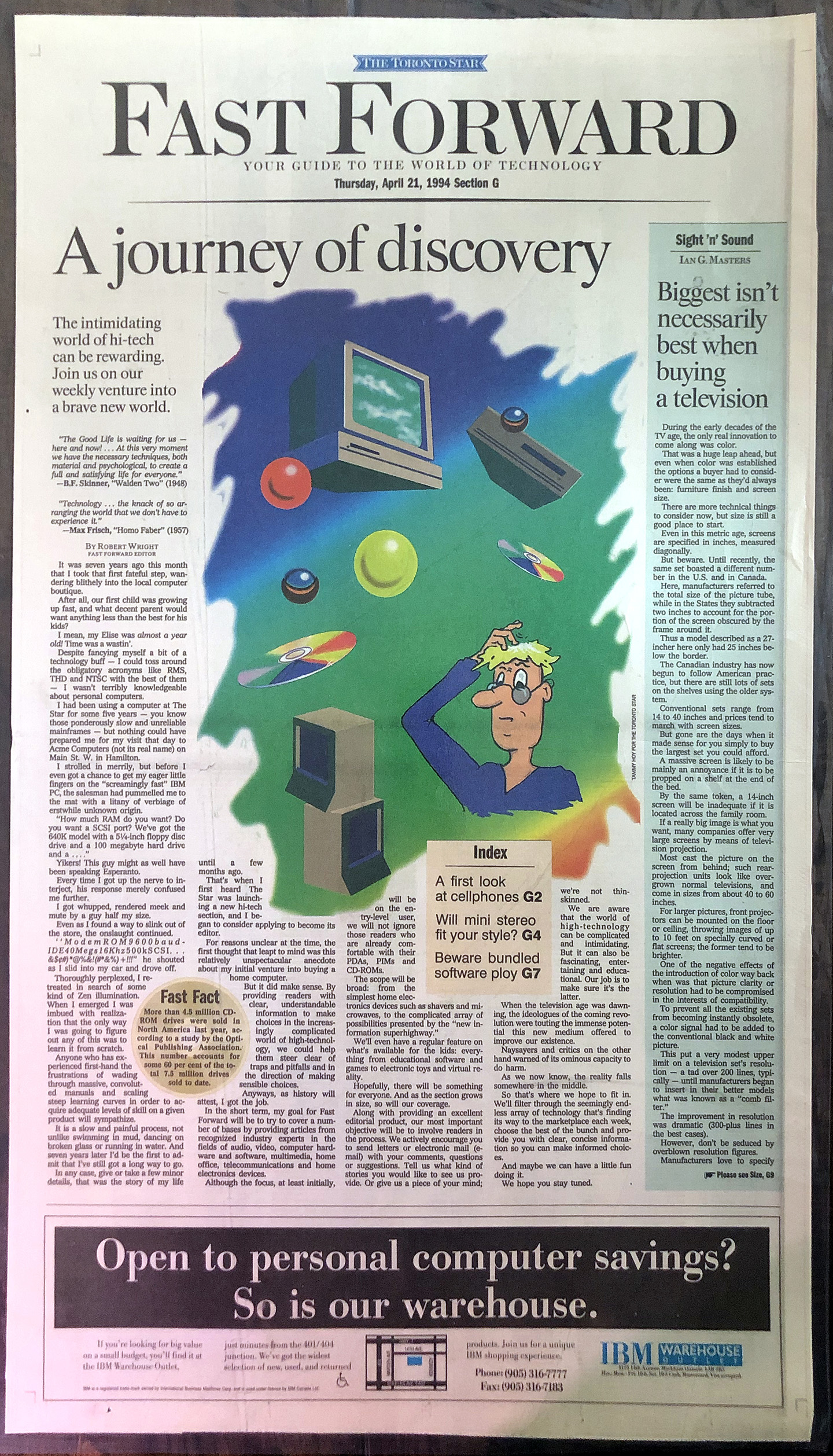
It was a series of unlikely but fortunate events. Back in 1994 I was studying Illustration and design at Sheridan College and my roommate mentioned a job ad that he saw for freelance newspaper design work that was posted in the wrong department at our college (That department being animation and not design). I was really excited and I hoped it might be a great opportunity to get some real-life work experience while still at college. I called the number on the ad and they asked me if I could make it to 1 Yonge St. within the hour. I told them I could be there in two.

 I was so nervous. In my interview I was told that they needed a front-page illustration for a new section on technology; and they needed it by tomorrow! It was a sink or swim situation. I told them, I’ve got this.

It was a super exciting opportunity, but the worst part of it, ironically was the technology at the time. Envision this, I had to produce an illustration overnight using one of the first versions of Photoshop. I had no scanner because at the time they were a couple thousand dollars. We did not have cellphones so I couldn’t transfer any kind of image or reference material to my computer. I literally had to draw something with a mouse and make it look high tech. And on top of all this, it would take an hour to apply a filter. Layers were not even invented yet! Needless to say I did my best with what I had. And they liked it!

I can certainly see that I’ve grown but they’re not bad considering this was the ’90s, an era when rotating logos with flames were in still in fashion.

 In the coming months I completed several of the front pages for this section and invested in a scanner so that I could add some imagery to some of my future art. I loved every minute of it. I continued on that year to complete my degree in Illustration and Design at Sheridan College.

That same year my mum saw a job ad in the Toronto Star looking for an artist to work in the newspaper industry. I jumped on it. I started out in the graphics department at The Canadian Press and later began creating full-page newspaper designs, motion graphics and various other artistic material for Pagemasters North America, a subsidiary of The Canadian Press.

What do you like about newspaper design?
I like that once you build a good working relationship with your editors the sky is the limit in terms of what you can create. Within the confines of the newspaper’s style there are so many unique opportunities to express yourself. 

The goal being to work with the editor to create something a little unique that also goes well with the story. It’s also rewarding to meet extreme deadlines because you get to see your work published the next day or a few days from the day you put it together. There really is no time to fuss over things or overthink.

I love it because it’s also a beautiful collaboration between typography and art. The trick being to combine both, to create something really special.

What advice do you give when teaching people about design?
Think outside the margins and use white space to your advantage.  While margins are there to maintain consistency, you don’t always want your page to be completely bound by a grid. Fronts and special feature pages are a great opportunity to go outside the lines a little. The best pages are ones that surprise you.

I’m in my happy place when I have lots of room for art.

Play with the space to create a flow. Your eye should travel through the page elements, typically top to bottom. Think about things like the crop of a photo. Would an extreme vertical or extreme horizontal work better?  Cutting out a photo is a great way to add interest to a page. Mixed media can also be really interesting. Adding hand-painted art, collages, art with different shapes are all great ways to deviate from your standard rectangle.

Do you rely on one design principle more than others (white space, text as design, colour, cutouts, etc.)?
I really think a good page will make use of many elements, but if I had to pick only one thing, I would say I prefer designs with larger graphical elements. If you are able to push some of your text to the next page take advantage of that and make your art big. Make your headlines pop, use that white space to your advantage. Add some cutouts. I’m in my happy place when I have lots of room for art.

Tell me about a design you loved that was rejected.
I designed a front page made up entirely of different woodgrain. I loved it! It had fine grain, big grain, coloured grain, all running every which way and just this very small little headline positioned over top.  I was a little disappointed when they decided not to run it but hey you move on. You win some. You lose some. That’s what it’s all about.

How do you feel now about the first handful of pages you were proud of? Still love them? Wonder what you were thinking? Wistful for times gone by?
Haha, it’s really not a fair comparison when you consider the technology of today versus the technology of 1994. Just for fun I dug up some of my first illustrations and pages. I can certainly see that I’ve grown but they’re not bad considering this was the ’90s, an era when rotating logos with flames were in still in fashion. My first page entitled “A journey of discovery” is very apt. Life sure is about learning and improving as you go.

What would you say is the biggest change you’ve noticed since you started designing (new rules, time, etc.)?
I would have to say it’s the technology. When I started at The Canadian Press none of us working there even had an email address. Can you imagine? The company was super excited because they had just upgraded to colour computers and shortly after that they upgraded to 28.8 baud modems. That’s right, we were using dial-up connections to send graphics back and forth from home to work.

When it came time for the yearly federal budget we would travel to Ottawa and lug mountains of equipment to produce graphics. We had giant tube screen monitors tied to dollies and full-sized hard drives packed up in crates on wheels. We would show up at 6 a.m. to set everything up! The cleaners would be vacuuming around us as we transmitted the files back to Toronto.

Today the material is released digitally and graphics are created on the fly from home or from the office. The speed at which photos, graphics and pages are created has increased exponentially and they’re available on the web almost instantly. Pages are built in databased systems so they can be edited,  proofed and sent to print at lightning speed.

How do you design when there is no obvious art?
This is a great question. Having great art with a story is awesome but having mediocre art or no art can sometimes be a lot more fun!  It’s the perfect time to turn a negative situation into an opportunity.

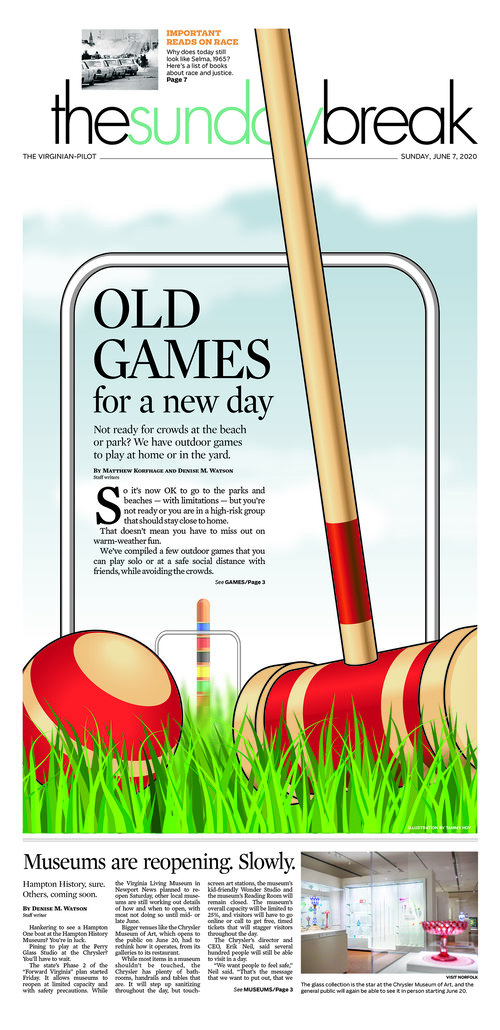
If I am short on time I will sometimes have a look at stock art. Rather than just picking something generic and slapping it on to my page, I try to create something new by combining several pieces of stock art or by playing it up with some creative typography. For a page on old games becoming popular again, I used various pieces of stock art combined with some of my own hand-drawn elements to create a scene depicting a game of croquet with the headline displayed through the wicket.

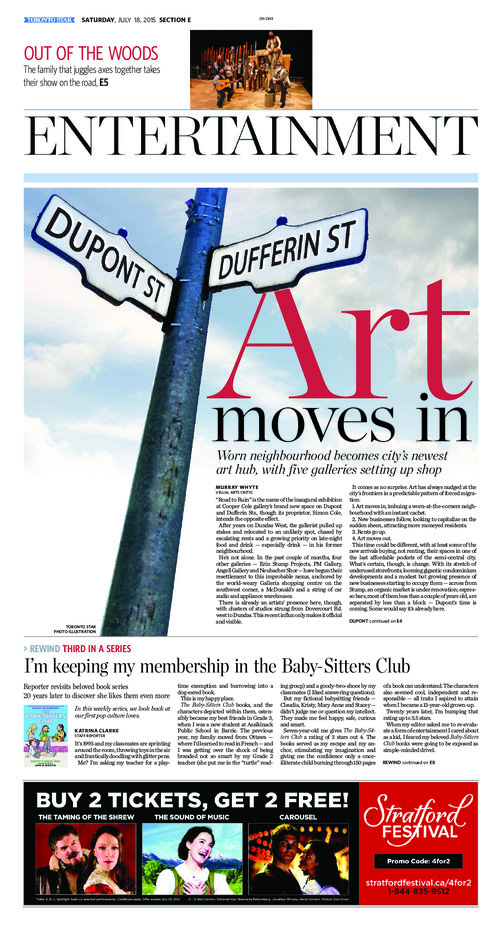
 For a local story on a new intersection where all the art galleries were moving to, I decided to create something from scratch. I took my phone outside and photographed the street sign at an intersection outside. I came back to the office, cloned out the street names in Photoshop and carefully imposed the new ones in. It was something unique and went really well with what the story conveyed.

So draw something, pick up your camera, go outside and shoot something. There really are so many options and it can be a lot fun to try something new.

It might be like picking favourite family members, but if you had to pick up to three favourite pages, what would they be and why?
That is hard but here you go:

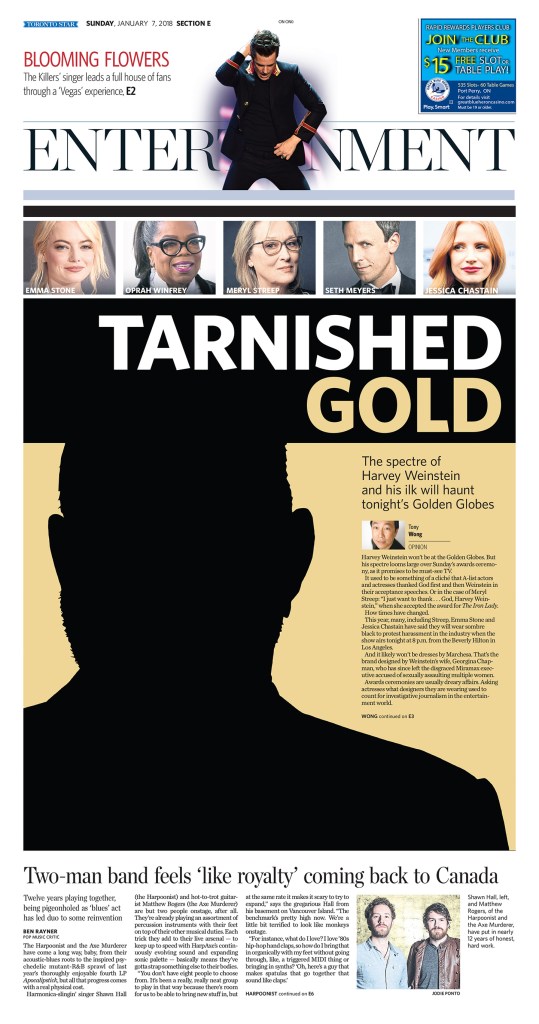
Tarnished Gold
This was a page on the spectre of Harvey Weinstein haunting the Golden Globes. Instead of running a typical photo of Weinstein I felt the page would have more impact if I drew just an outline of him and displayed it as a shadow.  I used a complementary gold colour to represent the Golden Globes. The little profile pictures at the top also draw the reader in. I felt this was a good way to illustrate a sensitive topic.

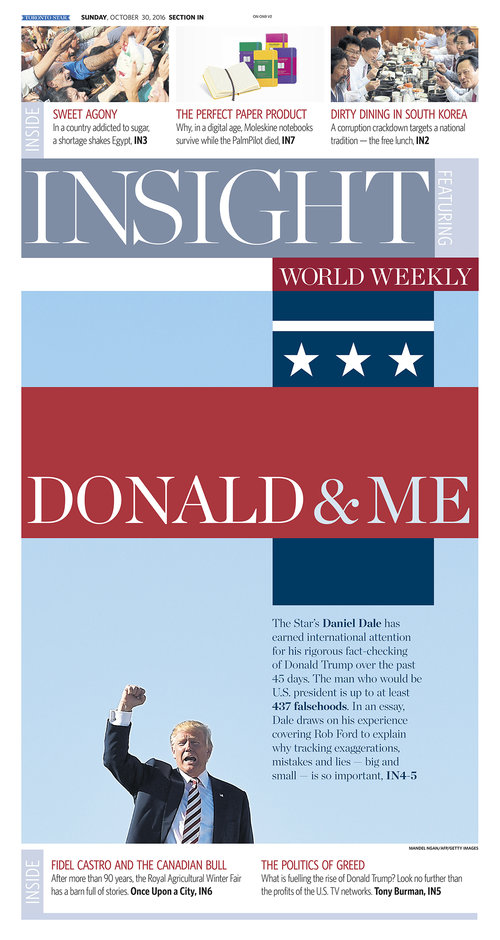
Donald & me (front and spread, Yes I’m trying to squeeze an extra page in here)
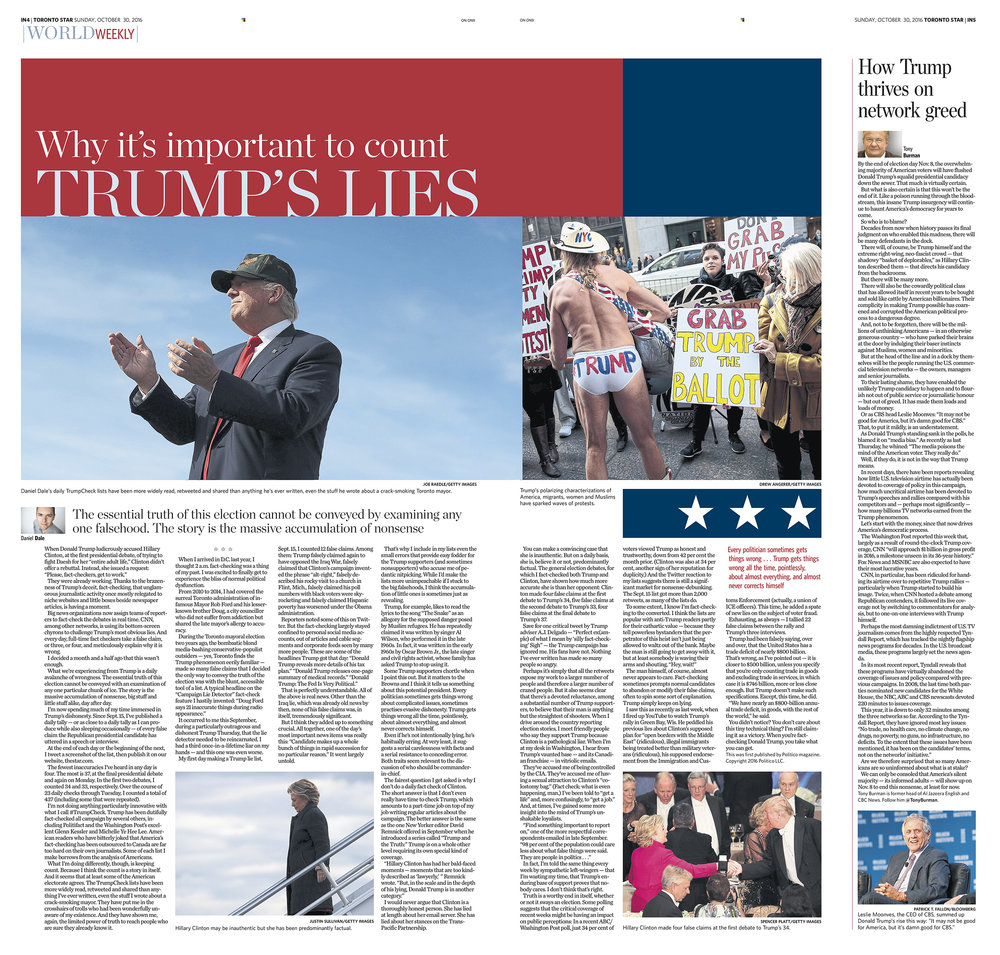
I really like this package  because of the graphical elements. You really can’t miss the stars and stripes when it comes to Donald Trump, so I used them to guide your eye through the feature without (hopefully) overpowering the pages. I also made the decision on the front to make the message of the story larger than Trump himself. Part of being a designer is to remain objective. 

Orange wine
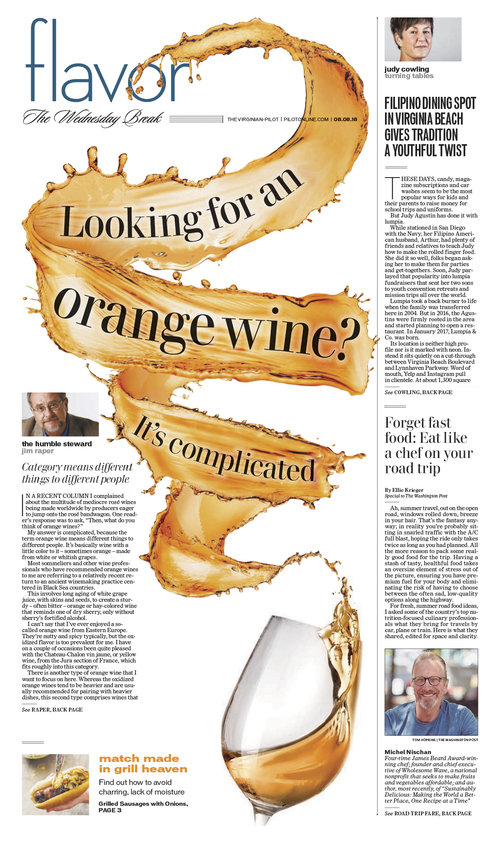
This is one of my favourite pages because the wine looks like it’s jumping right out of the glass and almost off the page. There is so much movement and colour.  Working the display text into the splash was a challenge but I am happy with the end result.

Thanks, Tammy! And now a couple more that I love

When I was perusing Tammy’s website (did I mention Tammy has a website? And not just with newspaper designs) it brought back a lot of memories. All of these pages I’d seen come to life in my time at Pagemasters. I agree with all of her choices. The Trump package is amazing. The orange wine splashing around the page. But since I am supposed to celebrate design, I wanted to share a couple more that I loved for various reasons.

The Secrets of Wonderland page has always left me in awe. I mean, sure, the art is great. A perfect starting point. But having the text come in around those fingers, making it look three dimensional is gold. It’s also a bold use of a cover. One article, one monster piece of art.

The Where to shop next page speaks to me for a different reason. I have long been a major fan of the Virginian-Pilot. This is a page that just sticks so true to the Pilot’s design philosophy, I thought it needed to be called out. As an outsourcer, Pagemasters is occasionally and misguidedly criticized for shoddy work from those who don’t actually see what we do. All these pages prove otherwise, but this one is so close to the flavour of the Pilot, its long and storied history of design that I wanted to shout out Tammy for capturing it. You wouldn’t be able to tell it apart from a page that ran in 2011 or 2015. It just screams Pilot. So I shout Tammy’s praises from the rooftop. And to boot, a bold headline, fun art treatment, colourful. The pictures lead the eye all the way down the page.

If you are a designer or know of a designer who wants to be featured, click here to send me an email!

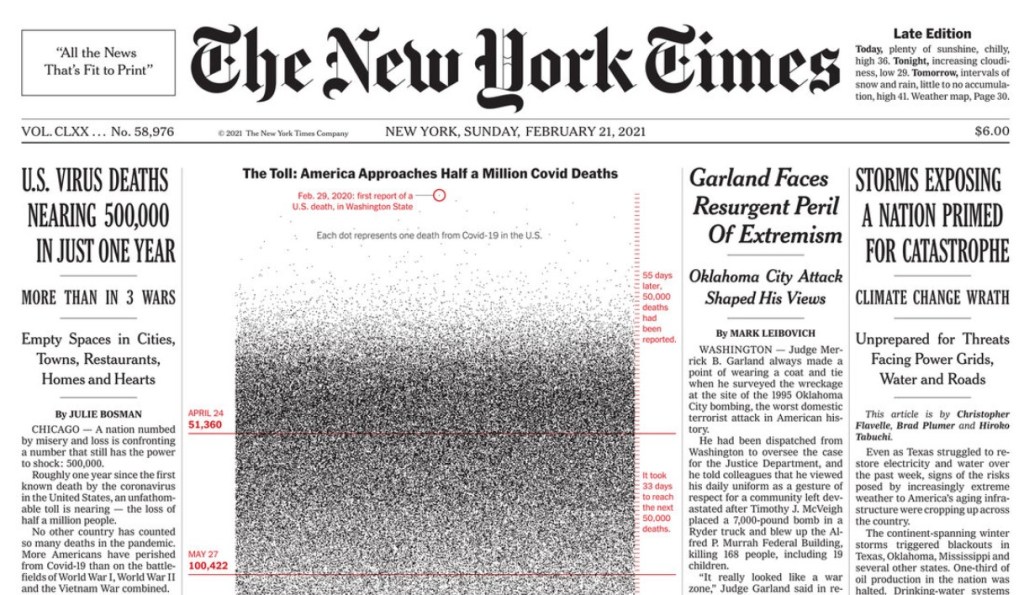
Top half o the New York Times Feb. 21 cover.

By Brad Needham

Once in a while, on a day you wouldn’t expect, a front page comes along that leaves readers awestruck. It’s a page that does something to convey a story or an idea so big. Through a design, through a graphic, through an image. Sunday’s New York Times front page was such a page.

At a quick glance, the reader wouldn’t even know what they were looking at. The Gray Lady was even greyer as the primary graphic on the page was black and white and at first indiscernible.

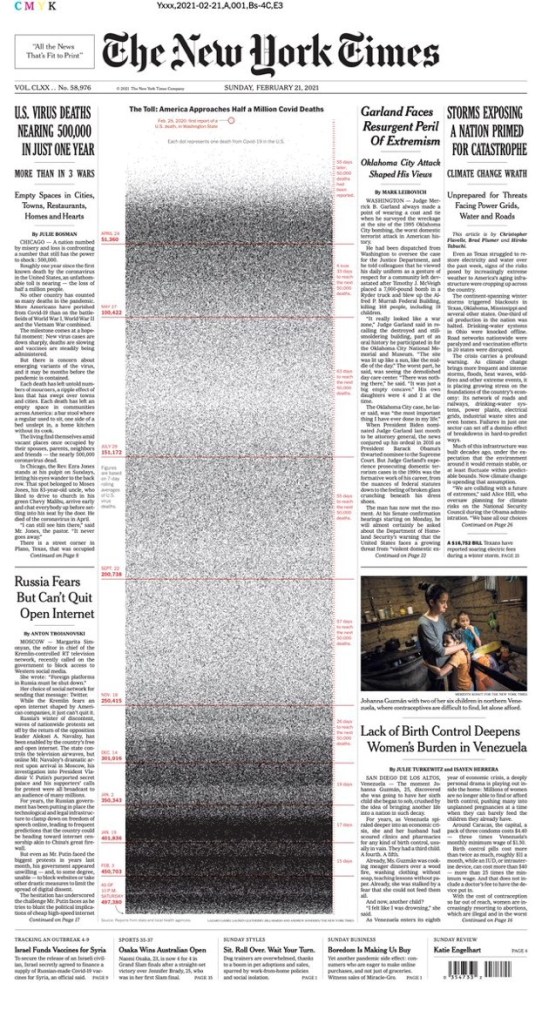
It doesn’t get you at first glance. But when you look deeper you see it. The graphic is made up of nearly 500,000 dots, each one representing an American who has died from COVID-19. On the front page of the New York Times, about half the page taken up by almost 500,000 tiny dots. In newsprint almost certainly blending together becoming unrecognizable as single dots as the death toll starts increasing at an alarming rate. The page goes from grey and white to almost a block of black. That is part of what makes it so powerful. How in itself it tells a story. The dots blur together.

New York Times cover, Sunday, Feb. 21.

It goes to speak to the power that still resides with newspapers and why I celebrate them. Of course it’s easy to celebrate the New York Times, though more often than not it’s for the reporting, not the design. It may not be as grey as it once was, but its front page is still usually pretty busy. Even this one has other stories. Imagine if the entire front was simply this graphic?

In a New York Times Insider article about this page, Nancy Coleman explains that a similar version of the graphic ran online in January. Despite that, I didn’t see much about it on Twitter or other social media. But when I searched for front pages on Sunday, this page was everywhere. And that’s quite a feat for a newspaper page.

“The prominent real estate in the print edition conveyed the significance of this moment in the pandemic and the totality of the devastation,” she says in the article.

Because there is still nothing like it. The power of the front page. Where real estate is finite.

It may sound like a contradiction, but the graphic is both painfully simple — dots — and thoughtfully complex. What often gets lost in newspaper design is what happens before the execution. Someone is conceptualizing. They are either given a story or idea and told to come up with something or they come up with a concept and run it by their editors.

A huge shoutout to New York Times graphic editors and the graphics co-ordinator who worked on this (Lazara Gamia, Lauren Leatherby and Bill Marsh) as well as those who made the decision to run this in print. The insider article, linked to above, is a must read for those who wonder what goes into such decisions.

… unlike the previous approaches, Sunday’s graphic depicts all of the fatalities. “I think part of this technique, which is good, is that it overwhelms you — because it should,” Mr. Gamio said.

From the NYT insider article

Here is some of the reaction from Twitter, just a sampling as there was a lot more.

Any time the front page of a newspaper makes such an impact in the digital world, and not for something stupid, it deserves to be called out. So thank you, New York Times, for such a powerful page. A devastating milestone captured not only for today’s readers, but beyond.