September 11, 2001. 9/11. It was a day that changed the world. The attacks in New York, heard and seen around the world. Today marks 20 years since that infamous day. I remember my first indication something was up was waking up to an email from a friend who worked at the United Nations saying, don’t worry, I am safe. Shortly thereafter the world watched as a second plane flew into the World Trade Center buildings. I was in my final year of journalism school so wasn’t in a newsroom, but I have heard the stories. The chaos. Tearing papers apart. Trying to get special editions out. The Guelph Mercury apparently put out an edition with the attacks on the cover, removing all the stories that were there, but left the turns from the original stories inside.
September 11, 2021. Twenty years later, I look at some amazing newspaper covers as the world remembers and reflects on that day. Some are what you would expect. Some are not. It was a tragedy on an unimaginable scale. But this is about the creativity in newsrooms around the world. How do they tell the story visually? I will let the covers mostly speak for themselves. There were dozens (the vast majority of papers in the U.S. had a big 9/11 splash) so I have chosen a few that cover the themes I saw. Some just wildly creative and powerful, simple and elegant. Some showing current photos, some showing destruction. Some taking an artistic approach. Here they are.
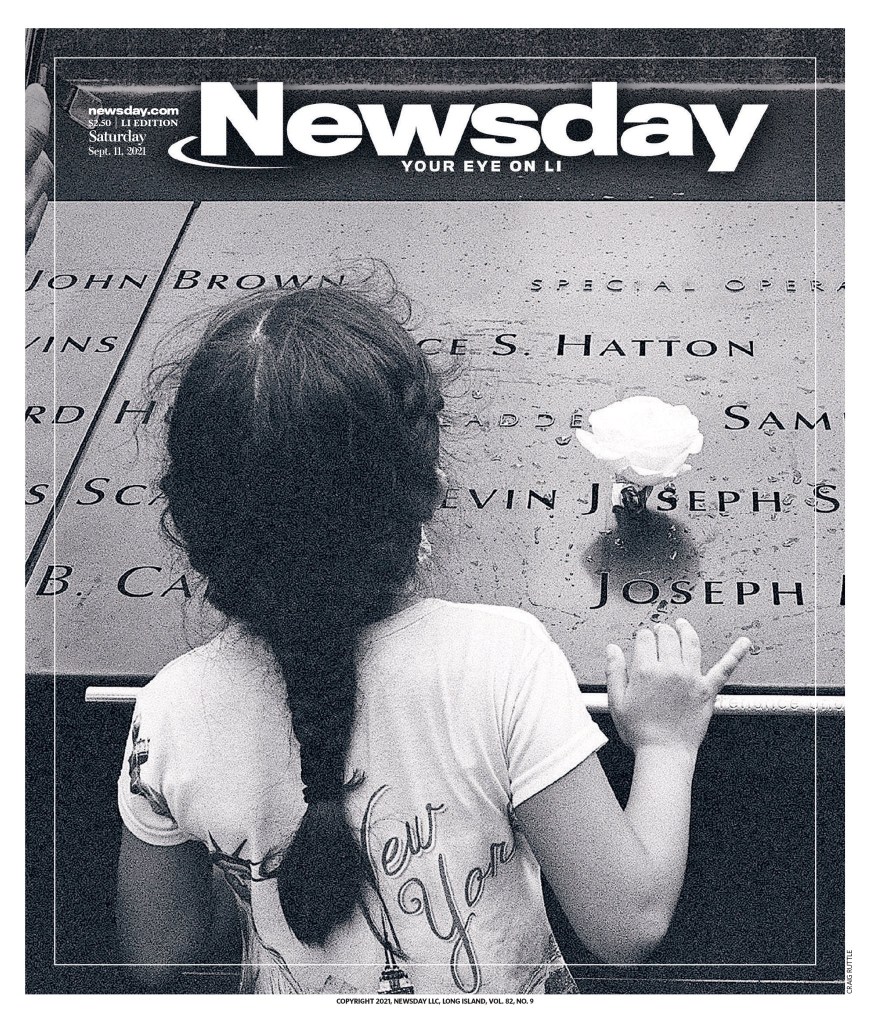
This Newsday cover does so much. It’s different than many others. No towers, no planes, no destruction. Just a little girl. A New York T-shirt. A monument remembering those who died. A single flower.
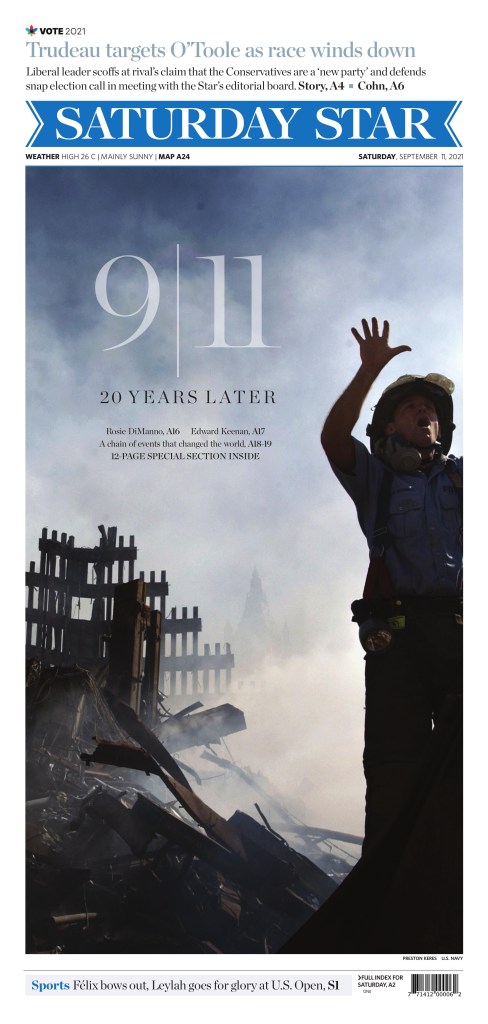
Definitely the strongest 9/11 front page in Canada. The Toronto Star uses a big, powerful image. So well processed. An image similar to this was used in many newspapers. It was just used better here. Minimal text. Stunning.
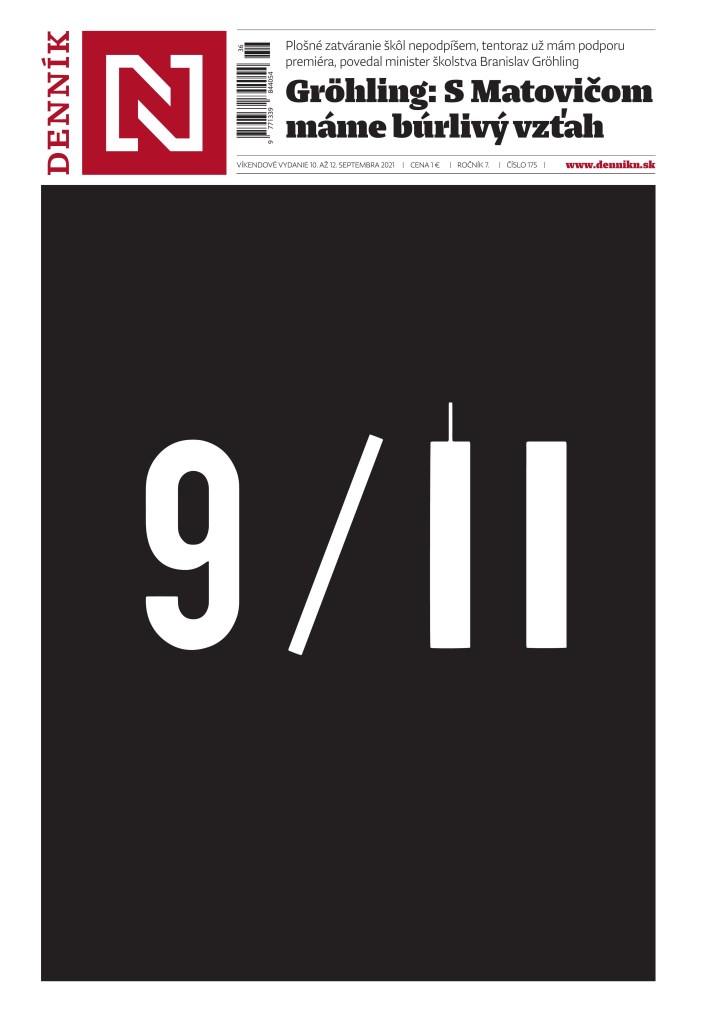
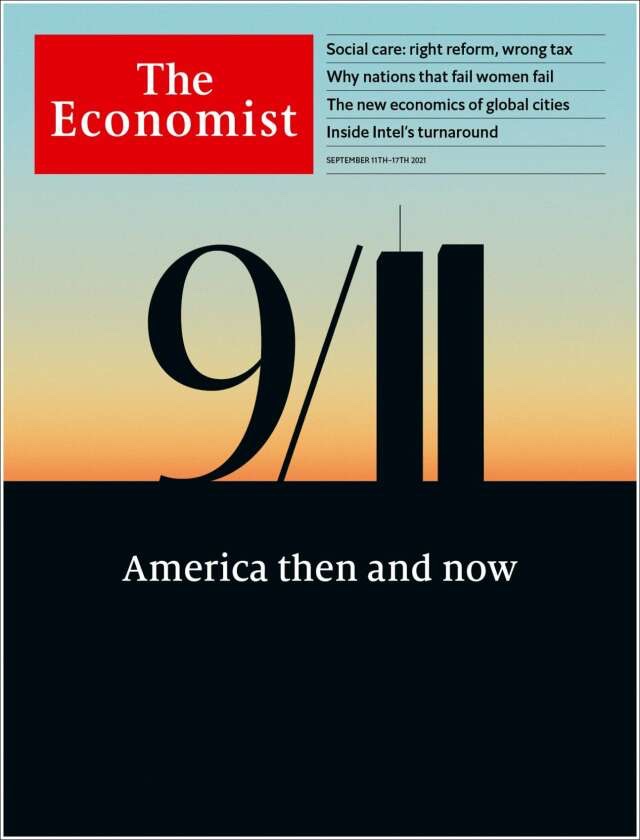
The Dennik N page from Sept. 10 and The Economist from Sept. 11 do something similar with the numbers, similar conceptually, but they look so different. These are two of my favourites. Simple. Beautiful. I love so much that one line, on the first 1, makes all the difference. It takes it from numbers to buildings. So smart.
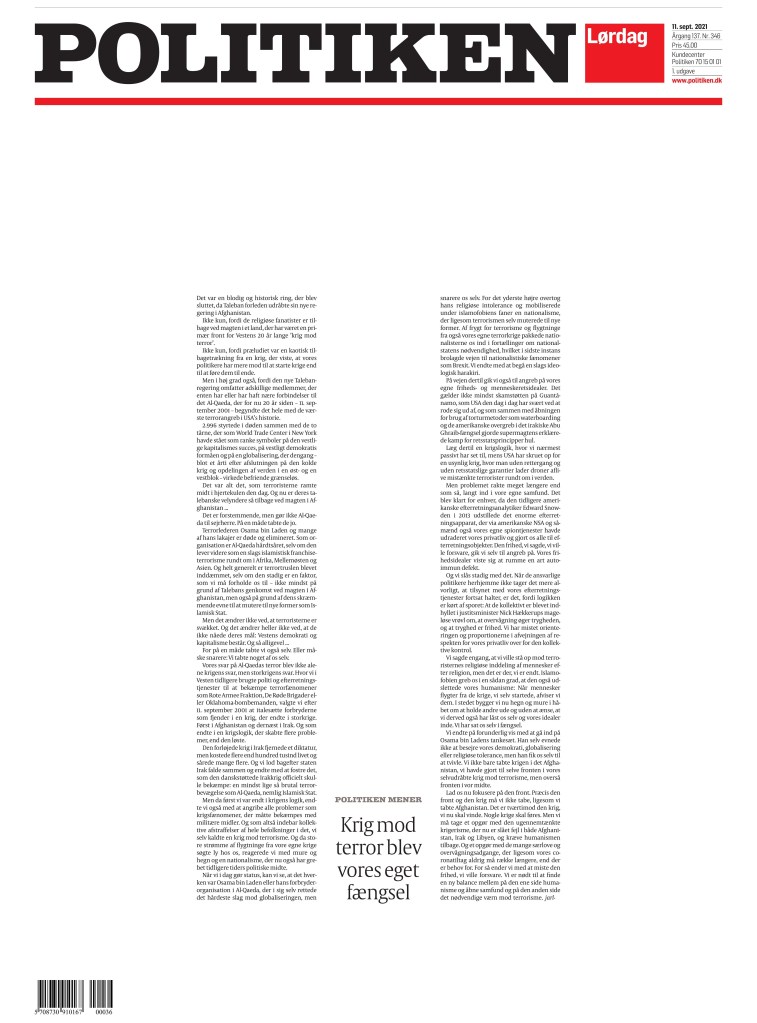
This is a creative page by Politiken. It is so simple.
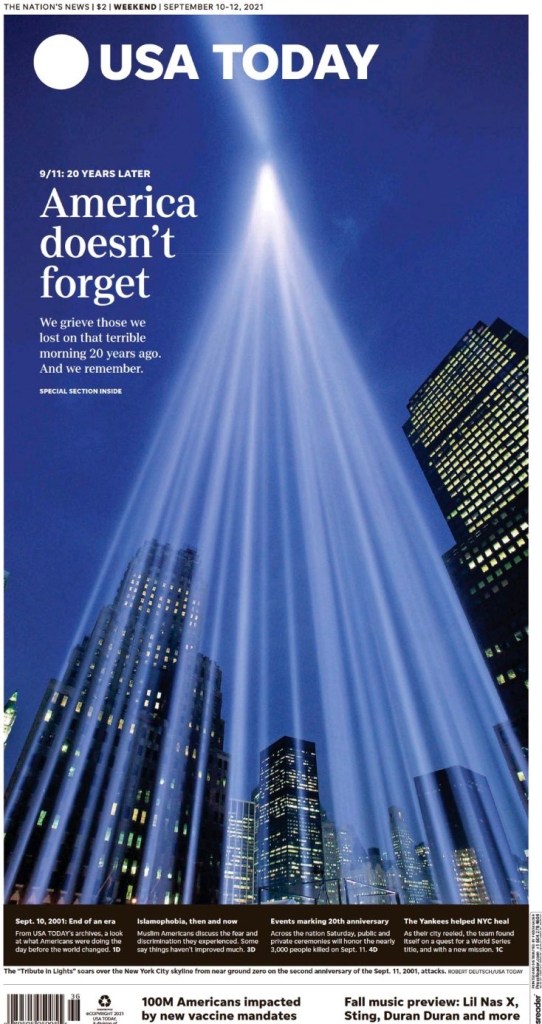
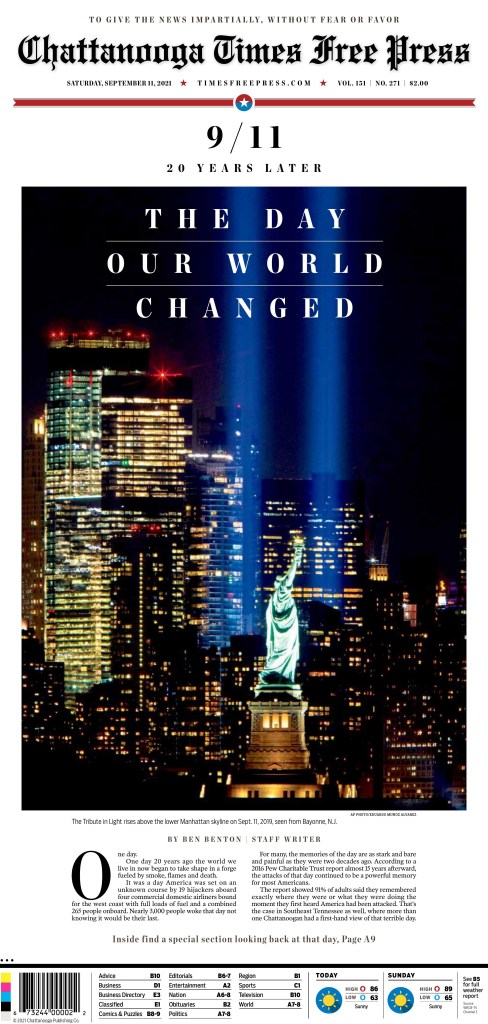
These two — above, USA Today, and below, Chattanooga Times Free Press — went with the big photo of the Tribute Lights. Many papers took this approach.
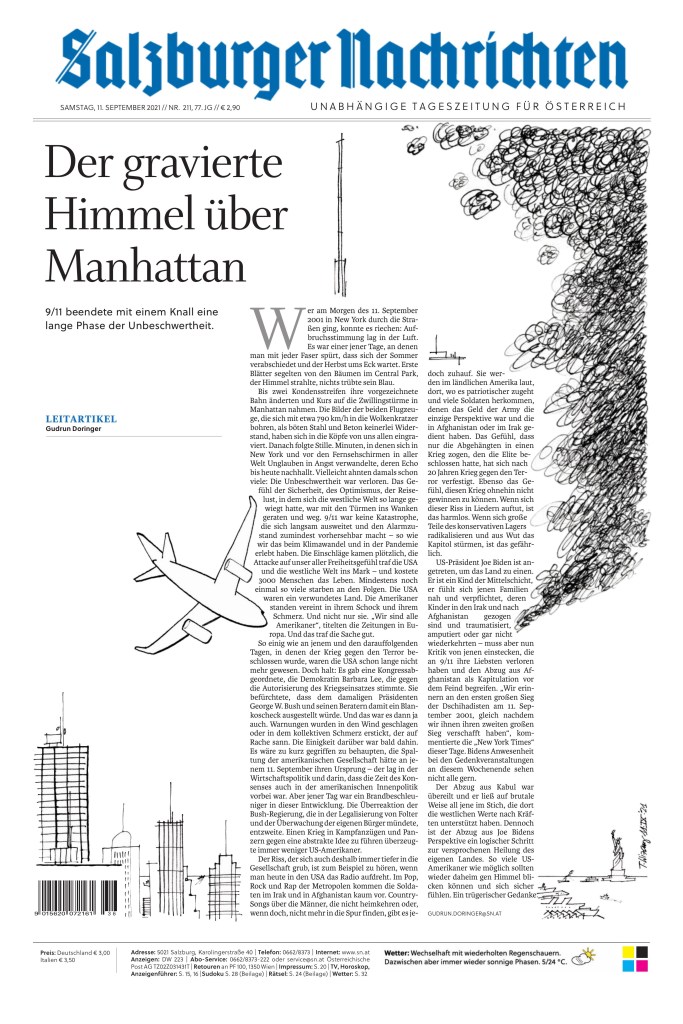
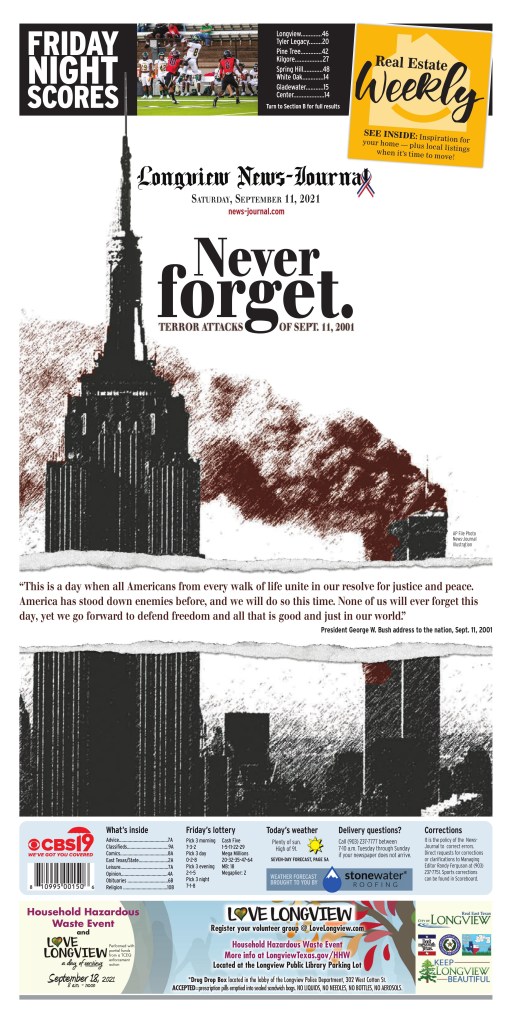
Both these pages used an art-based approach. Above, Salzburger Nachrichten is quite bold. Below is the Longview News-Journal.
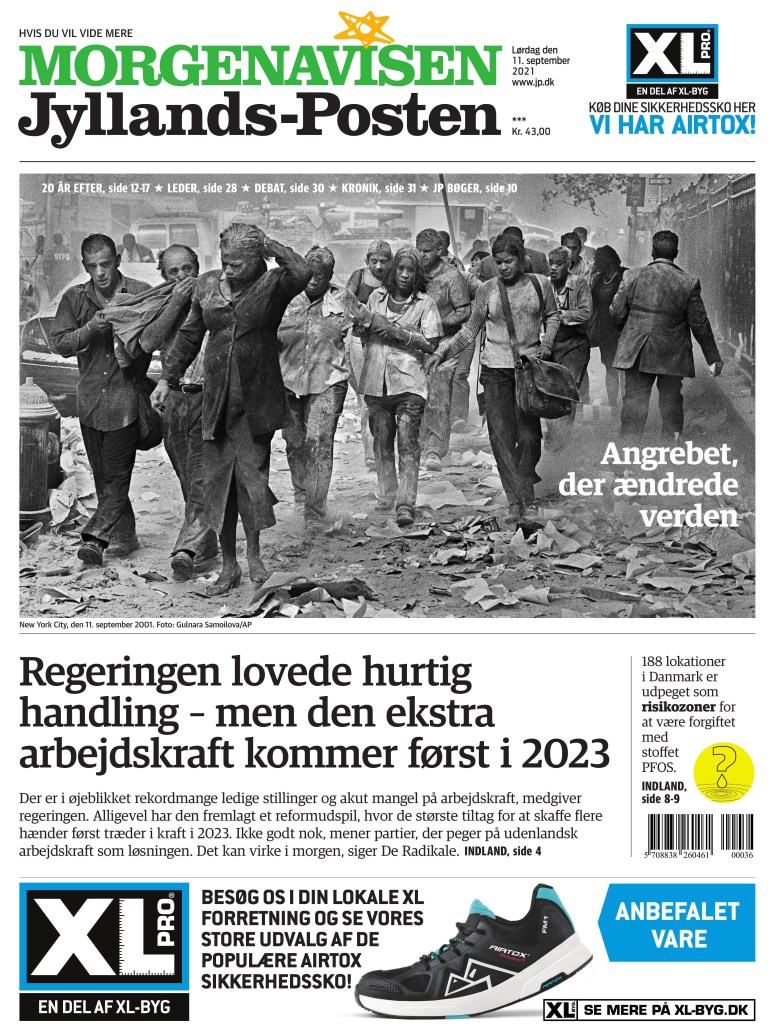
The Jyllands-Posten uses a different photo than most. No destruction visible. But the people. What a photo.
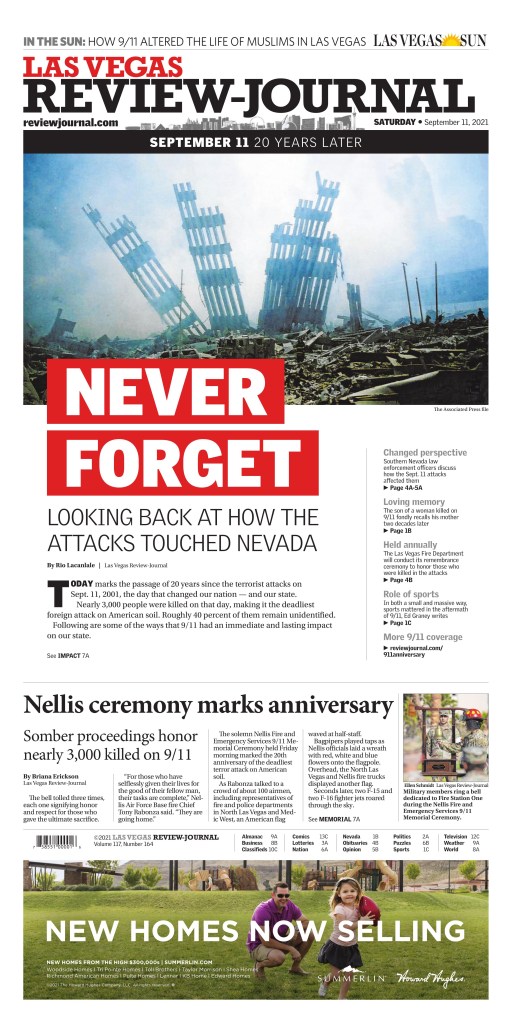
And the Las Vegas Review-Journal. It uses a similar photo to the Star, without the person. This photo was used widely today.
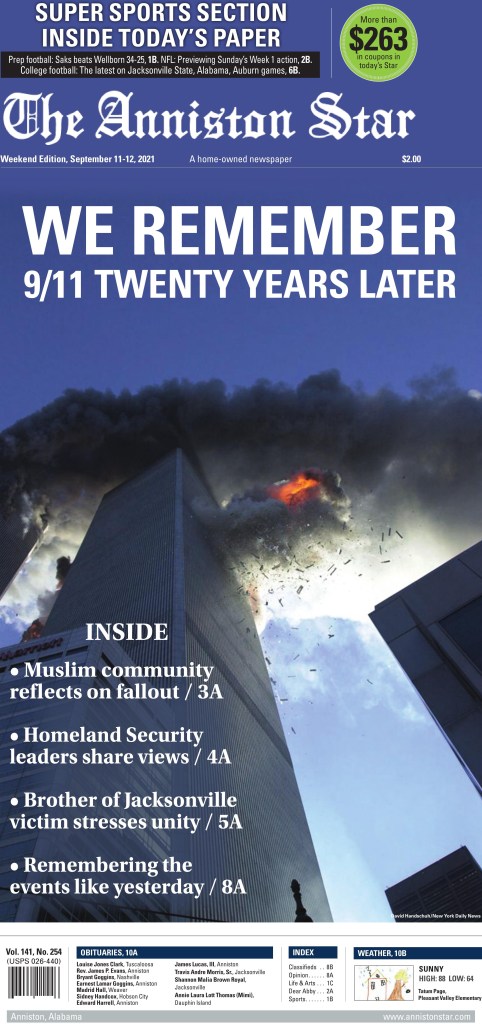
The Anniston Star went with one of the most terrifying photos from 2001. These photos will never not send me right back.
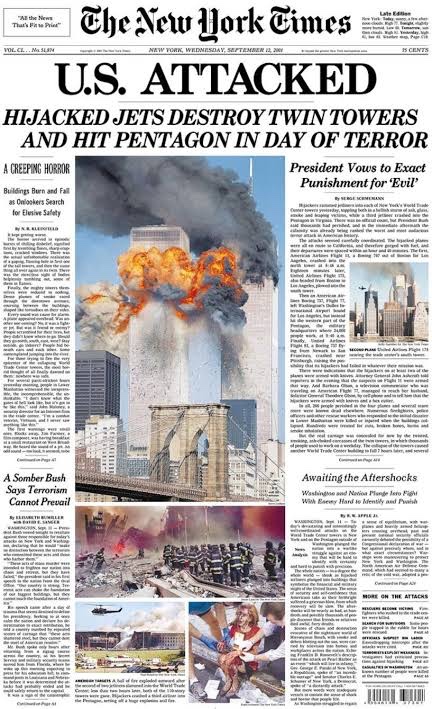
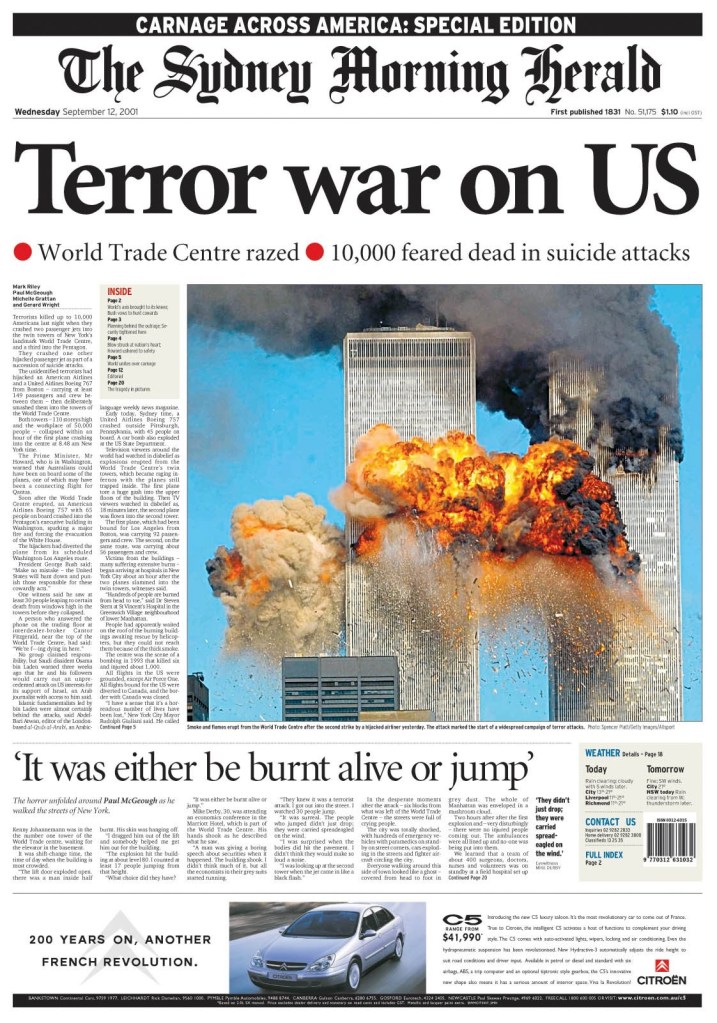
And below are two pages from 2001. I have looked at pages from this time in a previous post, so I won’t go too far into it. The New York Times and The Sydney Morning Herald, Sept. 12, 2001.
Scrolling through newspaper designs on the Freedom Forum’s website is one of my favourite hobbies. I like to do it as often as possible, and hope I can even get there daily. The site is amazing, but only hosts pages for the day of publication. Like Cadbury Eggs and Easter, after that they’re gone. But it means if I miss a day, I might miss some magical front page designs. It also makes it exciting when I do find a great design. Like hearing your favourite song on the radio, rather than on repeat on Spotify.
Thursdays have been lucky days for me so far. Though it could be forced luck. I want to publish a post by Thursday every week if possible, so as a typical journalist, I wait until Thursday. And wouldn’t you know it? There are some great designs this week too. What I like to do most days is truly take a brisk scroll through the pages. If a page doesn’t catch my eye as I scroll through hundreds from around the world, I move on. But some did catch my eye today. As a picture is worth 1,000 words, I won’t blather on too much about each page, but I do want to celebrate the creativity and explain why I like these pages.
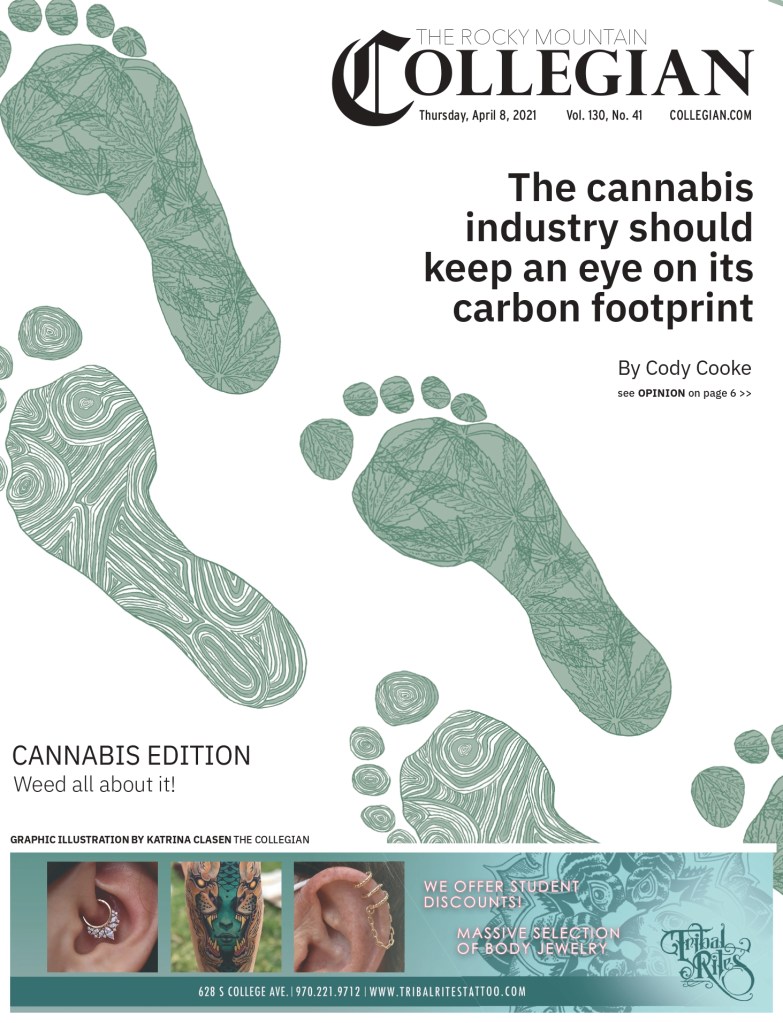
Anyone familiar with my designs might think I have a bias toward this because it reminds me of me. That’s simply … only slightly true. I love that the Collegian cover is blown out on one topic. I love the footprints, and how they’re a design in themselves. And, yes, I will give points for the play on words, Weed all about it. (Insert slow clap here.) It’s an important topic, creatively done. The white space is well used, which is harder than it looks. All in all, it’s a smokin’ page. The design draws me in and makes me want to … weed the story.
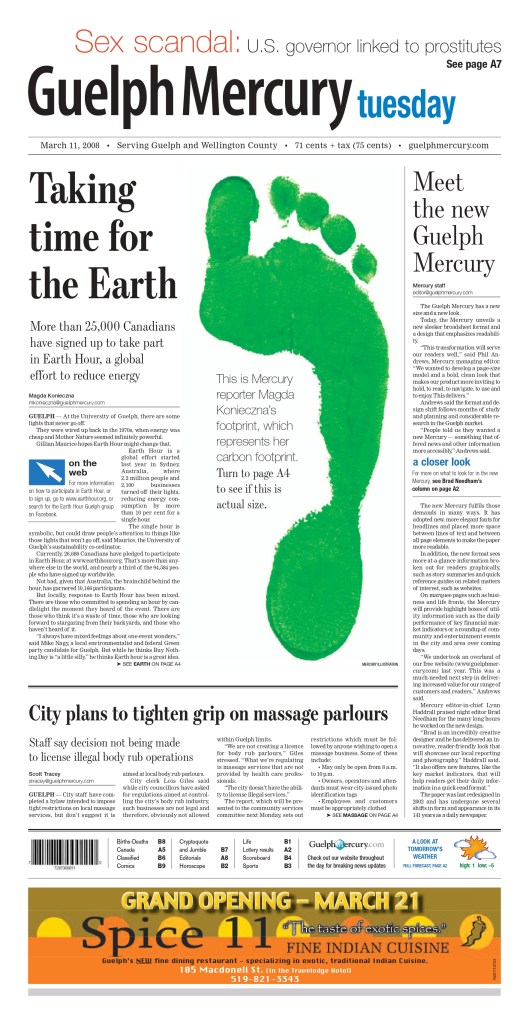
Great minds think alike. This was a page I did after completing a redesign of the Guelph Mercury (RIP). This was the first day of the redesign, and also looking at a carbon footprint.
The Toronto Star often has solid designs, particularly for their centrepiece stories. (Disclaimer: I worked at the Star!). This is a basic design: reverse text (white on black), big numbers. But that’s all you need. It’s above the fold, which, as discussed in a previous post, might be an outdated model in terms of design consideration, but it allows you to blow out part of page, and leave the rest for key news content. In the age of shrinking news holes and page counts, that can be crucial. Designs are nice, but readers come first. But the Star balances this well. Two key numbers that help tell a story. Text on photo. A nice header graphic. And a good bit of two stories to boot. That is just a nicely put-together newspaper page.
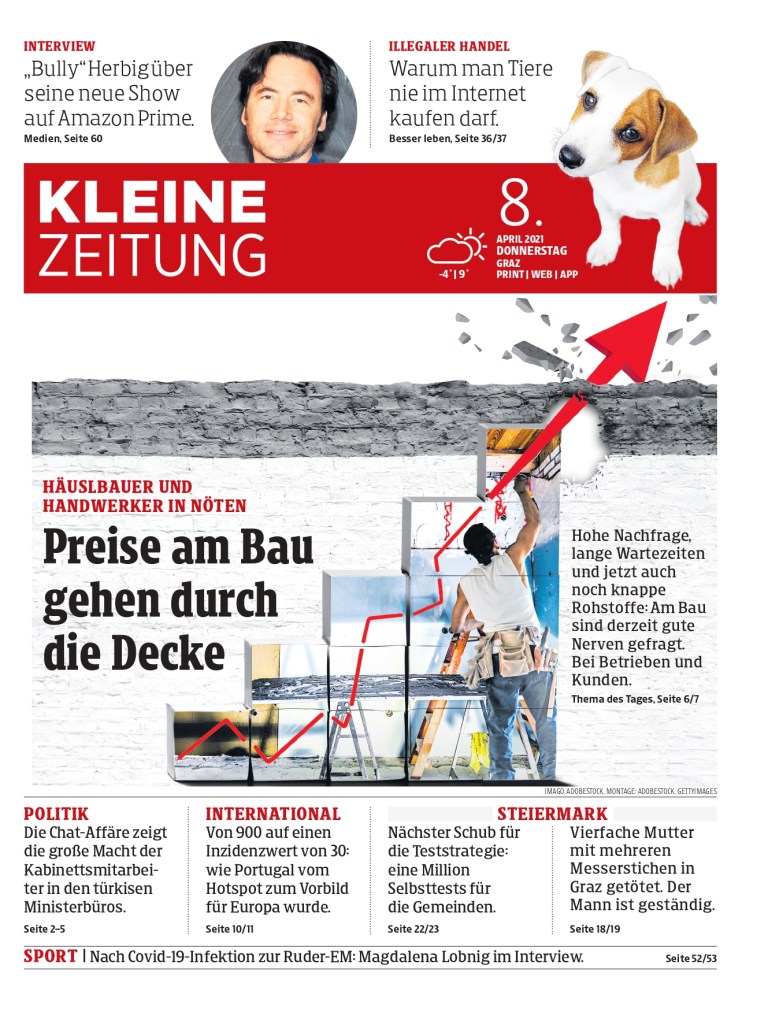
I like these two pages for the same reason: creative graphics/illustrations. Kleine Zeitung uses its headline to complement the photo, about prices going through the roof. I love it when a headline and photo or graphic really work together. And it’s just a fun illustration with the arrow breaking through the top. It looks like live action!
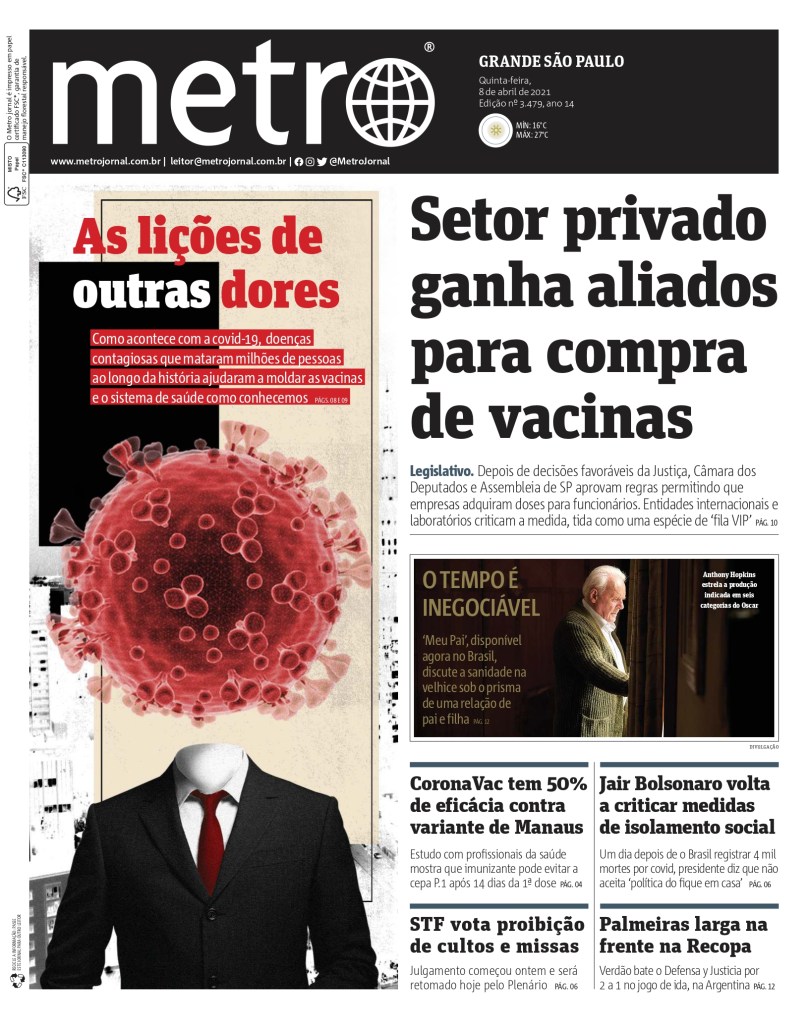
The Metro graphic captures your attention instantly. Presumably intentionally, it also ties the text to the picture, talking about how diseases have helped shape vaccines and health systems. And we all know that distinctive COVID shape by now. I also really dig the use of colours. The tan and black, with red text. Also using reverse text, as the Star did above. Often it can seem too busy. Three colours of headline text, different background colours. But this is thoughtfully done.
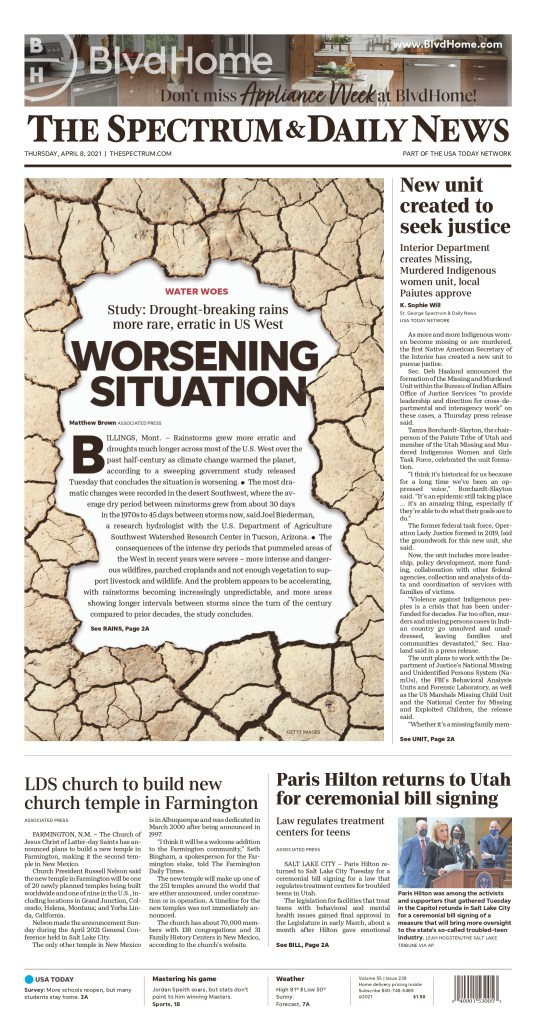
It’s pretty obvious what I like here on this Spectrum & Daily News page. You can see the thought process that went into this. It’s a Getty Images illustration (thank goodness for good stock art). But the design is visually enticing. A break from big blocks or text or a picture of some dry landscape in the region. I like the big and literally bold headline, the small red kicker and the big drop cap. And they story is placed in the middle of an interesting image, so you get a big, bold illustration, but also can start to tell the story on the front page. All can be entry points to draw the reader in. There is little doubt where one’s eye will go first on this page, or at least which story.
That concludes today’s leisurely scroll! Thanks for joining me. If you have any thoughts, let me know below!
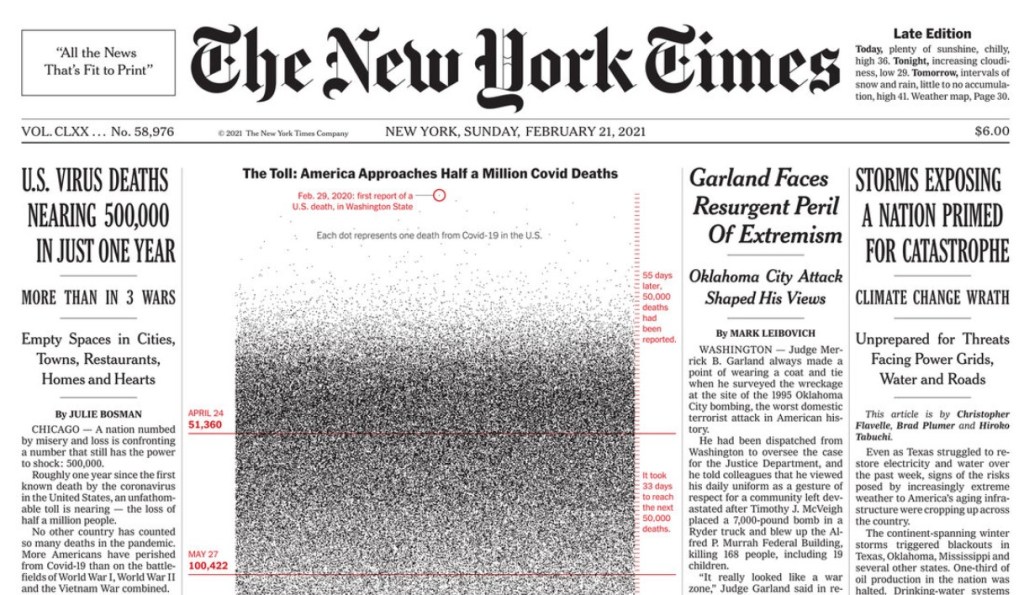
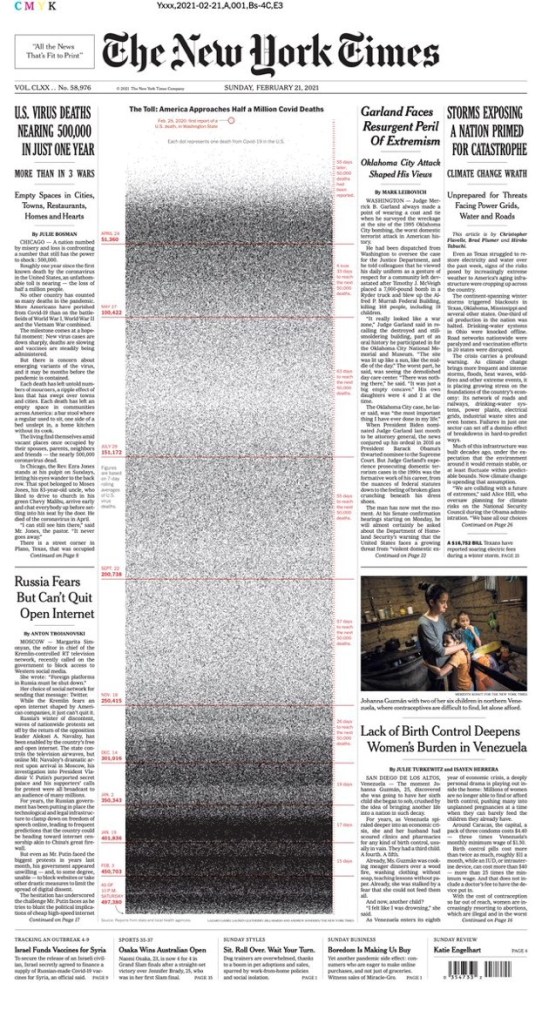
Once in a while, on a day you wouldn’t expect, a front page comes along that leaves readers awestruck. It’s a page that does something to convey a story or an idea so big. Through a design, through a graphic, through an image. Sunday’s New York Times front page was such a page.
At a quick glance, the reader wouldn’t even know what they were looking at. The Gray Lady was even greyer as the primary graphic on the page was black and white and at first indiscernible.
It doesn’t get you at first glance. But when you look deeper you see it. The graphic is made up of nearly 500,000 dots, each one representing an American who has died from COVID-19. On the front page of the New York Times, about half the page taken up by almost 500,000 tiny dots. In newsprint almost certainly blending together becoming unrecognizable as single dots as the death toll starts increasing at an alarming rate. The page goes from grey and white to almost a block of black. That is part of what makes it so powerful. How in itself it tells a story. The dots blur together.
New York Times cover, Sunday, Feb. 21.
It goes to speak to the power that still resides with newspapers and why I celebrate them. Of course it’s easy to celebrate the New York Times, though more often than not it’s for the reporting, not the design. It may not be as grey as it once was, but its front page is still usually pretty busy. Even this one has other stories. Imagine if the entire front was simply this graphic?
In a New York Times Insider article about this page, Nancy Coleman explains that a similar version of the graphic ran online in January. Despite that, I didn’t see much about it on Twitter or other social media. But when I searched for front pages on Sunday, this page was everywhere. And that’s quite a feat for a newspaper page.
“The prominent real estate in the print edition conveyed the significance of this moment in the pandemic and the totality of the devastation,” she says in the article.
Because there is still nothing like it. The power of the front page. Where real estate is finite.
It may sound like a contradiction, but the graphic is both painfully simple — dots — and thoughtfully complex. What often gets lost in newspaper design is what happens before the execution. Someone is conceptualizing. They are either given a story or idea and told to come up with something or they come up with a concept and run it by their editors.
A huge shoutout to New York Times graphic editors and the graphics co-ordinator who worked on this (Lazara Gamia, Lauren Leatherby and Bill Marsh) as well as those who made the decision to run this in print. The insider article, linked to above, is a must read for those who wonder what goes into such decisions.
… unlike the previous approaches, Sunday’s graphic depicts all of the fatalities. “I think part of this technique, which is good, is that it overwhelms you — because it should,” Mr. Gamio said.
From the NYT insider article
Here is some of the reaction from Twitter, just a sampling as there was a lot more.
The United States is nearing half a million coronavirus deaths. Fewer Americans died in World War I, World War II and the Vietnam War, combined.
Here is the front page of The New York Times for Feb. 21, 2021. Each dot represents one death from Covid-19 in the United States. pic.twitter.com/zmY8tn7E6V
The front page of The New York Times today is so sad and so devastating. Each dot in the middle graph represents one death from Covid-19 in the U.S. The death toll is almost 500,000. https://t.co/CwpU07X621pic.twitter.com/AOBY9dsCov
Any time the front page of a newspaper makes such an impact in the digital world, and not for something stupid, it deserves to be called out. So thank you, New York Times, for such a powerful page. A devastating milestone captured not only for today’s readers, but beyond.
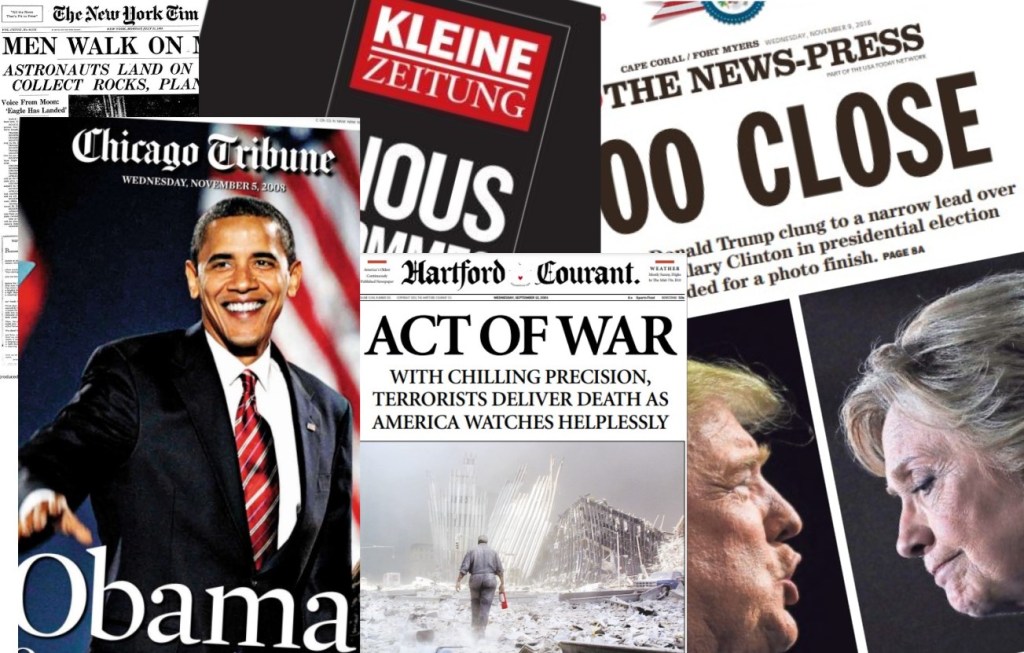
Screenshots of various papers on big days. On big days, front pages can become historical touchpoints.
By Brad Needham
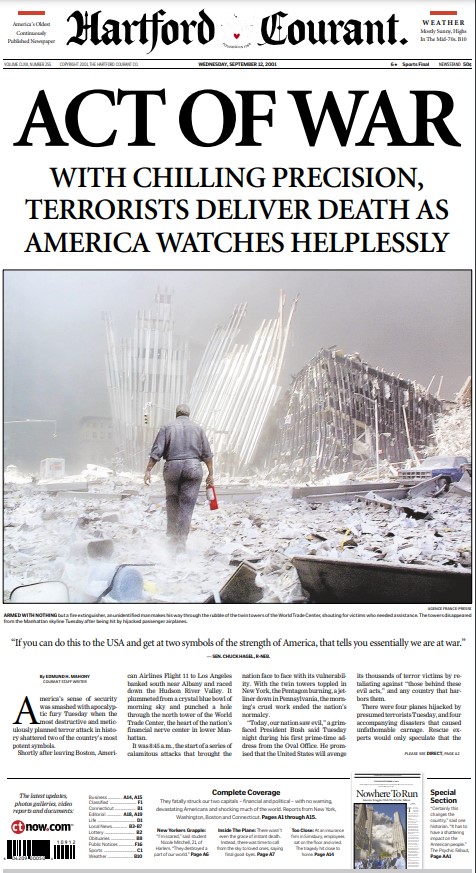
While some people have started taking screenshots of websites on big days, nobody is going to remember what the home page of the New York Times or Globe and Mail looked like on the night/day Donald Trump was elected. More so, most don’t care. But the front page of the newspaper? Many will remember. Many will seek it out later to see how it was played. Same for other major events. People in Hartford will remember the Harford Courant cover on September 12, 2001. People around the U.S. will remember the covers of their papers when Barack Obama won a historic victory.
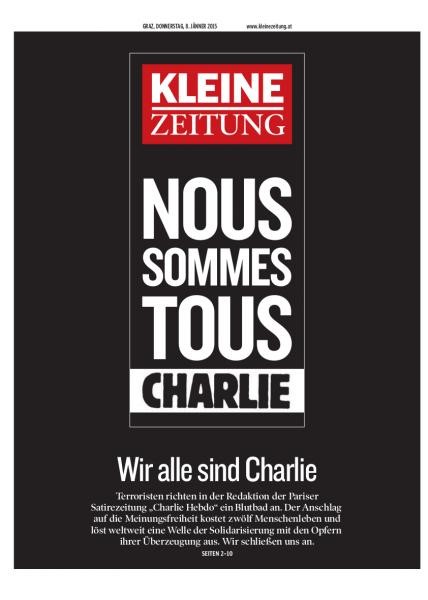
There is something about a newspaper front page. They are a reference point for history. So much so that the Freedom Forum Institute is collaborating with more than 2,000 newspapers around the world on its front page gallery. Every day they post front pages of the day, and only for the day. However, going back as far as Sept. 11, 2001, 9/11, they have compiled key front pages from monumental days: 9/11, Donald Trump and Barack Obama’s presidential victories, the Charlie Hebdo attack, Osama bin Laden’s death, and so on. The pages are from events “that are considered of historical significance and fit its educational mission.”
These three covers, The Sunday Telegraph, USA Today and The Philadelphia Inquirer, on the second acquittal of Donald Trump on impeachment charges. The U.S. papers went big. The Telegraph not so much.
Acquitted. Again.
Most recently, and the news hook if you will, was Trump’s latest acquittal. It was both a more and less historic day than his first acquittal on impeachment charges. It happened on a Saturday. Thankfully for American readers Sundays are still big publishing days. In Canada, most of the front pages from big Saturday news would come on Monday. In the examples above, two of the headlines are similar (USA Today and the Philadelphia Inquirer), both big and both use acquitted. Another not included said “Acquitted. Again”. Big bold words. The other, from the Telegraph in the U.K., shows how a non-U.S. paper played it. It didn’t get nearly the play it did in the American or even North American, media. Just another front page story.
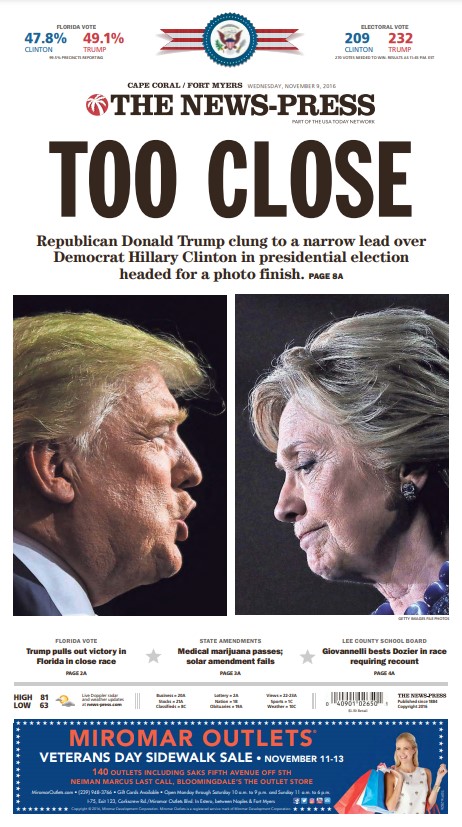
I am always amazed at how these pages come together. While the conceptualizing for some, like elections, can start well in advance, for other events, it’s a mad dash to the finish, like the covers for September 12, 2001, (or for some papers, September 11 as they rushed to put out special editions or put out their afternoon or evening editions. The Guelph Mercury (RIP) tore up its cover to replace it with a 9/11 cover. As the story goes, it was so rushed that the turns from the stories that were on the cover originally still ran). I feel fortunate that I have been able to work behind the scenes on a lot of big days. I’ve worked too many elections to remember, but I do remember some. Obama was memorable. Trump was even more so, only because it was so tight and surprising. While papers always have contingency plans for election covers, I would wager most papers, like the Toronto Star, had a “Hillary Clinton wins” design firmly planted on the page for much of the night, with a Trump victory on the pasteboard.
There are a few things I find notable about big day newspaper front pages. Here are a few things I love.
Headlines: Big and short
Big events can be a headline writer’s dream … or nightmare. Often a big front page headline is 72 points. Smaller for most non-tabloid papers. But on big days the font size isn’t just bumped up a few points, it often explodes. 100 points. 200 points. And the bigger the font the smaller the headline in terms of words. Now instead of seven or eight words, you get two or three. The bigger the event, the fewer words you get to capture it for posterity. While some of these are tragic stories, I want to note the work by creative headline writers and designers who can create these packages and that capture the moment. The team that puts these pages together recognize the importance of what they’re doing. Some examples, and they may seem simple, but the words have to be just right:
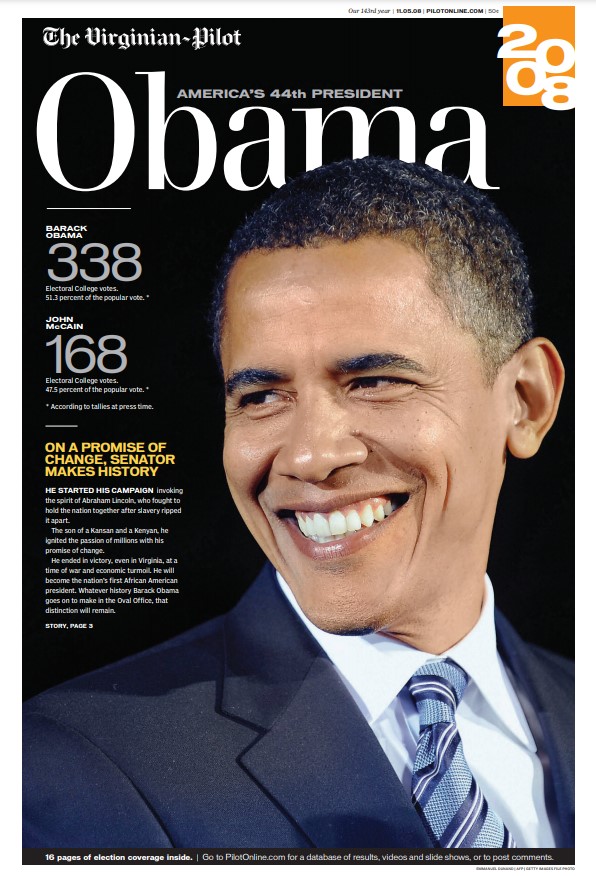
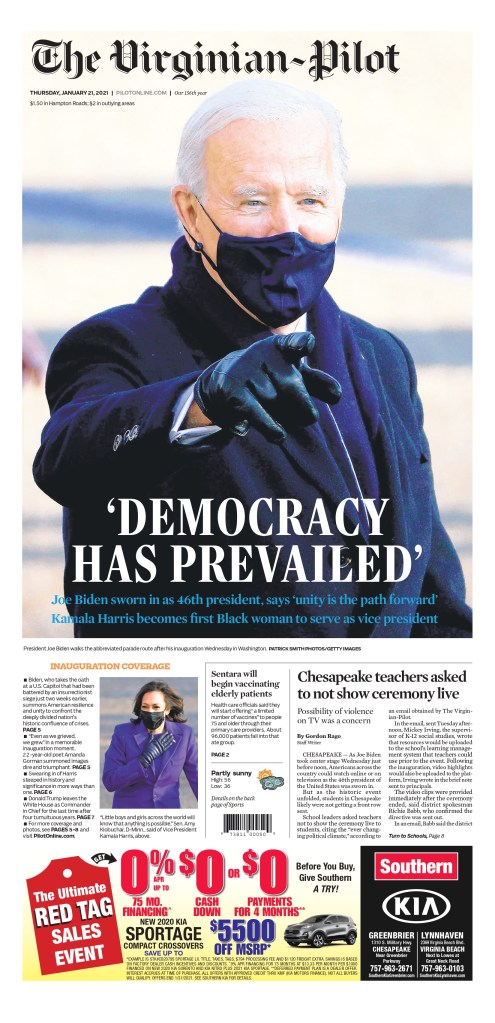
OH-BAMA! It was a historic day. Americans elected their first Black president. Here are some of the headlines: Virginian-Pilot, Obama; Critica, Historica; The Commercial Appeal, YES HE DID; Philadelphia Daily News, New York Times and The Honolulu Advertiser (and more for sure), OBAMA; Kansas City Star, HISTORY. And, OH-BAMA!, Orange County Register. Lots of Obama, lots of history, lots of yes he can or did … And all beautifully played with strong, emotive art, and other key elements.
9/11 Some papers came out that day, some the next. The common theme was shock, anger, sadness. Here are some headlines: The Arizona Republic, TERROR; The Oakland Tribune, Terrifying; The San Diego Union-Tribune, NATION IN ANGUISH; Hartford Courant, ACT OF WAR; Chicago Tribune, ‘Our nation saw evil’; The New York Times, U.S. ATTACKED. There were some outliers, such as the Washington Post: Terrorists Hijack 4 Airliners, Destroy Word Trade Center, Hit Pentagon; Hundreds Dead.
Capitol riot What started as a fiery protest turned into a riot at the U.S. Capitol, when an angry mobbed stormed the building. Here are some of the headlines: Arizona Republic, PRO-TRUMP MOB INVADES CAPITOL; Anchorage Daily News, Pro-Trump mob storms Capitol; Tampa Bay Times, UNDER SIEGE.
I love that despite being hundreds or thousands of kiliometres apart there is often such similar language from paper to paper. Repetition of big, powerful, emotive words. Terror. Victory. Siege. History. On their own the words wouldn’t mean much. That is where the rest of the design comes in. One, two or three words. A poweful photo. A deck. All of the sudden a quick glance can tell the story. I think it’s magical.
The art of design: the photo
Iconic front pages are often made iconic by iconic photos. (Don’t tell the former editor from the Toronto Star that I said iconic three times in one sentence. I will be blackballed from the industry.) Those who choose the pictures deserve some props as well. It’s not an easy task most days, but on days of historical significance it is an even greater responsibility. Even on days when the art essentially chooses itself, it can be a painstaking process. Do we show the planes crashing into the building? Do we show show the Turkish police officer carrying little Alan Kurdi’s body? It’s an excruciatingly hard decision some days. And in print, once the paper hits the press, the decision is irrevocable.
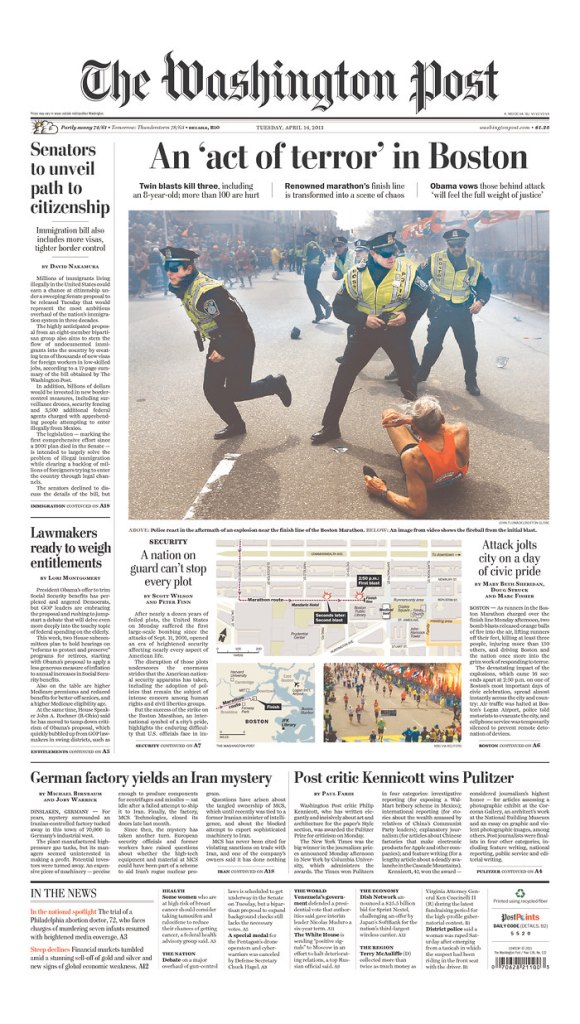
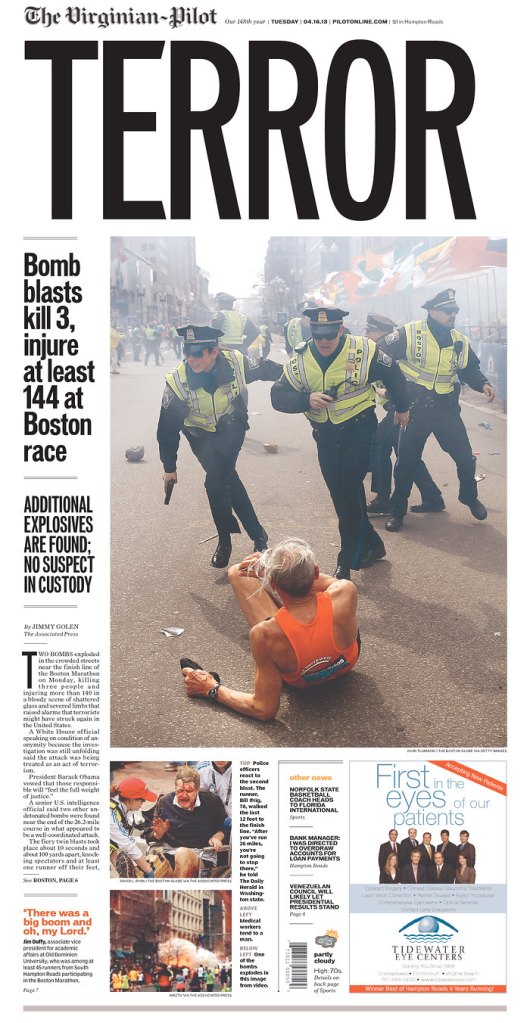
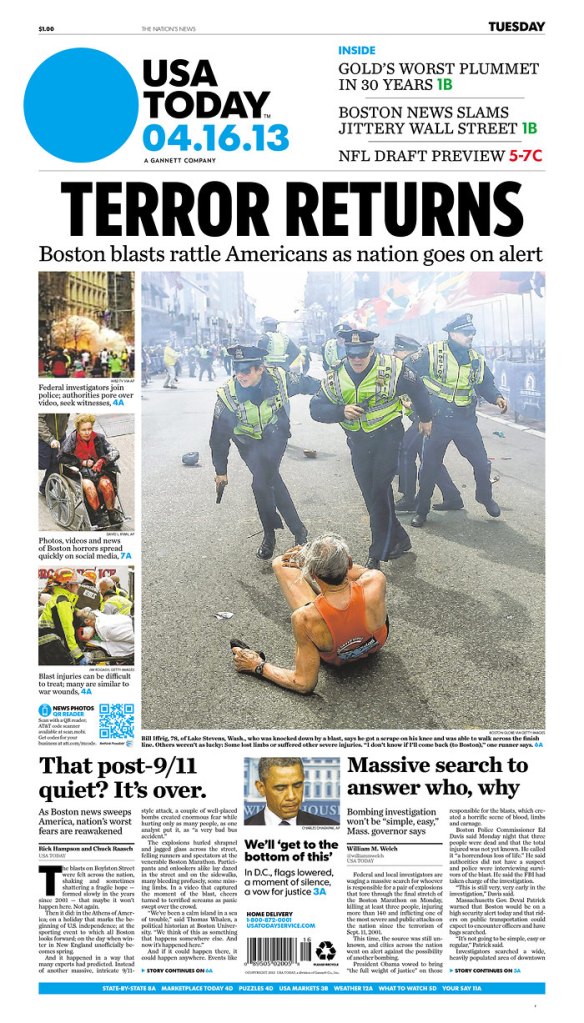
Three front pages from three papers covering the Boston Marathon bombing. The Washington Post, Virginian-Pilot and USA Today. All images can be found on the Freedom Forum Institute’s website.
The Boston Marathon bombing was a good example of a major story and of art choosing itself. When it happened, newsrooms started buzzing (I was in one and I remember it well). Images were flowing in. There were lots. The main image was replaced and replaced. Until the image came in. Rather than one caught by a witness cellphone, it was by Boston Globe photographer John Tlumacki. Not all papers chose to run it, but many, maybe even most, did. It captured the panic. The moment. A runner on the ground. Police with guns drawn. Smoke. The kind of photo rarely captured by an amateur photographer. One captured by a newspaper professional.
Two of the three papers above took a similar approach. The big headline. Terror. Big photo. Less information. The Virginian-Pilot has a long and storied history, and is one of the most recognized papers in the world for its incredible design. I love that it’s not afraid to reduce the size of its flag to give more pop to the content. It’s bold. The Washington Post played it straight. More information, less about the design. As newspapers get smaller being able to blow out your cover on one story still happens, but it’s a much bigger investment than it once was. We might see more covers like the Post’s, but some papers are still going big. And I will celebrate them as I see them (I will write more about this in a future post). Being able to turn around a front page that captures a key moment in history at a glance, while under pressing deadlines, is an incredible feat, pulled of by teams of passionate editors and designers, and it happens all over the world.
Here are a few of the amazing pages from big events. I don’t think I need to say anything more. The designs say it all. Credit to the papers in flags, and to the Freedom Forum Institute, which has kept these pages easily accessible for the public to see.


 Covers in a dangerous time